

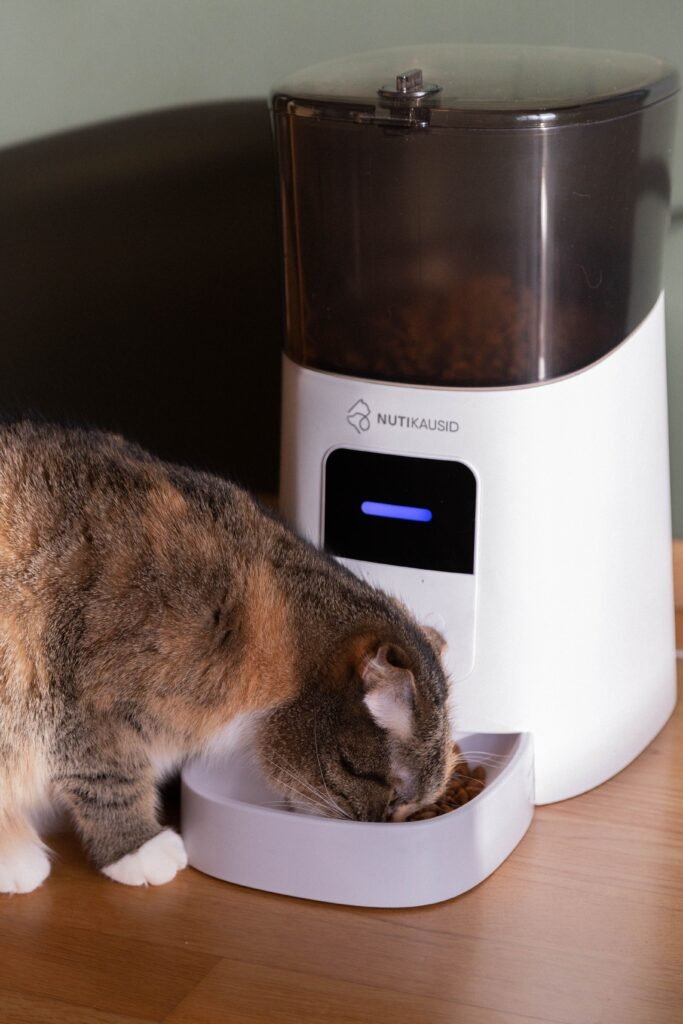
An automatic cat feeder is a scheduling tool, not a personality transplant. Used well, it can keep meals regular when you work late, split a daily ration into smaller portions, or stop one cat from finishing another cat’s breakfast. Used poorly, it can spill kibble, serve the wrong cat, or hide a change in appetite.
If you are shopping for the best automatic cat feeders, ignore manufactured “number one” lists and ask what problem you are trying to solve. The right machine for a single indoor cat on dry food is not the right machine for two cats on wet food, or for a home where one cat guards the bowl. This guide covers the main types, the features that matter, and how to match a feeder to your household.
This is a buying and setup guide, not a feeding prescription. If your cat has a medical diet or a sudden change in appetite or weight, speak with your veterinarian before you change how meals are offered.
What an automatic feeder can and cannot do
A good feeder can offer meals at consistent times, measure dry food more consistently than a distracted scoop, reduce early-morning waking if meowing currently produces breakfast, and, in some designs, limit which cat can reach which meal. It cannot replace fresh water, litter-box care, or daily observation. It also cannot make an unsuitable diet healthy, safely replace you for many days without a backup plan, or tell you why a cat has stopped eating. Keep checking the hopper, the bowl, and your cat. Food left behind, food vanishing too fast, vomiting, or weight change are reasons to pay attention—and, if they persist, to call your veterinarian.
The main types of automatic cat feeders

The category matters more than brand names.
Gravity feeders
A gravity feeder is a hopper that tops up a bowl as your cat eats. It is simple, usually inexpensive, and has no schedule at all. Gravity feeders suit some cats who self-regulate on dry food. They are a poor fit for cats who overeat, need measured calories, or live with a companion who will empty any bowl that stays full. Think of them as “always available dry food,” not true portion control.
Timed dry-food dispensers
This is what most people mean by an automatic cat feeder: a hopper, a programmable clock or app, and a mechanism that drops a set amount of kibble into a bowl. These work well when your cat eats dry food and you want several small meals to run whether or not you are home.
Look closely at how portions are set. Some models use “portions” equal to a roughly consistent volume; others claim weight-based control. Volume is not the same as calories, and kibble size changes how much falls through a chute. After you set a program, weigh a few dispensed meals and compare them with the amount on your food bag or the amount your veterinarian recommended.
Wet-food automatic feeders
Wet food spoils if it sits out, especially in a warm kitchen. Wet-food feeders usually use multiple trays with timed lids and, in many designs, ice packs or a cooled compartment. They help if your cat prefers wet food or you want a cooled breakfast ready before you get home. They typically hold the next few meals rather than a week of kibble, so they suit a workday better than a long trip. Trays and seals should come apart easily for cleaning.
Microchip and RFID feeders
These open only for a cat wearing a registered microchip or a collar tag. They are one of the better answers to a multi-cat problem: the fast eater, the food guarder, or the cat on a different diet. They are not magic. A second cat may loiter and steal food once the bowl is open, and collar tags can come off. A cat must also be comfortable putting their head into a somewhat enclosed space, so look for a wide, low opening and plan a slow introduction.
App-connected and camera feeders
Wi-Fi feeders add remote programming, notifications, and sometimes a camera. That can help if your schedule changes often or you want to see that a meal dropped while you are away. The tradeoff is complexity. A unit that can still run its basic schedule from on-device buttons is more practical than one that becomes a decorative bin without a signal.
Features that matter more than marketing

Use this as a comparison checklist rather than a ranking.
Portion control you can verify. You want a mechanism that dispenses predictably and a bowl you can see. Oily or large kibble can jam some chutes; very small kibble can over-pour. Test with your actual food. If your cat needs precise caloric control, treat the display as a starting point and confirm with a scale.
Capacity that matches your routine. Buy enough for your real gap—a workday, overnight, or weekend—plus a modest buffer. A huge hopper is less helpful if food goes stale or a jam empties half the container onto the floor. Refill on a schedule so you still look at the food and the cat.
Power backup. Timed feeders should not depend on a single power source. Look for mains or outlet power with battery backup, or batteries plus a clear low-battery warning, and test what happens when you unplug the unit.
Food type and climate. Dry hoppers and wet trays are different machines. If your cat eats both, automate dry meals and keep wet food as a hand-fed ritual, or add a small cooled wet-food tray. In hot weather, be cautious about wet food sitting in an open bowl.
Easy cleaning. If parts cannot come apart, they will not be cleaned often enough. Look for a hopper and bowl that separate without tools, smooth surfaces, easy-to-wash pieces, and reachable seals.
Security, noise, and placement. Choose some weight, a locking lid, and non-slip feet; clever cats learn to paw lids or tip light units. Place the feeder where your cat already likes to eat: low traffic, easy escape routes in a multi-cat home, and away from the litter box.
Simple controls versus smart extras. Ask how you will change a meal time when you are tired. Physical buttons help. An app is useful as an extra, not the only way into the settings. A camera does not make a poorly designed hopper better.
Multi-cat access. Decide whether you need separate rooms, a microchip or RFID feeder, several smaller meals, or extras such as baby gates and microchip cat flaps. Technology works best when the room layout supports it.
Match the feeder to your household

One easygoing cat on dry food. A reliable timed dispenser with backup power and easy-to-wash parts is usually enough. You may not need a camera or chip reader.
A cat who begs at dawn. Program the first meal for the current wake-up time, then ease it later in small steps. A feeder breaks the “meow equals breakfast” loop only if you stop rewarding the meowing too.
A cat who eats too quickly. Several small servings across the day, or a slow-feeder bowl in front of the machine, can help more than one dumped meal. Persistent gobbling, regurgitation, or vomiting deserves a veterinary conversation rather than another gadget.
Two or more cats, or one cat on a different diet. Prioritize access control: microchip or RFID feeders, separate stations, or closed-door mealtimes. A shared hopper will not settle a food dispute.
Wet-food households. Choose a tray feeder designed for wet food, with cooling if meals will sit out, and a cleaning routine you will keep.
Nights away. Automation can cover a night or a workday. For longer absences, someone still needs to check the cat, litter box, water, and the feeder itself.
How to introduce an automatic feeder
Cats are conservative about food and new objects. A feeder that appears overnight and immediately clunks out breakfast is asking for suspicion.
- Leave the unplugged feeder in the usual eating spot for a day or two. Let your cat sniff it first. Drop a few familiar kibbles in the bowl by hand.
- Feed a normal meal from the new bowl so the scent and location become familiar.
- Run a programmed meal while you are home. Stay nearby without making the machine feel like a trap.
- If the sound startles your cat, pair it with something pleasant and keep early portions small.
- Only rely on the feeder after several successful meals and a portion check on a scale.
In a multi-cat home, introduce access-controlled feeders one cat at a time so you can see who is eating what.
Cleaning, jams, and everyday reliability
Make cleaning part of the purchase and the weekly rhythm. Empty and wipe dry-food hoppers regularly so fat from kibble does not go rancid or clog the mechanism. Wash bowls as often as an ordinary cat dish. Wash wet-food trays after every cycle and dry the seals. Keep spare food and a regular bowl so a jam is not a crisis.
If a feeder repeatedly mis-pours or jams with your usual kibble, that is a compatibility problem. Switch foods only if the new food is otherwise appropriate; otherwise, switch the feeder.
A practical buying checklist
Before you buy, you should be able to answer yes to most of the following:
- I know whether I need dry, wet, or both.
- I can measure and later verify portion size.
- The feeder has a power plan I trust, including backup.
- I can take it apart and clean the parts that touch food.
- The lid and body can stand up to my cat’s curiosity.
- The design suits one cat or solves my multi-cat problem.
- I can change settings without hunting through an app if the Wi-Fi fails.
- I have a backup plan for jams, travel, and power cuts.
- I will still watch my cat’s appetite, weight, and litter-box habits.
If a listing cannot tell you how portions are measured, what happens in a power cut, or how to clean the hopper, keep shopping.
The honest way to choose
The best automatic cat feeder is the least complicated device that solves your real problem and still gets washed. For many homes, that is a timed dry-food dispenser with backup power and a visible bowl. For others, it is a chip-reading feeder that protects a medical diet, or a cooled tray for wet meals.
Buy for the cat you have and the schedule you actually keep, then give the routine a quiet week of supervised trials. A feeder that fits will feel boring in the best way: meals happen, and you still know how your cat is eating.
FAQ
Are automatic cat feeders good for all cats?
No. They suit cats who will use a new device, eat the type of food it can hold, and do not need every meal hand-adjusted for a medical reason. Cats who are very nervous about enclosed spaces, households in the middle of a diet investigation, and cats with rapidly changing veterinary feeding plans may do better with supervised meals. When in doubt, ask your veterinarian before you automate a special diet.
Can I use an automatic feeder for wet food?
Only if the feeder is designed for it. A standard dry hopper will not keep wet food safe or palatable. Look for timed trays with lids and, when meals must sit out, a cooling system. Even then, follow the food maker’s guidance about how long wet food can remain at room temperature, and clean trays thoroughly after each use.
How do I stop one cat from eating another cat’s food?
A shared gravity or open timed feeder usually will not solve this. Better options include microchip or RFID feeders, feeding in separate rooms, or using a microchip cat flap so one cat can reach a feeder the other cannot. Watch the first weeks carefully; some cats wait beside an opening lid and steal food after the correct cat has triggered it.
What should I look for if the power goes out often?
Prioritize battery backup, a visible battery status, and a feeder that can keep its schedule without Wi-Fi. After setup, test by disconnecting outlet power and confirming the next meal still drops. Also keep a low-tech backup: a measured portion in a sealed container and a spare bowl.
Will a feeder stop my cat from waking me up at night?
It can help if the waking is a learned request for food and you program meals so your cat is not left genuinely hungry overnight. It will not help if you still get up and feed them when they meow, or if they want company rather than calories. Change meal timing gradually, keep night-time attention boring, and make sure daytime play and feeding needs are actually being met.
[…] Before you buy anything, try two stations with real space, meals you can supervise, and picking the bowls up when the slower cat is done. Many pairs improve once the faster cat cannot casually reach both dishes. If you still need a machine, choose one that fits the room, is straightforward to clean, and does not block a walkway. How to choose an automatic feeder, including timed models, is a separate buying question in best automatic cat feeders. […]