

Indoor life can be a very good life for a cat. It removes traffic, unfamiliar animals, and many outdoor hazards, but it does not automatically provide a day with enough to do. Cats are not bored because they are ungrateful. They are predators living in rooms that stay the same from breakfast to bedtime.
Indoor cat enrichment ideas are ways to give your cat outlets for hunting, climbing, scratching, watching, hiding, resting, and exploring. You do not need a catalog of gadgets—just well-placed resources, short play sessions you can repeat, and a habit of rotating what is out.
This is general information for cat parents in the US and UK, not a veterinary diagnosis or a behavior treatment plan. A sudden change—hiding, not eating, not playing, new aggression, or house-soiling—deserves a veterinary check first. Pain or illness can look like boredom or naughtiness.
What enrichment actually means
Enrichment is not the same as buying more toys. It is about offering choices that match feline needs:
- Hunt. Stalk, chase, pounce, and catch something, including food that takes a little work.
- Climb and survey. Safe height, with a view of the room or the window.
- Scratch. A place to stretch and mark that is not your sofa arm.
- Watch and sniff. Windows, safe outdoor air at a screen, and novel-but-safe smells.
- Hide and rest. Covered spots where no one has to be “on.”
- Connect. Play, grooming, or company when your cat seeks it.
A useful test: if you left the room for two hours, would your cat have more to do than stare at a closed door? If not, add one or two outlets rather than ten similar toys.
Give them the vertical part of the room

Cats experience a home in layers. Floor space that looks generous to you can feel exposed to them, especially in a studio or busy family room. Height lets a cat watch without sitting in the walkway.
A sturdy cat tree works when it does not wobble, offers at least one high perch, and includes a scratching surface. In a small apartment, wall shelves, a windowsill perch, or a secured bookcase can do similar work. Make sure a jump down lands safely, and anchor tall trees so they cannot tip. A perch overlooking the living room is valuable; one that forces a leap over a toddler, a dog, or a slamming door is stressful. In a multi-cat home, one tree is often not enough.
Scratching belongs here too. Cats scratch to stretch and to leave scent and visual marks. Offer one tall vertical post—sisal is a common choice—and one horizontal cardboard scratcher, placed where your cat already wants to scratch. If the sofa is still winning, do not punish the cat. Move a scratcher closer, protect the furniture for a while, and reward use of the post.
Windows are free television—if they are safe

A secure window view is one of the highest-value indoor cat enrichment ideas you can offer. Birds, weather, and people passing by give a cat something that changes all day.
Safety comes first. Screens should be strong enough that a leaning or launching cat cannot push them out. Do not leave a cat unattended at an open upper-floor window with a weak screen, and do not treat a balcony plant as a barrier. Attach a window perch as directed and test it before inviting the cat up.
A bird feeder in view can be delightful, but it can also over-arouse a cat who then redirects onto a housemate. If chirping stays relaxed, fine; if it produces frantic pacing or fights, move the feeder. A screened window also brings scent, which matters as much as sight. You do not need a catio for enrichment to “count.” If you are unsure whether a houseplant is cat-safe, keep it out of reach.
Play that ends with a catch

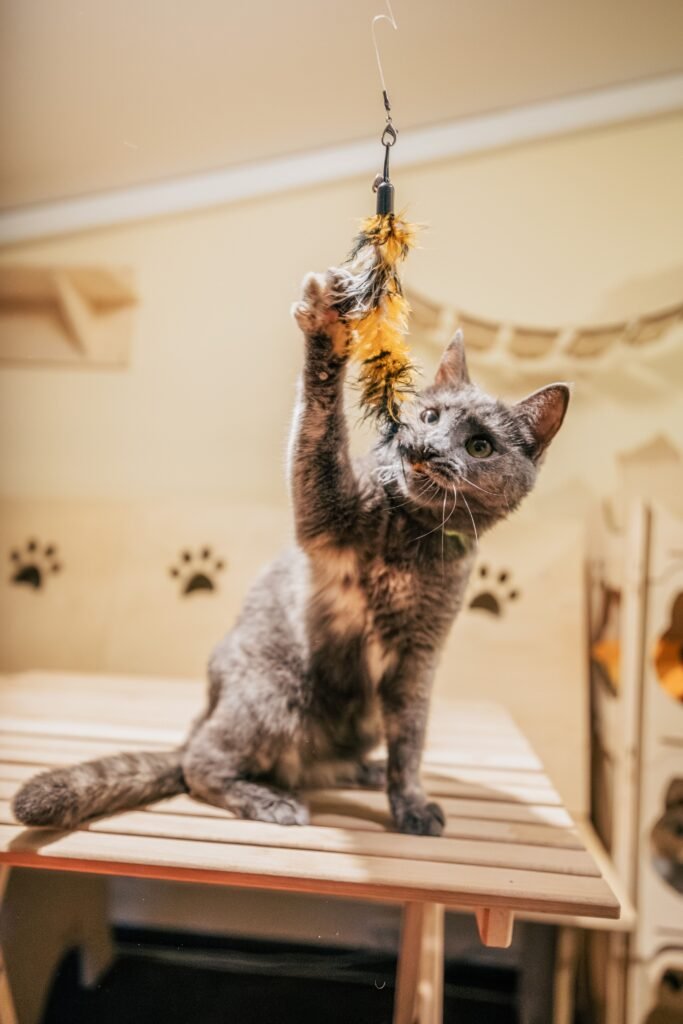
The most reliable play for most indoor cats mimics a hunt: something that moves away, hides, skitters, and can finally be caught. A wand or fishing-rod toy is the simplest tool. You are pretending to be prey, not taking the cat on a jog.
Keep sessions short and successful. Many cats do well with ten to fifteen minutes, once or twice a day. Let the “prey” travel along the floor, duck behind furniture, and slow down so your cat can stalk. End by letting them catch it, then offer a small meal or a few pieces of regular food. That hunt-catch-eat sequence helps many cats settle afterward.
Laser pointers can start a chase, but a cat cannot catch a dot of light. If you use one, finish with a physical toy or a snack so the hunt has an ending. Supervise string, feathers, and anything swallowable, and put wand toys away when you are done. Solo toys still help if you rotate a small set rather than leaving twenty objects out until they become invisible.
If your cat “does not play,” try a different time of day, a slower lure, or play just before a meal. Some older cats prefer gentle sliding toys to high jumps. A cat who used to play and has stopped should see a veterinarian.
Make meals a little more like hunting
Finishing a bowl in thirty seconds leaves a long empty stretch afterward. You do not have to turn every calorie into a puzzle—especially not for a thin, sick, or very anxious cat—but many healthy indoor cats benefit from working a bit for part of their food.
Options include a puzzle feeder that does not spray kibble under the fridge, a snuffle-style mat, scatter feeding on a clear patch of floor, and a lick mat for wet food. Dry pieces move through puzzles more easily; wet food works better on lick mats. An automatic feeder can keep meals consistent when you work late, but a timed drop into a bowl is convenience, not enrichment. You can still pair it with a puzzle or a short hunt before another meal.
Introduce puzzles gradually. If your cat walks away from food that is too difficult, make it easier. Weight loss is not an enrichment success. Cats on a veterinary diet should have any feeding game checked so they still receive the food they are meant to eat.
Boxes, tunnels, and places to disappear

A cardboard box remains one of the best indoor cat enrichment ideas ever invented, and it is usually free. Cats use boxes to hide, ambush a toy, nap, and feel smaller in a large room. Cut a second doorway in a large box so a cat cannot be cornered, and remove handles from paper bags.
Tunnels, covered beds, and a spare carrier left open with a familiar towel give similar “I can vanish” value. Place some hideaways in quiet corners. In multi-cat homes, spread these around; if the only safe box sits in one cat’s favorite room, the other cat does not truly have it.
A secure toilet area is part of feeling safe enough to play. A cat who is worried about the litter box, or who has to pass a rival to reach it, may spend the day on edge. Enrichment works better when clean boxes, separated food and litter, and an escape route are already in place.
A daily rhythm that fits real life
You do not need to entertain a cat every hour. You need a repeatable pattern.
Morning. A short wand-toy hunt, then breakfast. This helps many cats start the day with a completed cycle instead of dawn zoomies.
Daytime. Leave a window perch available, one or two rotated solo toys, and a bit of food in a simple puzzle if that suits your cat.
Evening. A slightly longer play session when you get home, ending with a catch and a meal or snack—often the best cure for late-night wall-climbing.
Night. If your cat regularly wakes you at 3 a.m., move the biggest play-and-feed block later in the evening rather than offering a second dinner on demand.
Kittens need more frequent short bursts. Senior cats may want gentler games, easier jumps, and extra warm, low-sided resting spots. Adjust height and intensity to the body in front of you.
Small homes and multi-cat homes
In a studio or one-bedroom, think upward and in corners: a window hammock, a slim tree, a scratcher beside the sofa, and boxes you can fold away when guests visit. You do not need a theme-park layout.
With two or more cats, duplicate the things worth guarding: food, water, litter boxes, high perches, scratchers, and hiding places. Play separately if one cat always “wins” the wand toy. Enrichment supports peace, but it cannot replace enough resources.
If you also share the home with a dog, keep chase toys and strings picked up, and give the cat escape routes the dog cannot follow. A cat who spends the day avoiding a playful dog is not enriched, no matter how nice the tree looks.
Safety notes without the scare list
A few household items cause outsized trouble: leftover string, hair ties, rubber bands, cooked bones, lilies, and essential-oil diffusers in small closed rooms. Put wand toys away. Use a breakaway collar if your cat wears one.
Open balconies, insecure screens, and unattended open windows are escape and fall risks. “My cat is careful” is not a barrier.
If enrichment is new and your cat hides more, you may have added too much at once. Scale back to one new perch or one daily play session. If appetite, litter habits, or personality change, call your veterinarian.
A starter kit that does not require a huge budget
Begin with this simple setup list:
- One sturdy climbing option: a cat tree, a tested window perch, or secured shelves.
- Two scratchers: one tall vertical post and one horizontal cardboard pad, placed where scratching already happens.
- One wand toy you put away between sessions.
- Three or four solo toys, rotated weekly.
- A few cardboard boxes or a tunnel.
- One easy food puzzle or lick mat, introduced slowly.
- At least one quiet hiding spot in a low-traffic corner.
Then watch. Use the perch your cat actually chooses, move the unused scratcher next to their preferred sofa, and swap the toy they ignore. These ideas work when they fit the individual, not when the living room looks like a catalog.
A fuller indoor day is built from ordinary materials and a short daily hunt you can keep doing on a Tuesday. Start with height, a window, a scratcher, and one good play session, then add food puzzles and boxes. Your cat does not need a perfect habitat—just a home that answers, “yes, there is something worth doing here.”
FAQ
How much playtime does an indoor cat need each day?
Many cats do well with two short hunting-style sessions of about ten to fifteen minutes, often morning and evening, plus opportunities to look out a window and work a bit for food. Kittens usually want more frequent bursts; seniors may prefer gentler, shorter games. Match the time to your cat’s interest and stopping point, not to a rigid stopwatch.
My cat ignores toys. What should I try first?
Try a wand toy just before a meal, move it along the floor like prey rather than waving it in the cat’s face, and let them catch it. Rotate toys out of sight for a few days. Some cats prefer paper balls or a slow-moving lure to bright store toys. If a previously playful cat has stopped, ask your veterinarian to rule out pain or illness before you assume the cat is simply uninterested.
Are automatic toys enough if I work long hours?
They can help as a supplement, especially motion toys you have safety-checked, but they rarely replace a real hunt-and-catch session with you. Pair time-alone tools—window access, a simple puzzle feeder, a sturdy tree—with play when you get home. An automatic feeder can keep meals on schedule; it does not, by itself, enrich the day.
Can enrichment stop my cat scratching the furniture?
It often reduces furniture scratching when you offer appealing scratchers in the right places and protect the old target for a while. Enrichment cannot guarantee a sofa will be ignored, and punishment tends to make cats more secretive rather than more informed. If scratching is sudden and intense, or accompanied by other behavior changes, check in with your veterinarian.
Is it cruel to keep a cat indoors?
Indoor living can be a responsible, welfare-minded choice when the home offers outlets for hunting, climbing, scratching, watching, and resting. The welfare question is less “indoors or outdoors?” than “does this cat have enough to do, and is the environment safe?” Outdoor access, if you offer it, should be safe and controlled. Indoor-only cats still need daily enrichment; four walls are not the whole plan.
Related reading
- Cat Litter Box Setup Apartment — A calm, low-odor apartment litter plan; security around toileting makes play and resting much easier in a small home
- Wet Vs Dry Cat Food — How wet and dry textures affect puzzle feeders, lick mats, and slower mealtimes
- Best Automatic Cat Feeders — When a timed feeder helps with routine, and how to pair it with foraging so meals stay interesting
[…] it does not replace play, scratching, or a stable climbing structure. For the wider daily picture, indoor cat enrichment ideas is the companion read. If you also need climbing in a tight plan, best cat trees for small […]
[…] outing should sit on top of a decent day at home, not stand in for one. For ordinary indoor days, indoor cat enrichment ideas will do more for most cats than a new piece of […]
[…] Enrichment, a daily play routine, and what to leave out when you go to work are also separate: see indoor cat enrichment ideas, how to build a daily play routine for an indoor cat, and how to keep an indoor cat busy while you […]
[…] a simple pattern you can repeat on ordinary days, see a daily play routine for an indoor cat and indoor cat enrichment ideas. Those guides are about everyday activity, not a last-minute […]