


If you need to know how to remove mats from a cat, the hard part is rarely the idea of “get a comb.” It is a small knot you can see and reach, a cat who may already be sore under it, and a bathroom floor that is a poor place for a struggle. Many flats have little space for a long session.
A useful mindset is this: you are dealing with one small, visible tangle, not proving that every mat can be taken out at home. Work with one hand on the coat, tease from the tip of the mat toward the skin only if the skin is clearly loose, use a suitable comb, and stop if the cat is in pain.
This is general information for cat parents in the US and UK, not a veterinary diagnosis, and not a promise that a mat will come out easily every time. It is not a guide to shaving a cat at home, and it does not treat mats as a cure for a skin disease. Mats tight to the skin, mats in armpits or groin, a cat that cries or bites, or a sudden coat change belong with a groomer or a veterinarian.
This is a mat that is already there, not the regular brushing routine
The job here is a limited plan for a tangle you can already see. It is not a rewrite of how to brush a cat at home. Brushing is the daily or weekly habit; this article starts after a mat has formed.
Loose hair around the flat is a different job: see how to manage cat shedding in an apartment. Nail care, mouth care, and clinic visits are separate tasks: how to trim a cat’s nails at home, how to care for your cat’s teeth at home, and how to get a cat comfortable at the vet. If the cat is already tense, signs your cat is stressed is a better first read than a longer session on the floor.
Think of three jobs, not one:
- Choose the right mat. Only start on a small tangle you can see and reach, with skin that is clearly loose underneath.
- Work slowly. One hand steadies the coat; the other teases from the tip of the mat toward the skin with a suitable comb.
- Stop in time. Pain, biting, a tight mat, or a difficult area is a reason to hand the job to a groomer or a veterinarian, not to push harder.
Decide whether this is a job you should start at all
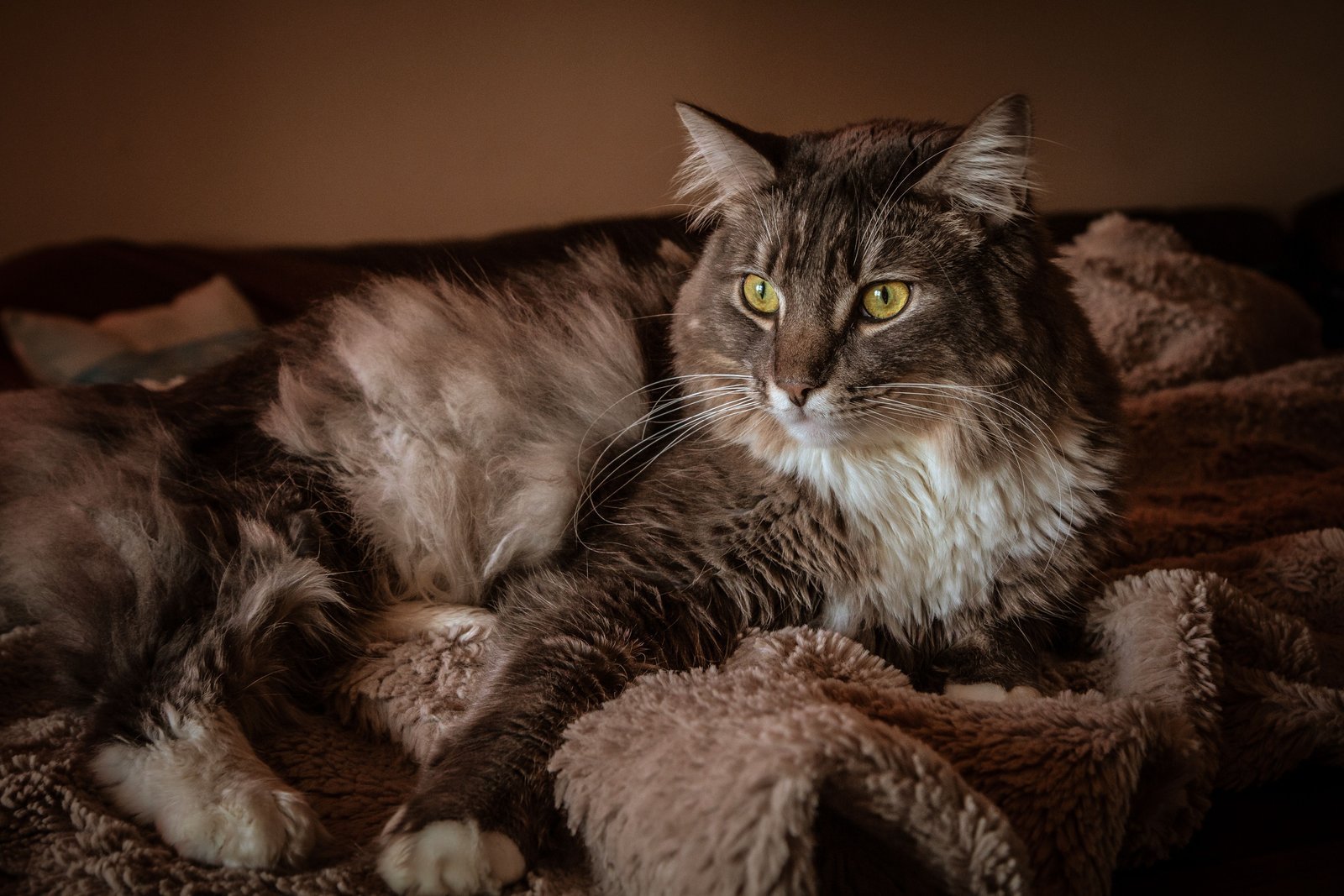
The photo above is a long-haired tabby resting on a plush blanket. It is a coat at rest, not a close-up of a mat.
Before you sit down with a comb, look at the actual knot. A small tangle on the outer coat — a shoulder, the back, or the flank — is the kind of job this plan is for. You should be able to lift the coat around the mat and see that the skin underneath moves freely and is not pulled tight or hidden inside the knot.
Do not start if any of these are true:
- The mat is tight to the skin, or you cannot see the skin at all.
- The mat is in an armpit, the groin, or under the tail, where the skin is thin and the cat is harder to hold safely.
- The cat already flinches, growls, cries, or tries to bite when you touch the area.
- The coat has changed suddenly — a new patch of tight knots, thinning, redness, or a cat who has stopped grooming themselves.
Those belong with a groomer or a veterinarian, not a longer try at home. A sudden coat change can be a health issue, and pulling at the hair does not treat it. If the cat is already hiding, a shy cat who needs to feel safe in an apartment will not become easier to handle because you cornered them in the bathroom.
Set up a short session you can actually stop
In a small apartment, the bathroom is often the only room with a door and a washable floor. Put a towel down, close the door so the cat cannot dash into the hallway, and set the comb within reach before you pick the cat up. If door-dashing is already a habit, how to stop a cat from door dashing is worth sorting out separately, not during a grooming hold.
Keep the session short. A few minutes on one small mat is enough for a first try. You can come back later if the cat is still relaxed.
Have a sturdy comb made for pet coats, such as a wide-tooth or stainless steel comb, not a household tool from a drawer. Do not use household scissors to cut close to the skin. The skin under a mat can be pulled up into the hair. If a mat needs to be cut away, that is a groomer or veterinarian job.
Sit on the floor or a stable chair so you are not standing and leaning. Support the cat’s body, pause, stroke a part of the coat that is not matted, then look at the tangle. If the cat stiffens or tries to leave, let them go. A hold that already feels like a fight is a reason to stop.
Work with one hand on the coat, and tease from the tip toward the skin

The photo above is a gray-and-white cat being brushed on a clinic or salon table. It is a brush in use in a professional setting, not a home de-matting session.
Once the mat is small and the skin underneath is clearly loose, use one hand to hold the coat between the mat and the skin, so the tug stays off the skin. With the other hand, start at the tip of the mat — the end farthest from the body — and tease a little hair at a time toward the skin, not down into it. Work in small sections. If the knot does not loosen, stop.
Hold the skin just firmly enough that a pull on the hair does not yank the skin with it, but do not pinch. If you cannot see the skin move separately from the mat, it is not loose enough for this method.
A suitable comb can help once the tip has started to open. Slide the teeth into the loosened hair and comb outward, still working from the tip toward the skin. Do not jam the comb under a tight knot and pull, and do not soak the mat in oil or conditioner. Wet hair can mat more tightly as it dries.
Do not pin the cat on their back or wrap them so tightly they cannot tell you they are done.
Stop if the cat is in pain

The photo above is a calm indoor hold, with a person supporting a tabby and holding a paw. It is not someone working on a mat, and it is not a nail trim.
Pain is a stop sign, not a cue to go faster. If the cat cries, hisses, tries to bite, or suddenly goes very still, put the comb down and let them move away. A still cat is not always a comfortable cat. If the area looks pink, if the cat flinches, or if you see any blood, stop and contact a veterinarian or a groomer rather than finishing the knot.
Do not try again immediately with a tighter hold. Give the cat a break in a room they already use, and leave them alone for a while. A second attempt later only makes sense if the first one was calm and you simply ran out of time on a loose tangle. If the first attempt hurt, the next step is professional help, not a retry.
Never give a sedative, a “calming” pill, or a leftover medicine to make the cat easier to handle. Medication decisions belong with a veterinarian. How to give a cat a pill at home is not a shortcut for de-matting.
Know when the job belongs to a groomer or a veterinarian

The photo above is a professional groomer holding a long-haired cat at a table. It is a salon or clinic hold, not a home method, and not a reason to attempt a clip or a shave yourself.
Hand the job over when the mat is tight to the skin, when it sits in an armpit or the groin, when you cannot see what you are doing, or when the cat is already in pain. A veterinarian is the right call if the skin looks sore, if there is a wound under the mat, if the cat seems unwell, or if the coat has changed suddenly.
This is not a “shave your cat at home” guide. A close clip against the skin, especially with household scissors, can cut the cat. If a shave or a close trim is needed, ask a groomer or a veterinarian to do it.
Do not treat the mat as proof of a skin disease, and do not treat removing it as a cure. Parasites, allergies, pain, and other health problems can all change how a cat grooms. If mats keep returning in the same place, or they appeared quickly, contact a veterinarian rather than only buying a different comb. If a clinic visit is already coming, do not force a last-minute session the morning of the appointment.
After a small mat comes out, keep the session ordinary
If the tangle loosens and comes away, stop on a good note. Put the comb down and let the cat leave the towel. Do not start hunting for the next knot in the same sitting unless the cat is clearly still relaxed and the next tangle is also small and loose.
Look at the skin where the mat was. If it is red, damp, or broken, or if the cat keeps licking the spot, contact a veterinarian. Do not put a cream or human product on the skin unless a veterinarian has told you to.
Then return to regular, short brushing in a place the cat already accepts, before the next small tangle becomes a tight one. The daily or weekly brush is how you try to need this article less often. That is a habit, not a guarantee that mats will never form again, especially on a long coat, an older cat, or a cat who is unwell.
Put the towel into the wash and keep the comb in the same place. If a later mat is tighter or the cat is less willing, do not treat the first success as a rule that you can always finish at home. The plan stays limited: one small, reachable tangle, skin that is clearly loose, a suitable comb, and a willingness to stop.
FAQ
Can I cut a mat out with household scissors?
No. Do not cut close to the skin with household scissors. The skin under a mat can be pulled up into the hair, and it is easy to cut the cat. If a mat needs to be cut or shaved away, that job belongs with a groomer or a veterinarian, not with a bathroom trim.
Should I start with a mat in an armpit or the groin?
No. Mats in armpits, the groin, or other tight, thin-skinned areas are not a good first home job. Those spots are harder to see and hold safely. Take that kind of mat to a groomer or a veterinarian rather than working on it on the floor.
Is removing a mat a way to treat a skin problem?
No. Taking out a small, loose tangle can make the cat more comfortable, but it is not a treatment or a cure for a skin disease. If the skin is red, sore, or broken, if mats appeared suddenly, or if they keep coming back in the same place, contact a veterinarian.
What if my cat cries or tries to bite when I touch the mat?
Stop. A cat that cries, growls, or bites is telling you the job is not safe to continue at home. Let them move away, and contact a groomer or a veterinarian. Do not add a tighter hold, and do not give a sedative to make the session easier.
How is this different from ordinary brushing?
Ordinary brushing is the daily or weekly habit that helps keep a coat from knotting. This plan is only for a small mat that is already there, one you can see and reach, with skin that is clearly loose underneath. It is a limited session, not a longer version of the regular brush.
[…] brushing a cat at home are the follow-up skills. If you find a mat, do not cut close to the skin; removing cat mats at home is a separate, careful job. A quick look at the nails is enough to see whether they are catching on […]