

If you are looking for the best double leashes and couplers for walking two dogs, start with how your dogs already move on a city sidewalk, not with a promise that one clip will turn two dogs into a tidy pair. A coupler is two short leads off one handle. A dedicated double leash is a two-lead tool with one handle built for that job. Two separate leashes are still the safer choice when the dogs are different sizes, when one lags, or when you need to peel one dog away at a door, a curb, or a passing bike.
This is general information for dog parents in the US and UK, not a training guarantee and not a product ranking. Hardware can make a good walk easier to hold. It cannot teach a loose leash by itself, and it will not stop a surge into a bike lane. If one dog panics, fights the teammate, or cannot walk politely alone, fix that on a single leash before you join the two dogs.
Coupler, double leash, or two separate leashes
The handling skills live in a different article. How to walk two dogs on city sidewalks is the choreography: who stands where, how you pass a tight spot, and how you keep two bodies from wrapping the same pole. This article is the tool in your hand.
A coupler keeps one hand free. That can help when you need a transit card, a door handle, or a poop bag. The cost is that a surge by one dog travels straight into the other dog, and both dogs have less independent slack. If the leads are very short, a spin around a signpost can wrap both dogs before you have time to drop a loop. A dedicated double leash tries to give you two leads and one handle, sometimes with a slightly longer shared section, so you can still hold one tool and make a small adjustment for one dog. Two separate leashes give you the most independent control, including the option to hand one leash to another person or to park one dog while the other moves. They also fill both hands, or they bunch in one hand the way a coupler would if you are not careful. If you often walk with a second person, two leashes are easier to split than a coupler you have to unclip on the sidewalk.
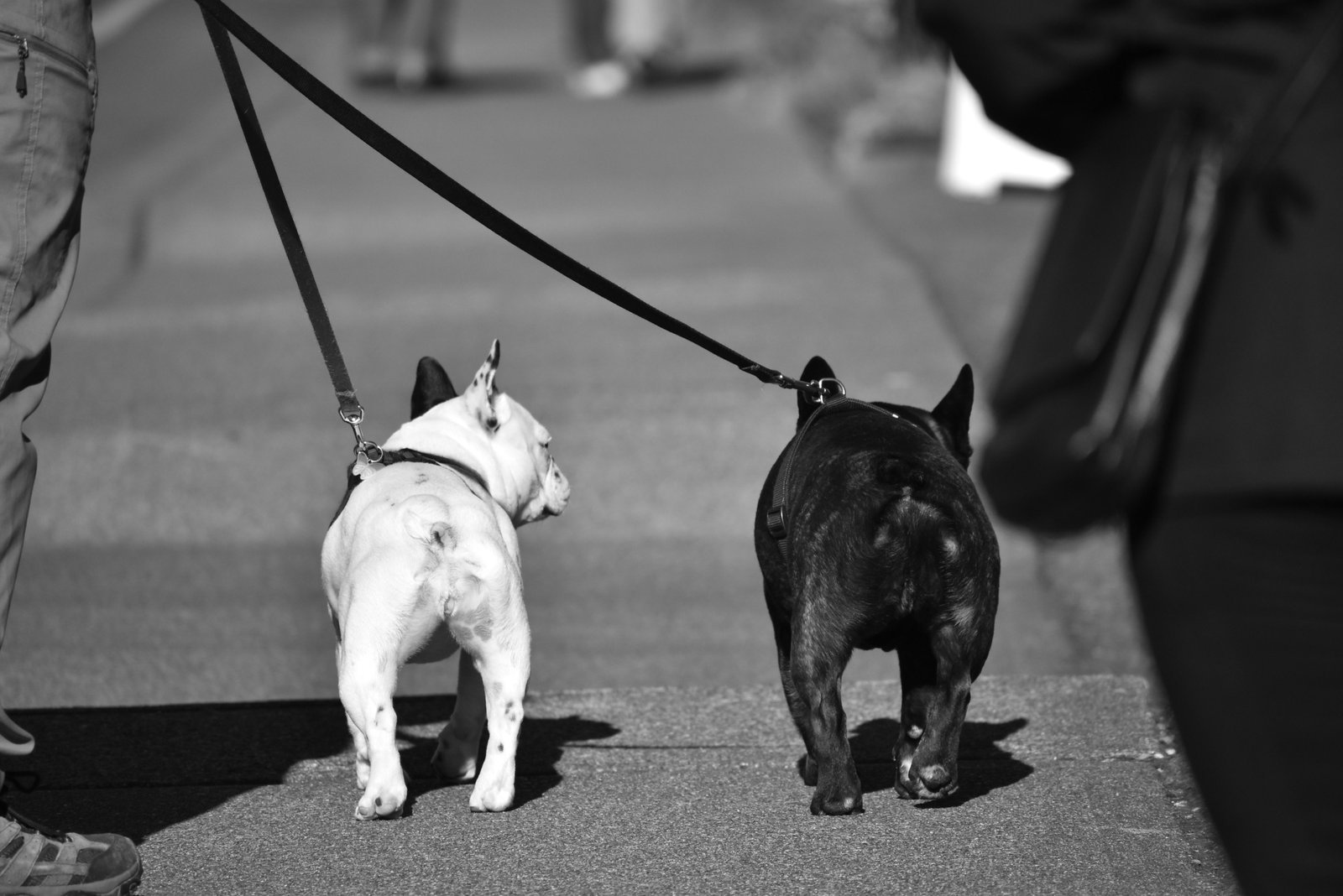
These two dogs are on separate leashes, not on a coupler. That is a useful picture of one of the real choices. If your dogs already walk like this, two leads may be all you need. If you want one free hand, a coupler or a two-lead handle is worth considering only when the dogs are fairly evenly matched and already walk without constant corrections.
A regular city leash is still the right starting point for each dog alone. The double-leash question comes after each dog can walk on a loose leash well enough that you are not using the second dog as a brake.
Length, hardware, and city tight spots
Match length to the place you actually walk. On a crowded sidewalk, short leads keep both dogs closer to your side and out of knees, strollers, and bike handlebars. Leads that are too short can stack the dogs on top of each other at a curb or an elevator door. Leads that are too long will sweep a lamppost or a passing ankle. There is no single perfect length for every pair, so pick a setup you can shorten at a door and keep tidy at a corner.
Elevators and transit doors are the test many city walkers forget in the shop. You may need to hold both dogs in a small box, step through a closing door, and keep a tail out of the threshold. A coupler can help if both dogs already wait close to you. It can also drag a smaller dog through the door when the larger one rushes. If that describes your pair, two leashes, or a two-lead handle you can split with both hands at the door, are usually easier to manage. Practice the wait before you enter, not after the door is already moving. If you cannot get both dogs to hold a pause on a quiet landing, the tool will not invent that pause on a busy morning.
Rain, gloves, and a wet handle change how the same tool feels. A coupler with a thin webbing handle can slide in a wet glove just when you need a firmer grip. A slightly wider handle, or a knot or loop you can actually hold, is more useful than a decorative trim. Check that you can still gather both dogs and unclip one lead without taking your gloves off in the rain.

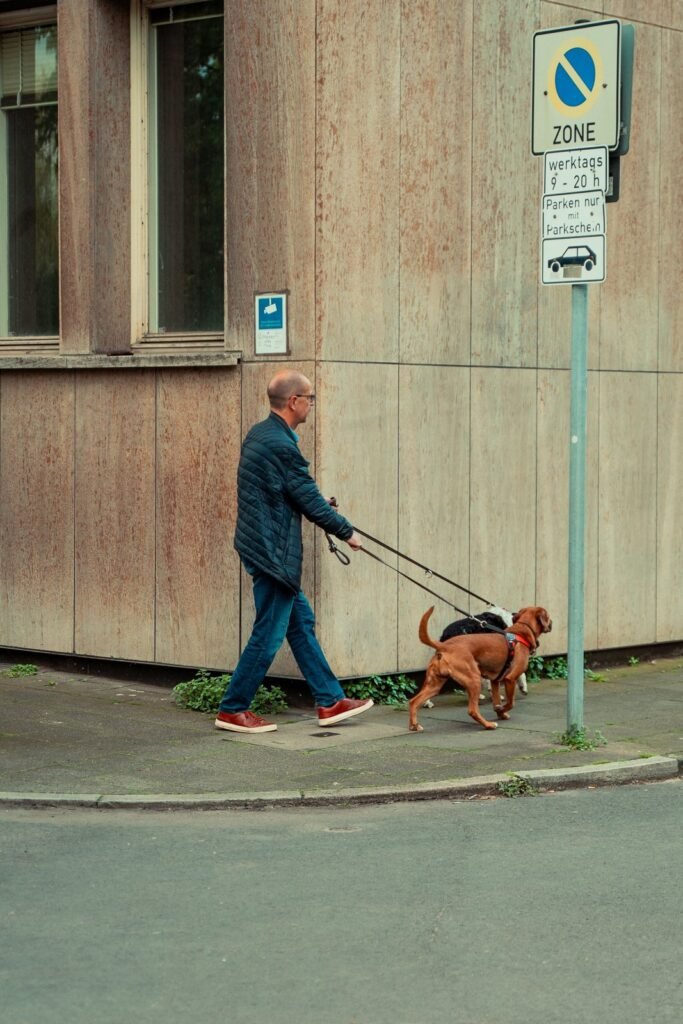
This handler has a leash in each hand, not a single coupler handle. That setup is slower at a ticket gate, and it is often clearer when the dogs need different instructions at the same moment. If your daily walk includes elevators, buses, or narrow cafe frontage, practice that part with whatever tool you are considering before you rely on it in a rush.
Look at the hardware as carefully as the length. You want clips that stay closed, stitching that does not look thin at the joints, and a handle you can keep hold of if one dog suddenly plants or lunges. Swivel clips can reduce some tangles. A clip that slips open under a twist is a safety problem on a city street. None of that requires a brand name or a price tag. It does require you to inspect the snaps, the join, and how the handle sits in a glove. If a clip, ring, or stitch looks worn, replace the tool before the next crowded walk rather than waiting for it to fail at a curb.
A hands-free leash is a different tool. It is built to sit at the waist or shoulder, not to split two dogs on a short coupler. A long line for park recall is also the wrong tool for this job. A long line is for a controlled, open practice space, not for splitting two dogs at a bus door.
When the dogs are not evenly matched
A coupler works best when the two dogs are close in size, close in pace, and already able to walk without constant pulling. If one dog is much larger, the smaller dog can be yanked off line or lifted onto two feet when the larger one turns. If one dog lags to sniff and the other forges, the coupler turns that disagreement into a tug between the two bodies instead of a conversation with you.
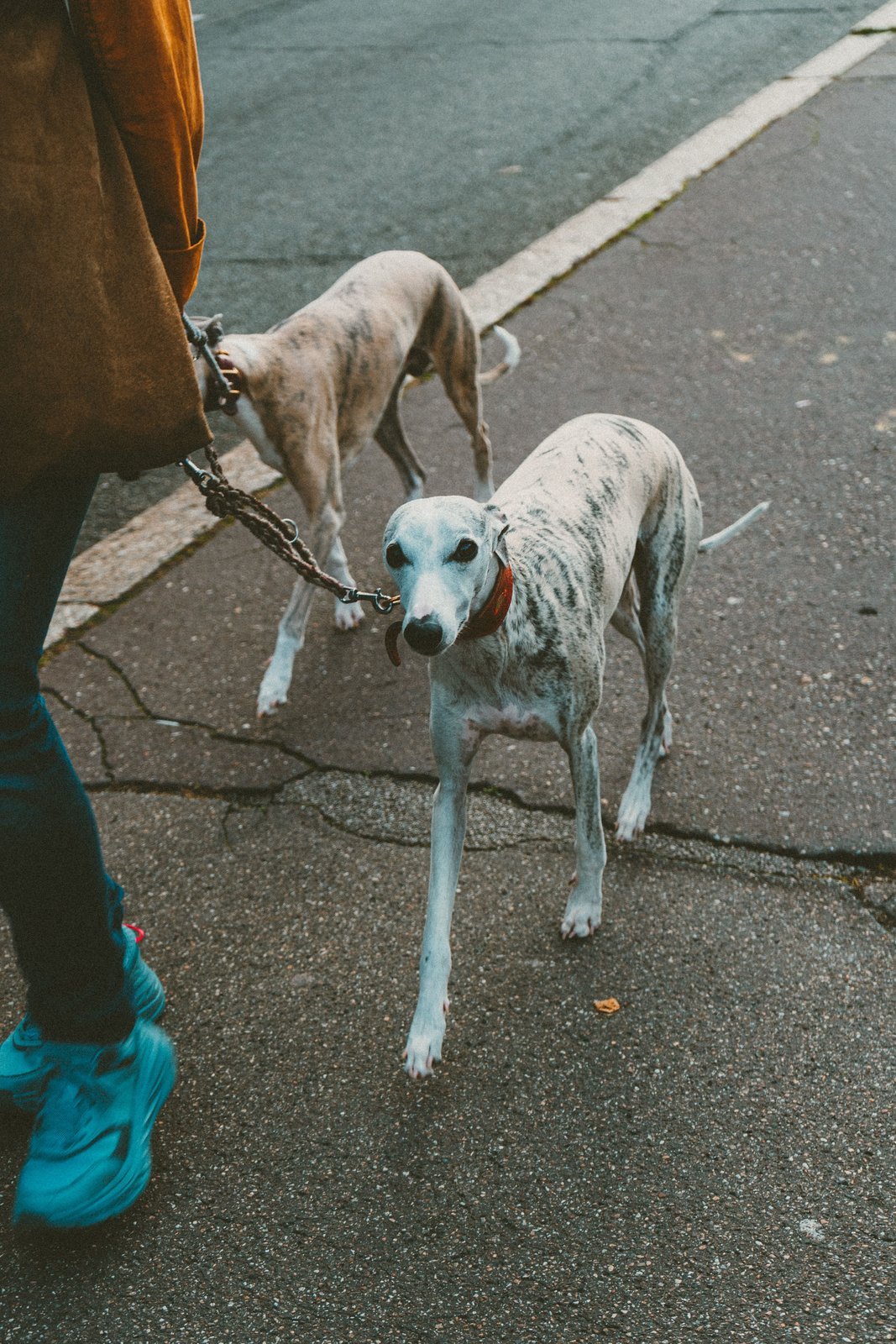
These two dogs are a closer match in size and stride than many city pairs. Even then, only one leash is clearly visible on the nearer dog, so this is not a photograph of a coupler. Use it as a reminder that a tidy pair still needs a tool that matches how they actually walk, not how they look standing still.
If one dog is a puller, a coupler will not solve it. The surge will go into the teammate. A harness meant for a dog that pulls and single-leash practice are the better first step. If one dog gets sharp around other dogs, clipping the two together can also turn one reaction into a two-dog lunge. How to help a dog stay calm around other dogs on city walks is the skills article for that problem. Do not use a coupler as a shortcut around it.
Two separate leashes are usually the safer choice when the dogs are unmatched, when one is still in training, when you expect tight elevator or transit doors, or when you may need to hand one dog off. A coupler or a two-lead handle is more worth it when the dogs already move as a pair, you want a free hand, and you have practiced the tight spots on a quiet block first.
If you try a coupler and the walks get worse, go back to two leashes rather than tightening the coupler and hoping the dogs adapt. Signs it is the wrong tool include a smaller dog hopping to keep up, one dog constantly wrapping the other, or you spending the whole block untangling instead of watching the sidewalk. Those are handling problems the gear is making louder, not proof that you need a shorter lead.
The rest of the walk kit, and what not to expect
The coupler or double leash is only one piece of the walk. A treat pouch keeps rewards where you can reach them with the free hand you just gained, or with the hand that is not managing a door. A poop bag dispenser belongs on the kit so you are not digging through a pocket with two dogs stacked at the curb. Those tools do not replace a good lead, and a good lead does not replace them. If a new coupler leaves you juggling bags, keys, and two tight leads at every corner, the walk is telling you the setup is still too busy, not that you need more clips.
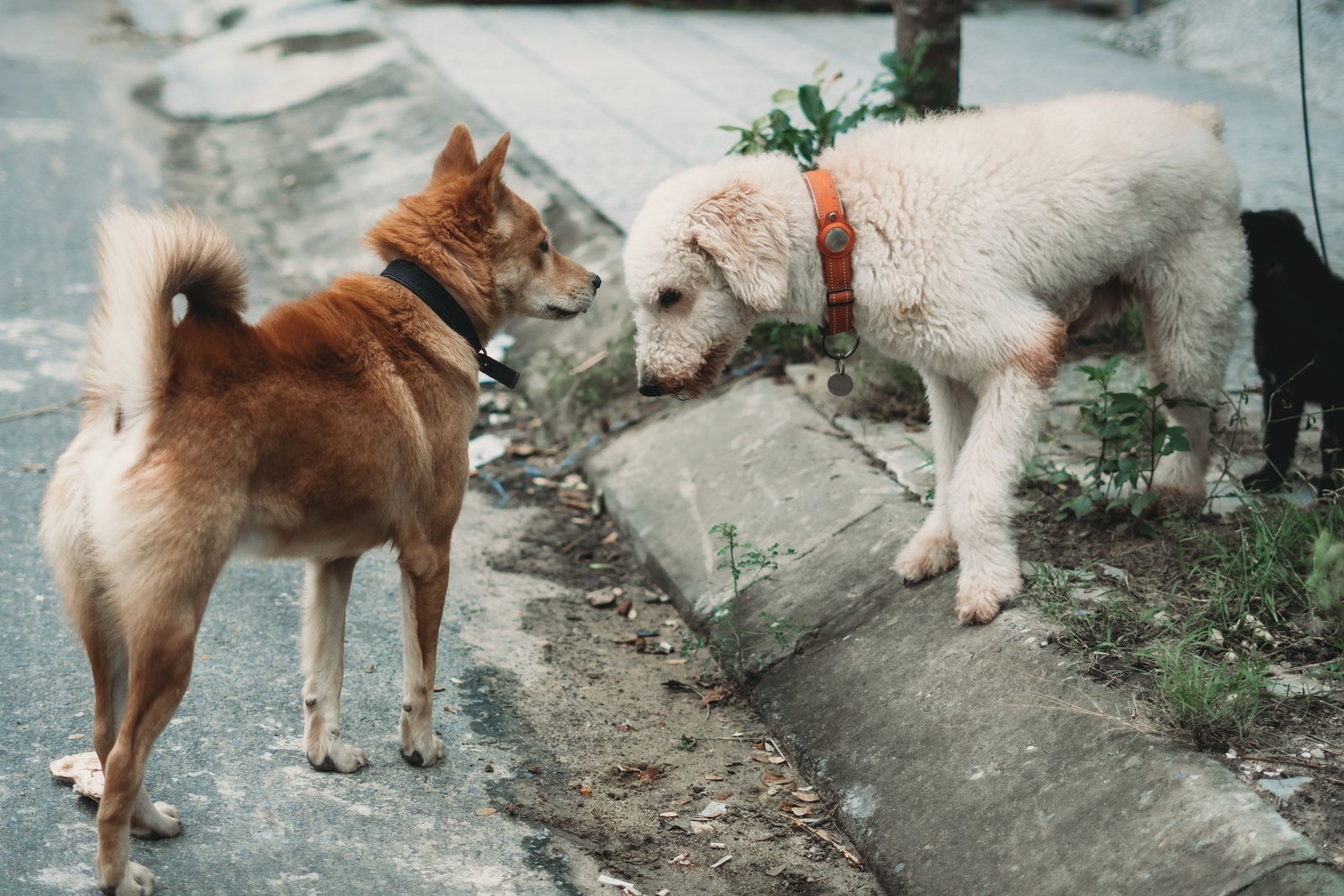
These two dogs are not a matched pair, and this is not a coupler demonstration. One is lean and prick-eared, the other is a white curly coat on a slightly higher curb, with a leash visible on that dog. Unmatched bodies are exactly the case where two separate leashes, or at least a setup you can split quickly, are usually easier to live with than a short shared coupler.
Do not expect a coupler to stop pulling. Do not buy the shortest coupler you can find for a large dog and a small dog. Do not use a long line as a city split lead. Do not invent a ranked list or a “best for this year” winner. Choose by coupler versus two-lead handle versus two separate leashes, by length, by clip quality, and by whether the dogs are evenly matched. Then practice the elevator, the corner, and the narrow sidewalk before the busy commute depends on the new tool.
FAQ
What is the difference between a coupler and a double leash?
A coupler is two short leads that join to one handle. A dedicated double leash is a two-lead tool built with one handle for walking two dogs. Two separate leashes are a third option and often give you more independent control.
When is a coupler a poor choice?
It is usually a poor choice when the dogs are very different in size or pace, when one lags or pulls, or when you often need to peel one dog away at a door, a curb, or a passing bike. In those cases, two leashes are usually easier to manage.
Will a coupler stop my dogs from pulling?
No. A coupler does not teach a loose leash. A surge by one dog can travel straight into the other dog. Teach each dog to walk well on a single leash first, and use a harness meant for pulling if that is still the main problem.
What length should I get for city sidewalks?
Choose a length that keeps both dogs close on a crowded sidewalk without stacking them on top of each other at a curb or an elevator door. There is no single perfect length for every pair, so pick a setup you can shorten at tight doors.
Are hands-free leashes or long lines a good substitute?
Usually not for this job. A hands-free leash is built to sit at the waist or shoulder. A long line is for controlled recall practice in an open space, not for splitting two dogs at a transit door or on a narrow sidewalk.