

If you have ever stood in the kitchen wondering how much you should feed your dog, you are asking a better question than it first appears. The bag offers a range, the internet offers calculators, and your dog offers a look that says the answer is “more.” None of those, on its own, is a complete plan.
The feeding guide is a starting point for an average dog of that weight, eating that specific food. Treats, training, dental chews, quieter apartment weekdays, and weekend hikes all change the day’s energy budget. Start with a measured portion, then watch your dog’s body over a few weeks.
This is general information for dog parents in the US and UK, not a veterinary diagnosis or a personal calorie prescription. If your dog is a puppy, has a medical condition, is gaining or losing weight quickly, or has suddenly stopped eating, speak with your veterinarian before you make large changes.
The label is a starting point, not a prescription

Pet food companies print feeding guidelines so you have somewhere to begin. Those charts are usually based on body weight and the calories in that recipe. They assume the food is the main diet and that the dog is a fairly typical adult.
Two details matter more than people expect. First, a “cup” is not a universal unit of nutrition. Foods vary in calorie density, and a loosely filled mug is not the measuring cup the company had in mind. If you use wet food, compare calories per can or per 100 grams, not just tin size. If you mix dry and wet, both portions count.
Second, the range on the bag is often wide. Many owners start high “to be safe,” then add treats. For a less active dog, begin in the lower half of the range and adjust. For a lean, busy youngster, you may need more. Measure rather than pour from memory, and if you change foods, read the new guide instead of copying the old scoop.
If you are comparing formulas, including grain-free options, look past front-of-bag claims. Our note on grain-free dog food can help you read those labels more calmly.
Real homes change the number on the chart
The same weight on a scale does not mean the same daily food. A neutered adult who potters around an apartment usually needs less than a sporty dog of identical size who runs every morning. Age, muscle, weather, and whether someone is home to play all matter.
Extra food hides in ordinary kindness:
- Training treats during a walk
- Dental chews and “healthy” snacks
- A sandwich crust, a lick of yogurt, or leftovers
- Puzzle feeders stuffed on top of a full bowl
- A second person’s secret handful
None of these is automatically wrong. They simply belong in the day’s total. If the bowl is filled to the guide and extras keep coming, weight often creeps up so slowly that it looks like aging.
Activity works the other way. A week of rain or long workdays can mean fewer walks; a hiking weekend can mean more. You do not need to recalculate every Tuesday, but notice the pattern. How often you should walk your dog affects appetite and calorie needs as much as the scoop does.
Read your dog, not just the measuring cup
Body condition is more useful than a single weigh-in, and much more useful than a calculator that cannot see your dog. You are not assigning a medical score at home. You are looking for a few calm, repeatable cues.
From above, many dogs in a healthy condition show a waist behind the ribs rather than a straight or widening line. From the side, there is often a gentle tuck from the ribs toward the hind legs—not a sagging belly or a sharply bony silhouette. You should usually feel ribs under a thin layer of cover, similar to the back of your hand—not hidden under a thick pad, and not only bone.
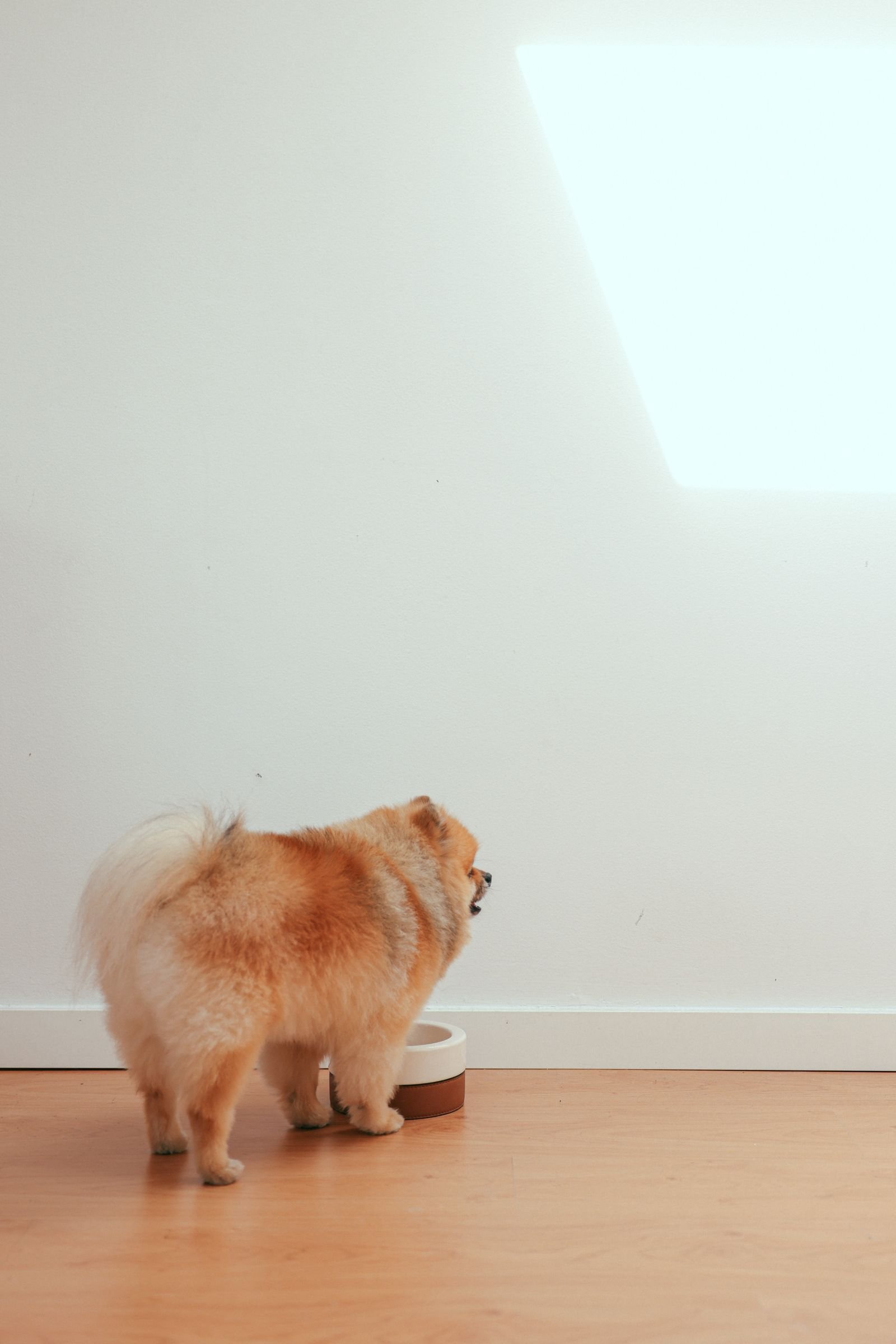
Long hair hides a great deal, so feel rather than only look. A fluffy dog can appear round and still be lean, or look fine while carrying extra weight. Compare your dog with your dog over time; breed outlines differ.
Weigh your dog every few weeks if you can. A slow trend matters more than a daily flicker after a drink. Coat, stool, and energy are supporting clues, not a diagnosis. New lethargy, straining, vomiting, or a swollen belly are reasons to call your veterinarian rather than change the scoop.
If chewing hard kibble suddenly looks uncomfortable, leftover food may be about the mouth rather than the portion. See dog dental care at home, and ask your veterinarian if meals have become slow or messy.
Puppies, adults, and seniors need different rhythms

Puppies are growing, and they usually do best on a complete puppy or all-life-stages food split into several meals. Young puppies often eat three or four times a day; many households move toward two meals as the puppy matures. Follow the puppy guide as a start, then watch body condition. A puppy should look smoothly covered, not pot-bellied from leftovers or ribby from an adult-style diet. Large-breed puppies should not be free-fed “so they do not go hungry”; extra weight during growth is not a kindness to developing joints. Ask your veterinarian what healthy growth looks like for your puppy’s expected size.
Healthy adult dogs often thrive on two measured meals a day. One meal can work for some adults if it suits their stomach and your schedule, but two meals are easier to manage. Free-feeding—leaving a full bowl down all day—makes it hard to notice a drop in appetite and hard to control extras.
Senior dogs often need fewer calories than they did at four or five, especially if walks have shortened. The answer is not automatically “less of everything.” Muscle is easier to lose with age, and a food that is simply sparse may shrink the body you wanted to protect. If you are choosing a food for an older dog, start with best dog food for seniors rather than cutting portions indefinitely on a formula that no longer fits.
A busy seven-year-old may still need a hearty adult ration. A young adult who has just been neutered and moved into a smaller home may need less than the bag suggests. Age is a clue, not a rule.
Treats count toward the day’s calories

If you remember only one household rule, let it be this: treats are food. A common veterinary guideline is to keep treats, chews, and extras to roughly 10 percent of the day’s calories, and to let the main complete diet provide the rest. You do not need to calculate this to the calorie. It is a reminder that “just a few” extras can equal another meal if they are rich or frequent.
You can still train generously:
- Use part of the day’s kibble as rewards
- Break commercial treats into pea-sized pieces
- Save richer treats for harder moments
- Count dental chews; many are substantial
- Fill a puzzle with part of the meal, not a bonus feast on top
Food puzzles and long-lasting chews are useful in apartments. They still belong in the total. If your dog destroys chews quickly, pick safer options and supervise; our guide to best toys for aggressive chewers can help you choose durable toys without treating every chew as extra dinner.
People food counts too. A little plain, dog-safe food can help as a topper; a running buffet of leftovers teaches your dog that the bowl is only the opening act. Skip unsafe foods such as chocolate, xylitol (birch sugar), grapes, raisins, onions, and alcohol, and ask your veterinarian when you are unsure.
Apartment and small-home feeding has its own logistics
In a studio or one-bedroom, mealtimes are part of the day’s structure. A set morning and evening meal is easier to keep consistent than an always-available bowl, especially when more than one person is tempted to “just top it up.”
If you share the home with another pet, feed separately enough that you can see who ate what. A confident eater can finish two portions while a shy one looks politely on.
Dogs who spend long stretches indoors still need mental work, but they may not burn what a countryside companion burns. Match the portion to most weekdays, not to an ideal Saturday. A rest space can make the hour after breakfast calmer; if you are choosing one, see best dog crates for apartments. The crate is not a place for unlimited food. Keep fresh water available.
When to ask your veterinarian
Call your veterinarian promptly if your dog:
- Suddenly refuses food for more than a meal or two, especially if they are a puppy, a senior, or a small dog
- Loses or gains weight quickly
- Vomits repeatedly, has diarrhea that does not settle, or seems painful around the belly
- Is always ravenous yet losing weight, or drinks and urinates much more than usual
- Has a medical condition, takes medication that affects appetite, or needs a weight-loss plan
A weight-loss plan should be gradual and supervised. Cutting food harshly, skipping meals as punishment, or putting a growing puppy on an adult crash diet is not kind and can be unsafe.
Online calorie calculators and breed charts cannot examine your dog. They may offer a rough sketch, not a diagnosis or a substitute for hands-on advice when something feels off.
A calm way to set and adjust portions
Use this as a first draft, then watch:
- Read the feeding guide for your dog’s current weight and the food you actually use.
- Start in the lower or middle part of the range for a moderately active adult who gets treats; start higher if they are lean, young, and busy.
- Allow, in a rough household way, for regular treats and chews—or use meal kibble for training.
- Measure every meal for two to three weeks instead of tinkering daily.
- Recheck body condition and weight if you can. Reduce slightly if your dog is gaining and already well covered; increase slightly, or ask your veterinarian, if they are losing cover or seem tired and lean.
- Change food or portions gradually. Sudden swings can upset digestion.
How much you should feed your dog will not be a single number on the fridge. It will be a measured habit, updated when life or the body changes, and checked with your veterinarian when the story does not add up.
FAQ
Should I follow the feeding guide on the bag exactly?
Use it as a starting range, not a rule. The guide assumes an average dog eating that food as the main diet. Your dog’s age, activity, whether they are neutered, and how many extras they receive all change the right amount. Measure the suggested portion, then adjust over a few weeks based on body condition and weight trend. If you are unsure where to start, many moderately active adults do well beginning in the lower half of the range, especially if treats are part of the day.
How many times a day should I feed my dog?
Most healthy adult dogs do well with two meals a day. Puppies usually need more frequent meals—often three or four when they are young. Some seniors or dogs with sensitive stomachs also do better with smaller, more frequent meals; ask your veterinarian if your dog has a medical reason to change the schedule. Scheduled meals make it easier to notice a loss of appetite than leaving food down all day.
Do treats really count that much?
Yes. Treats, dental chews, stuffed toys, and table scraps are calories, even when they are labeled as healthy or natural. A widely used household guideline is to keep extras to about 10 percent of the day’s intake so the complete diet can do its job. You can still train generously by using kibble from the meal or breaking treats into tiny pieces.
My dog always acts hungry. Should I feed more?
Not automatically. Many dogs will eat if food appears; enthusiasm is not a reliable hunger meter. Check body condition first. If your dog is already well covered or gaining, try spreading the same food over two meals, using puzzle feeders, and adding a sniffy walk or a short training session instead of another scoop. True constant hunger with weight loss, extra thirst, or other changes deserves a veterinary visit.
How do I know if my dog is overweight or underweight?
Look and feel, then confirm with a scale when you can. A dog in a healthy condition often has a visible waist from above, a slight tuck from the side, and ribs that are easy to feel under a thin layer of cover. A thick waist, no tuck, and ribs that are hard to find suggest extra weight. Ribs, spine, and hip bones that stand out with little cover suggest the dog is too lean. Long coats disguise both. If you are unsure, ask your veterinarian to show you on your own dog—that five-minute lesson is more useful than any photo chart alone.
[…] you change how meals are offered. For how much should go in the bowl in the first place, start with how much you should feed your dog and treat this guide as how a device might deliver those portions. If you also have a cat, best […]
[…] Even lower-risk extras still count toward the day’s calories. Treat shared food the way you would any other snack and keep the main bowl as the foundation, which is the approach in how much you should feed your dog. […]
[…] in a small kitchen where the bag lives in a cupboard. For a calmer walk through portions, use how much you should feed your dog rather than treating the chart as a finished […]