


If you want to stop a dog from begging at the table, the hard part in a small apartment is rarely the idea of “don’t feed from your plate.” It is a dog that sits at your knee, paws the sofa, or whines while you eat two feet away. In a studio or a one-bed flat, the table, the couch, and the dog’s bed often share one room.
A useful mindset is this: you are teaching the dog that your plate is not a second bowl, and you are designing the meal so that lesson is possible. Feed the dog on a schedule, give a settled place away from the food, pay the dog for staying there, and stop paying the habit with a scrap from your fork.
This is general information for dog parents in the US and UK, not a veterinary diagnosis, and not a promise that every dog will ignore the table after a few meals. A dog that already swallowed something odd should be a veterinary or poison-resource question, not a wait-and-see. This is not a medical article on hunger, parasites, or the idea that the dog is starving.
This is the dinner-table habit, not a sidewalk leave-it
The job here is the indoor habit of working your meal: staring, pawing, or whining at the table or the couch while you eat. It is not a rewrite of how to teach a dog to ignore food and trash on city sidewalks, which is an outdoor leave-it skill for wrappers and dropped food on a walk. A dog can leave a crust on the pavement and still camp under your chair at supper.
It is also not how to teach a dog to settle in a small apartment as a general calm-time plan, though you will use a settled place during meals. It is not how to stop a dog from jumping on guests, how to teach a dog to wait at the door, a chewing-furniture plan, or a guide to slowing down a dog that eats too fast.
Think of four jobs, not one:
- Feed the dog on a schedule. A predictable meal of the dog’s own food, apart from yours.
- Give a settled place. A bed, mat, or crate that is not at your knee.
- Reward staying there. Pay the dog for being on that spot, not for crowding the fork.
- Stop paying the begging. No scraps from the table, including “just this once” from a guest.
Feed the dog on a schedule, not from your plate
Begging is easier to practice when the dog’s own meals are vague. If food sometimes appears in a bowl, sometimes from your sandwich, and sometimes late from a takeaway box, the table starts to look like a reasonable place to wait.
The right amount still depends on the dog, the food, and your veterinarian’s advice. For help with portions, see how much you should feed your dog. Give the dog their meal in their bowl, on a schedule you can repeat on weekdays and weekends.
A practical pattern in a small flat is to feed the dog shortly before you sit down, or clearly after the plates are away. You are not skipping the dog’s dinner as a training shortcut. You are making the dog’s food predictable so your plate is not the only interesting event in the room.
If you share the home, agree the same rule. One person who “just gives a bit of chicken” undoes careful meals, and guests need the same brief. If you are often out at usual mealtimes, that is a logistics question for leaving a dog home alone in an apartment, not a reason to make your fork the backup feeder.
Give a settled place away from the plate
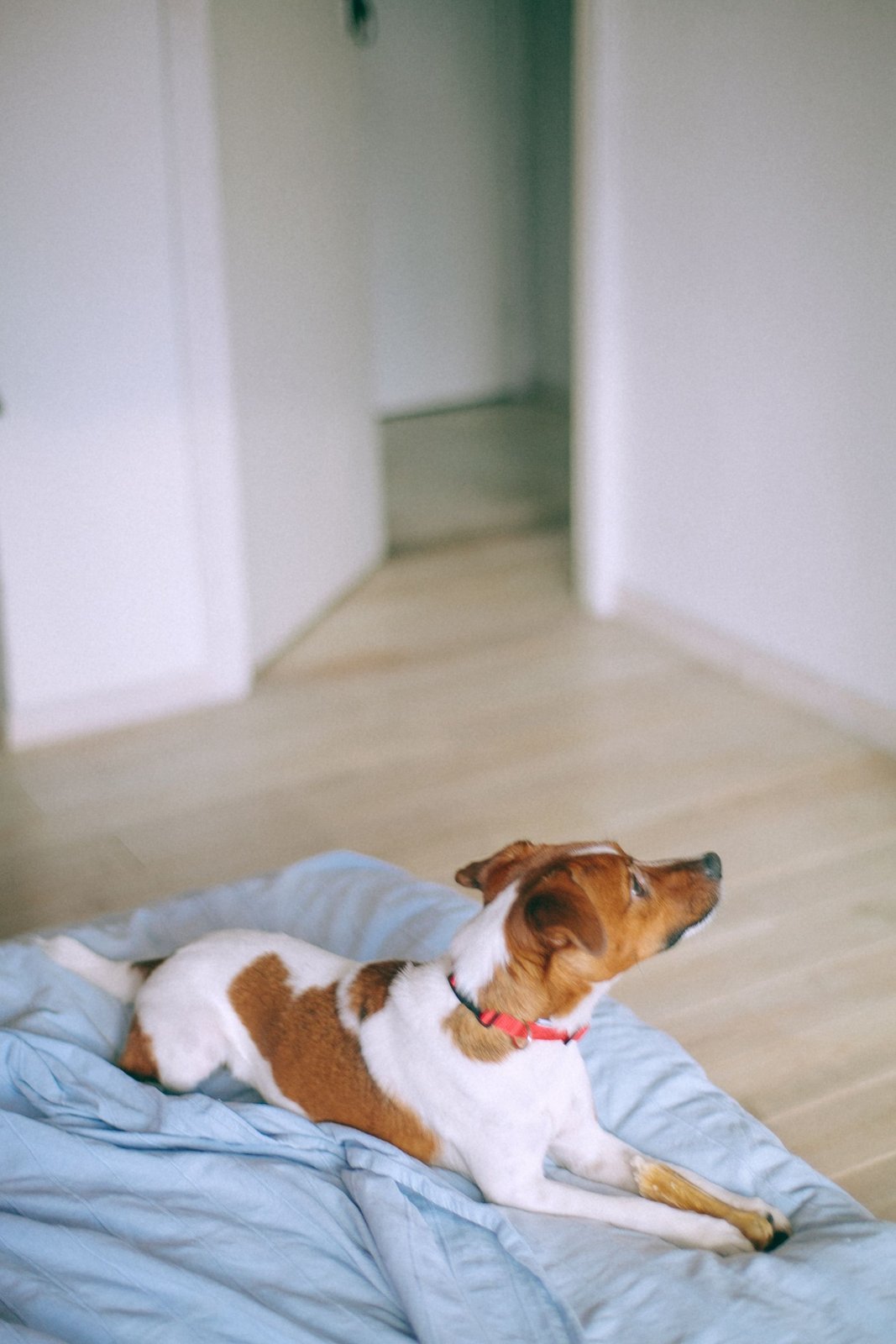
The photo above is a dog lying on a bed, looking up. It is a settled-place picture, not a dining table.
In a small apartment, “away from the plate” may only be the other end of the rug, a corner behind a sofa, or a crate along the wall. Distance still helps. If the dog can rest a chin on your knee, the place is too close for early practice.
Pick one spot and use it for meals. A bed, a mat, or a familiar crate can all work if the dog already accepts that place. If you are still teaching a crate as a rest tool rather than a timeout, see how to crate train a dog in an apartment. A crate is optional, and it is not a substitute for teaching.
If you need a physical boundary in a studio, a dog gate chosen for apartments can keep the dog out of the exact table zone while you eat. A dog bed that fits a small home makes the legal spot obvious. The lesson is: you sit down, the dog goes to that place, and staying there is what gets paid.
Practice the place when no one is eating. Walk the dog there, mark a settle, and toss a treat onto the bed. Then add a short stay while you sit with an empty plate. Only later do you add real food. If the dog cannot stay during a rehearsal, the real meal is too hard a test.
Reward staying there, not the stare at your fork
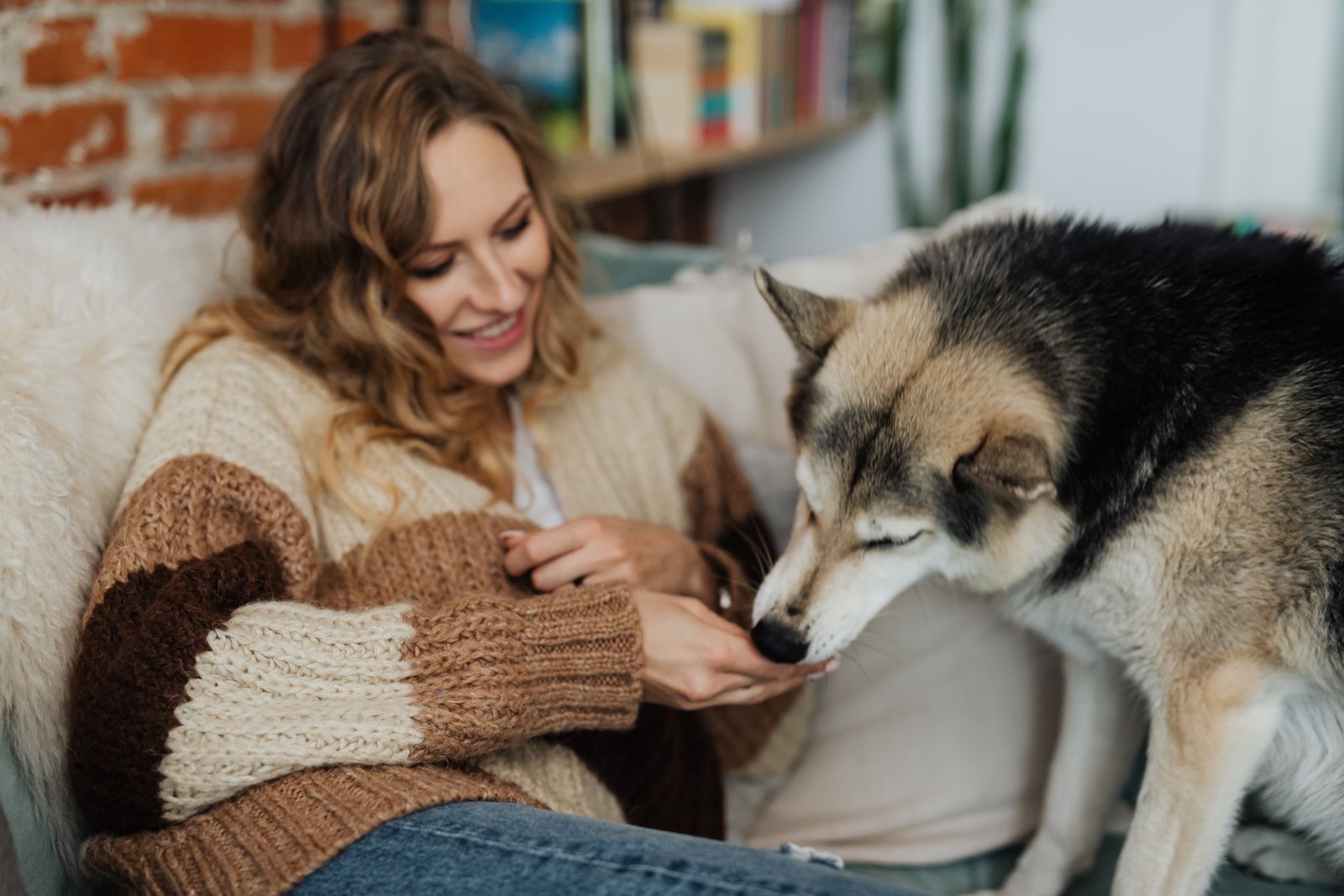
The photo above is a woman on a sofa feeding a dog from her hand. It is a reward picture, not a scrap taken off a dinner plate.
The skill you want is simple to say and easy to miss when you are hungry: the dog is on the mat, and that is worth paying. Staying there should predict something good from you, not a bite from your plate.
Use food the dog already likes, in a size you can deliver quickly. Ordinary kibble from the daily ration often works for an easy settle. A dog that has been paid from the table for years may need a higher-value piece reserved for this work. For help choosing what to use, see best training treats for dogs and how to choose dog treats. Keep the pieces small.
Walk the treat to the dog on the place, or toss it onto the bed. If you hold the reward out at the table, you have asked the dog to come back to your plate to get paid. If the dog returns to your chair, walk the dog back and try a shorter stretch. Do not fill the gap with a shock collar, a shout, or a skipped dinner. Pain is not part of this guide.
Early on, pay more often than you expect, then stretch the gaps. There is no set week in which this becomes automatic, and this guide will not invent one.
Stop accidentally paying the begging
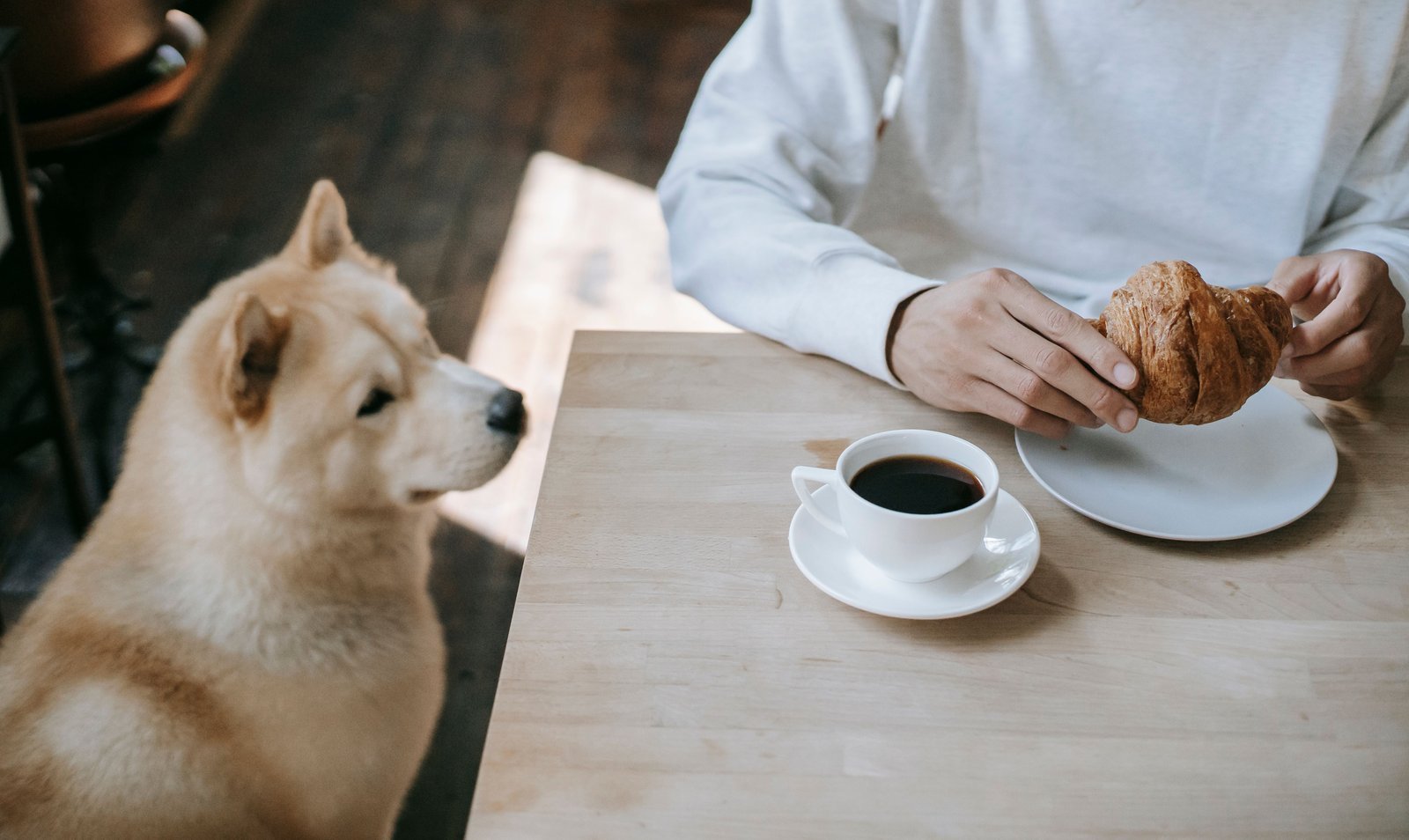
The photo above is a dog watching a croissant at a table. That stare is the habit this plan is built to replace, not a cue to share the pastry.
If the dog has ever been fed from your fork, the stare is not random. It is a behavior that has worked. Stopping the payout is as important as teaching the mat, including the obvious scrap, a plate left on the coffee table, and a guest who treats a begging face as a request.
Be consistent in the whole room, not only at a dining chair. In many flats, supper happens on the sofa, and the same rule applies. If you want to share a safe piece of human food, put it in the dog’s bowl after the meal, or use it as a training treat on the mat. Do not hand it over in response to a paw or a whine.
Table scraps can be unsafe
“Just a little” is not only a training problem. Onion and garlic, chocolate, anything with xylitol, grapes, and fatty leftovers can be dangerous. For a practical overview of what is usually safer and what is not, see human foods that are safe for dogs. That guide is not a reason to turn your dinner into the dog’s meal.
If the dog already swallowed something odd — a chocolate wrapper, onion, gum, a cooked bone, or a food you cannot identify — contact a veterinarian or a pet poison resource rather than waiting to see what happens. If the dog is vomiting, drooling, restless, or unusually sleepy, treat that as urgent. This article cannot tell you that the dog will be fine.
A mealtime plan that fits a small apartment

The photo above is two people eating pizza and salad with a dog sitting nearby on low seating, not at a formal dining table, and the dog is not taking food from the box.
A weekday shape might look like this:
Before you eat. The dog has already had their meal, or you plan to feed them after the plates are cleared. A short toilet trip can take the edge off. If you are still deciding how often to go out, keep that in how often you should walk your dog.
When you sit down. Send or lead the dog to the place. Pay a settle. Sit down with your food. Pay again before the staring starts, if you can.
During the meal. If the dog stays, quietly reinforce. If the dog comes back, do not reward the return. Pause, reset the place, and shorten the next stretch. A chew on the bed can help some dogs, as long as it is safe and not a second dinner of rich leftovers.
When you finish. Plates go to the sink or into the fridge, not onto a low table the dog can raid. If you want to give a leftover that is actually safe, it goes in the bowl after the meal, not as a prize for lingering under the chair.
Takeaway nights and guests are the usual weak points. Decide before the food arrives, and give visitors the same brief so they do not start a new payout. The plate rule does not change because the food came in a cardboard box.
When this is a veterinary question
A dog that begs at meals is usually practicing a habit that has been paid. This guide will not diagnose hunger, parasites, or a sudden change in appetite.
Contact a veterinarian if the dog suddenly seems ravenously hungry, loses weight, drinks far more than usual, vomits, has diarrhea, or begs along with other signs of being unwell. A dog that already ate a risky table food belongs with a veterinarian or a poison resource, as above. Do not skip meals as a test, and do not assume a thin or frantic dog is “just being greedy.” The training plan is for the everyday stare at your plate, once the dog is otherwise well and being fed enough.
FAQ
Will my dog stop begging at the table after a few meals?
No. Some dogs improve once the schedule, the place, and the payout are consistent. Others keep testing for a long time, especially if scraps used to work. This guide will not invent a week by which every dog ignores the table. Start with rehearsals, pay the settled place, and treat a difficult takeaway night as a harder test, not the first lesson.
Should I skip the dog’s dinner so they are less interested in mine?
No. Skipping the dog’s meal is not a training method, and this plan does not use hunger as a tool. Feed a measured meal on a schedule, in the dog’s bowl, and keep your plate out of the payout. If you are unsure about portions, use the feeding guide and ask your veterinarian rather than withholding food.
Is it all right to give leftovers if I put them in the dog’s bowl?
Sometimes, if the food is actually safe and it is not handed over in response to begging. Many table foods are not safe, including onion, chocolate, xylitol, and fatty leftovers. Check the safe-foods guide, keep portions small, and put any safe extra in the bowl after your meal. If the dog already swallowed something odd, contact a veterinarian or a pet poison resource rather than waiting.
What if the only place I can eat is the sofa, and the dog always sits there too?
Use a settled place that is still distinct from your lap and your plate, even if it is only the other end of the room. A bed, a mat, a gate, or a crate the dog already accepts can mark that spot. Reward staying there during sofa meals the same way you would at a table. The rule is about your food, not about owning a dining room.
Can I use a shock collar so the dog stops coming to the table?
No. This plan uses a schedule, a settled place, a paid stay, and an end to table scraps. A shock collar is not part of the method, and shouting after the whine is not a substitute for it either. If the dog cannot stay, make the task easier, add management, and pay the place more often.
[…] rather than waiting to see. This article is about unattended food on a tight kitchen surface. Stopping a dog from begging at the table is manners during a sit-down meal. Teaching a dog to ignore food and trash on city sidewalks is the […]
[…] skills still help, but they are not this article. Stopping a dog from begging at the table is about mealtime manners on ordinary nights. Stopping a dog from stealing food off counters is a […]