


If you need to leave a cat home alone for a weekend, the useful question is not whether cats are “independent.” It is whether a Friday-to-Sunday plan in your apartment can keep water, food, litter, and safety from failing while you are gone. A workday is a different job. Keeping an indoor cat busy while you are at work covers those eight hours. This article is one or two nights, and it is also about when a weekend plan is not enough for a longer trip.
This is general information for an otherwise healthy adult cat, not a veterinary diagnosis and not a promise that every cat will be comfortable alone. There is no honest rule that cats are fine alone for four days. Kittens, seniors, recently sick cats, and cats on medication should not be left without a person who can check them. If you are unsure whether your cat belongs in this 1-2 night plan, ask your veterinarian before you go.
Set out water, food, and litter so one failure is not the weak point

Water and litter fail more often than food. A single bowl can be knocked over, a fountain can clog or lose power, and a box that is already close to full on Friday will be a much worse box by Sunday.
Put out more than one water source, in more than one place, and clean them just before you leave. A heavy bowl that is hard to tip is a good baseline. If you use a fountain, treat it as one option among others, not the only drinker in the flat. For help choosing and maintaining a fountain, see best cat water fountains, then still leave a plain spare bowl the cat already uses.
Food should match what the cat already eats, in an amount that covers the nights you will be gone without leaving a huge pile that can spoil or be binged. If you are still settling portions, how much you should feed your cat is the place for that everyday math. Split dry food into more than one dish if that is how your cat already eats, or use an automatic feeder only if it is already a familiar, reliable part of the routine. Wet food left out for a whole weekend is a poor plan in a warm apartment. If your cat relies on wet food, a person who can refresh a meal is the more honest setup.
Litter needs the same redundancy. Scoop the box before you go, and if you have space, leave a second clean box rather than hoping one will stay usable. A box hidden in a tight cupboard can be missed if it overflows. Place boxes where the cat already goes, away from food and water, and make sure a door cannot swing shut and trap the cat away from them.
A puzzle feeder can slow a meal and add a little occupation, but it is not a weekend babysitter. If the cat already ignores puzzle toys when you are at work, do not expect a new one to carry Saturday and Sunday.
Do a room-by-room safety pass before you go
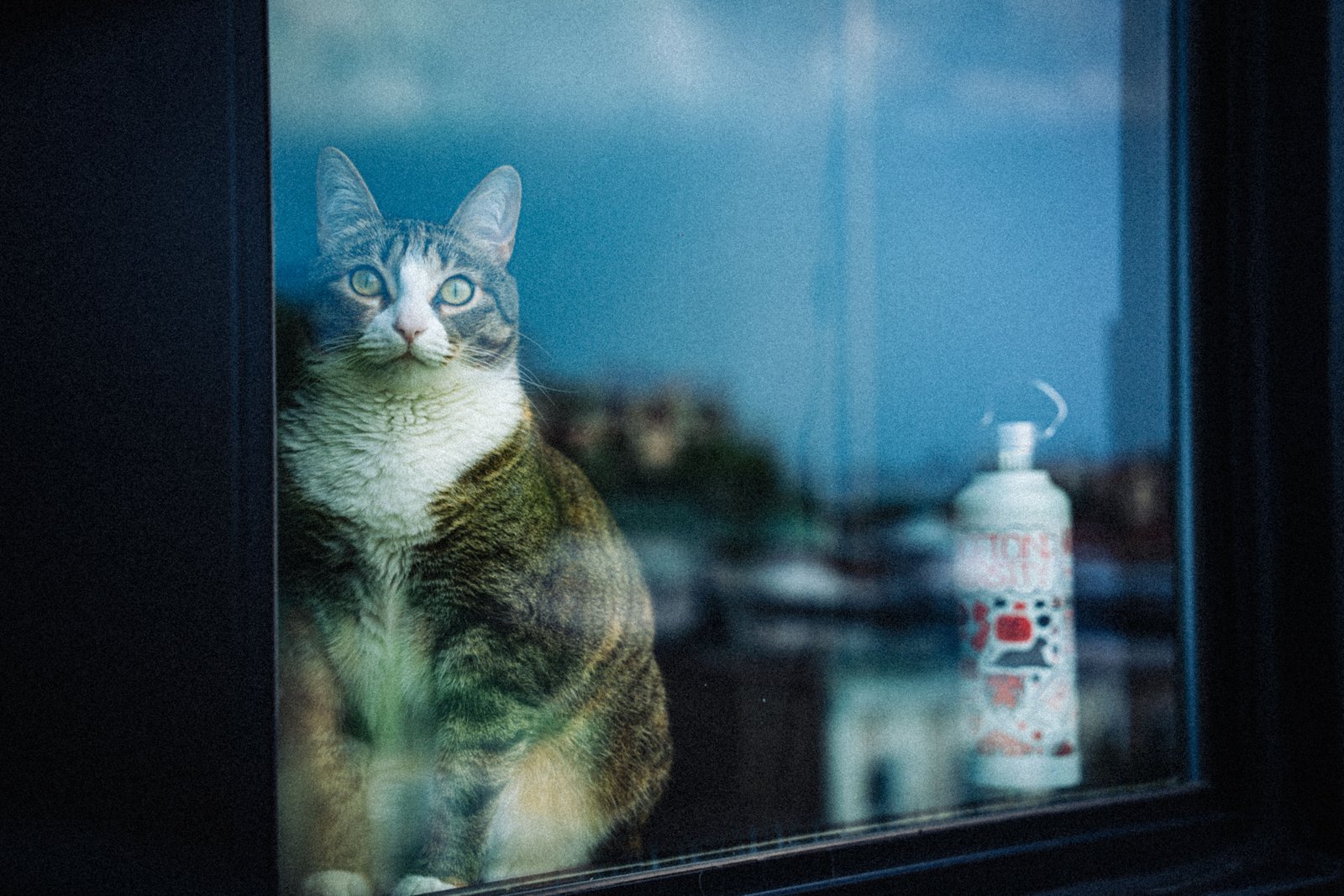
A weekend alone is a long stretch for a bored or scared cat to test a window, a cord, or a balcony door. Walk the apartment as if you will not be there to interrupt a bad idea.
Start with windows, screens, and the balcony. Close and latch windows you do not need open. Check that screens are actually seated, and do not leave a balcony door ajar “just for air” if the cat can slip through or lean through a gap. Indoor window and balcony safety is the dedicated guide for that part of the home; use it, then still do a fresh pass the evening you leave. A weekend is long enough for a loose screen or an unlatched slider to become the whole story.
Next, cords, blinds, and anything a cat can chew or wrap around a neck or a paw. Unplug or tuck away chargers, fairy lights, and dangling blind cords in rooms the cat can reach. Move houseplants that are tempting or toxic out of reach, or out of the rooms the cat will use. Trash, medication, string, rubber bands, and food left on a counter all look different when no one is there to say no.
If you have never done a full pass of the flat, how to cat-proof a small apartment is the room-by-room plan to use first. This weekend check is shorter and more specific: close the rooms you do not want the cat living in for two nights, confirm the cat can reach water, food, litter, a rest spot, and a hiding place, and remove the hazards that get worse over a long unsupervised stretch.
Leave a familiar bed or perch in a quiet room, and keep the usual lights-and-sound pattern as close to normal as you can. A radio or a lamp on a timer can help some cats; a sudden, empty, dark flat can be harder. Indoor enrichment ideas can make the space more interesting, but do not fill the rooms with brand-new objects the night before you leave. Stick to toys and perches the cat already understands, and pick up anything that can be shredded and swallowed.
When a drop-in visit is the more honest plan

A fully solo weekend is a reasonable plan only for some cats, in some homes, for one or two nights. A drop-in visit from a person is the more honest plan when water or litter could reasonably fail, when the cat is anxious, when you have more than one cat with a tense relationship, or when you simply will not be back on Sunday as planned.
A visitor does not need to throw a party in your living room. A trusted friend, neighbor, or professional sitter who can walk in, refresh water, scoop the box, offer a meal, and look at the cat for ten quiet minutes is already doing the important work. Ask them to message you if the cat is not eating, is vomiting, is straining in the litter box, is hiding in a new way, or seems unwell. Those are veterinary questions, not “wait until Monday” questions. Leave a short written note with your vet clinic’s number, where food and litter live, and anything the cat usually does that would look odd to a visitor.
If the cat is a kitten, a senior, recently sick, or on medication, do not treat a drop-in as optional. Those cats should have a person who can check them, and some will need more than one visit or a stay with someone who can watch them more closely. A longer trip — midweek through the following weekend, or anything beyond these one or two nights — is not a stretched version of this plan. Arrange actual care, or do not go.
An automatic feeder or a camera can help, but it is not a check-in
An automatic feeder can space meals if the cat already uses one reliably. It can also jam, dispense nothing, or dump too much food at once. That is why it is a helper, not a replacement for spare bowls or a person. If you are still choosing one, best automatic cat feeders covers the practical trade-offs. Set it up days before you leave, watch it work, and still leave a backup portion the cat can reach if a cycle fails.
A camera can tell you that the cat walked past the sofa at 2 a.m., and it can help you notice a problem earlier than Sunday evening. It cannot scoop a box, refill a dry fountain, or take a cat to the vet. Pet cameras for apartments can help you pick a setup that fits a small home, but a live view is not the same as a drop-in. If what you see worries you — a cat that has not appeared, a knocked-over bowl, straining in the box — you still need a person who can go in.
Do not use gadgets to justify a longer absence than this weekend plan can honestly cover.
Come home without overwhelming the cat

The first hour back matters as much as the packing list. Come in quietly. Let the cat choose contact. A long, bright greeting, a forced pickup, or a sudden round of guests can be a lot after two quieter days. Put bags down, refresh water and scoop the box, and offer a normal meal before you try to “make up” for the time apart with frantic play.
When the cat is ready, a short, familiar play session can help you both reset. Keep it to the kind of play the cat already likes. A daily play routine for an indoor cat is a useful pattern for ordinary evenings; you do not need a special weekend version, only a calm return to the usual rhythm.
Then look, really look, at the cat and the apartment. Did the water get drunk? Was food left or finished too fast? Is the litter box unusually wet, dry, or messy? Is the cat eating, hiding in a new place, moving stiffly, or unusually clingy or withdrawn? Signs your cat is stressed can help you sort ordinary “you were gone” behavior from a pattern that needs attention. A cat that is not eating, is vomiting, is straining in the litter box, is hiding in a new way, or seems unwell when you return is a veterinary question. Call the clinic rather than waiting to see if Monday feels better.
When a weekend plan is not enough
Use this 1-2 night setup only when the cat is an otherwise healthy adult, the apartment can be made reasonably safe, and you will be back when you said you would. If any of those pieces is missing, a person who can check in — or a stay somewhere the cat can be watched — is the plan, not a better feeder.
A weekend is also the wrong time to change food, rearrange the whole flat, or introduce a new animal. Keep the days before you leave ordinary. The cat should already know where the bowls, the boxes, and the quiet spots are.
If you travel often, treat the drop-in person as part of the routine rather than an emergency add-on. That makes Friday less of a scramble, and it gives you someone who already knows what “normal” looks like for your cat. The goal is a quiet, uneventful couple of nights, not a test of how little care a cat can survive.
FAQ
Can I leave a healthy adult cat home alone for a whole weekend?
Sometimes, if the cat is an otherwise healthy adult, the apartment is set up with spare water, food, and litter, and you have done a safety pass. This is a 1-2 night plan, not a rule that cats are fine for four days. If you have any doubt, arrange a drop-in visit.
Is an automatic feeder or a camera enough without a person checking in?
No. A feeder or a camera can help, but it cannot replace a person who can refresh water, scoop the box, and look at the cat. Feeders jam, fountains clog, and a camera cannot take a cat to the vet. Use gadgets as extras, not as the whole plan.
What matters more when I am away: food, water, or litter?
Water and litter fail more often than food. Leave more than one water source, scoop the box and consider a second clean box, and set out food the cat already eats in a sensible amount. Do not leave wet food sitting out for the whole weekend.
Which cats should not be left without a person who can check them?
Kittens, seniors, recently sick cats, and cats on medication should not be left without a person who can check them. Some will need more than one visit or a stay with closer supervision. Ask your veterinarian if you are unsure whether your cat fits a solo 1-2 night plan.
What should I watch for when I come home?
Look at the cat and the apartment: water, food, litter, hiding, and overall demeanor. A cat that is not eating, is vomiting, is straining in the litter box, is hiding in a new way, or seems unwell is a veterinary question. Call the clinic rather than waiting until Monday.