


If you are looking for the best cat tunnels for apartments, you already know the constraint is not interest. Many indoor cats will shoot through a tube or claim a cardboard box the hour it arrives. The hard part is finding something that does that job without taking the only path to the kitchen or collecting fur you cannot wash.
A useful mindset is this: a tunnel or hideaway is a compact, covered place to pass through, stalk, or retreat—not a bed, a climbing tree, a window seat, or a toy you wave. In a studio or small flat, the versions that work are usually short, collapsible, or low enough to slide under furniture, and easy to clean. Sometimes a box is enough.
This is general, practical information for cat parents in the US and UK, not a product test and not a veterinary behavior plan. Cats vary. If your cat suddenly hides all day, stops eating, or seems painful or unwell, contact a veterinarian. A new cave should not be used to explain a health change.
Tunnels and hideaways are not beds, trees, or toys
It helps to keep the jobs separate when every item has to earn a square foot. A bed is a comfortable surface for sleep and rest. If you are choosing cushioned sleep spots for a tight floor plan, that is the work of best cat beds for small apartments, not this guide. A hideaway can include a soft floor, but its main feature is cover: sides, a roof, or a tunnel wall the cat can get inside.
A cat tree is about height, scratching, and a view of the room, which is why best cat trees for small apartments is a different decision. A window perch is for watching the outdoors; see best window perches for cats when that is the need. Interactive toys are for play you share, which best interactive cat toys covers on its own.
Tunnels and hideaways do a narrower job: a covered route or a small enclosed spot at floor level. In a small apartment, that can matter because there are fewer sofa undersides or spare rooms to claim. Used well, they complement a bed, a tree, or a perch. They should not be asked to replace them.
Think of three jobs, not one:
- Cover. The cat can get in, under, or through something, not only sit on top of it.
- A small footprint. The item fits under furniture, along a wall, or in a corner, and can often fold away.
- A cleanable surface. Fur, litter dust, and the occasional mishap should not retire the piece after a week.
What “compact” actually means in a small apartment

Many cats already use the gaps you have: under a chair, behind a sofa, or under a low table. A store-bought tunnel or hide is trying to offer a similar covered feeling without blocking the room.
Measure the real gap before you shop. The space under a sofa or media unit is often lower than you think. A tunnel that cannot slide under furniture has to live in the open, so it needs a short length, a fold-flat design, or a corner that is not also a walkway.
A long, looping play course can be fun in a larger room and a frustration in a one-bedroom, where every extra bend becomes a trip hazard. Start smaller than you think you need.
Leave clearance at both ends. A tunnel shoved flush against a wall becomes a dead end, which some cats dislike and which makes cleaning harder. Your cat should be able to enter, pass through, and leave without wriggling against a skirting board.
Tunnel styles that fit under furniture or along a wall
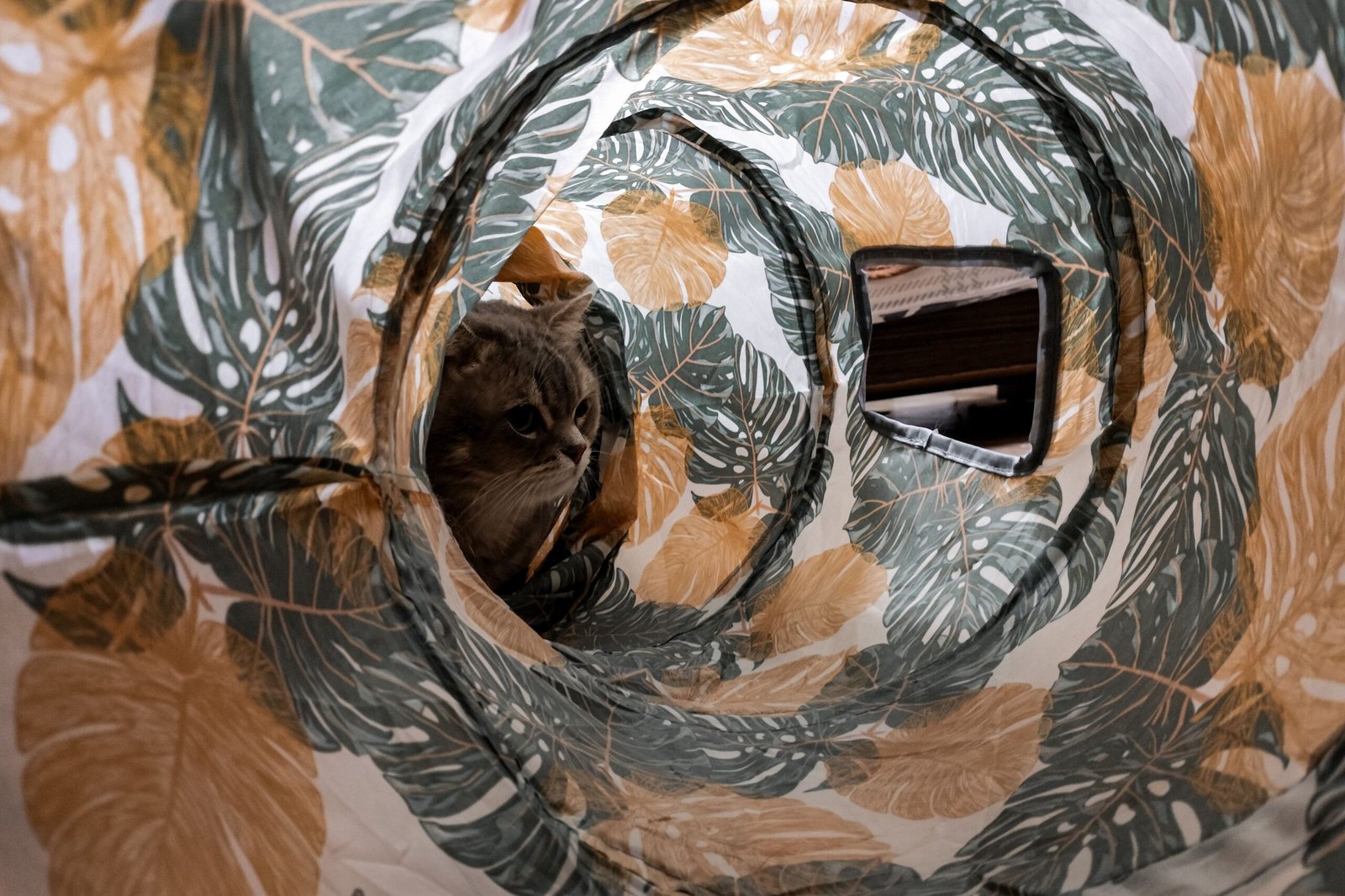
You do not need a ranked shortlist. You need a shape that matches the gap you actually have. A short, straight fabric tunnel is the simplest apartment option. It can sit under a sofa, under a bed if the clearance is there, or along a wall. Look for openings at both ends so the cat is never trapped in a closed tube, and a diameter that fits your cat without feeling like an open hallway.
Collapsible or pop-up tunnels are useful when the living room also has to be a workspace. They should fold down small enough to store, and open without a frame you have to rebuild each evening. If the tunnel has a flexible hoop or wire, check that it stays covered and does not poke through the fabric as it ages.
Connected or S-shaped tunnels make a longer stalking path, which some cats love and some apartments cannot spare. If you try a longer layout, keep it against a wall or under furniture rather than across the only route to the door. Sections you can detach are kinder than one giant piece when you need the floor back.
Sound matters in a flat. Crinkle fabric can make a tunnel more interesting for play, and it can also be sharp in a quiet building or if you work in the same room. A quieter cloth may get more everyday use; neither is “better” in the abstract.
Skip anything with small detachable parts, loose decorative strings, or a single exit that can collapse shut. A tunnel should stay open, stay put on a smooth floor, and unzip or come apart for washing.
Hideaways, caves, and when a cardboard box is enough

Not every cat wants a tube. Some want a still, enclosed spot they can sit in and watch from—a cave, a covered cube, or, very often, a cardboard box.
A box is enough more often than people expect. It is the right first test if you are not sure the cat cares about covered spaces, and a fair long-term option if the cat already loves it. Choose a sturdy carton that does not collapse when the cat leans, cut one or two openings with smooth edges, and remove tape loops, staples, and loose plastic. Two openings turn a box into a short tunnel as well as a hide, which many cats prefer to a cave with no back door.
Replace the box when it is dirty, soft, or starting to break. You can add a washable towel or mat inside and launder that cloth, rather than pretending a cardboard den will stay fresh indefinitely.
Bought hideaways make sense when you want something that washes more easily than cardboard, or a shape that will not be recycled by mistake. Look for a cover you can remove, a size that lets the cat turn around, and at least one clear exit. A cube with a tiny hole may appeal in a photo and feel stuffy in a warm apartment.
A hideaway is still not a bed, even if the cat naps in it. If the cat prefers an open cushion, keep the cave as an option, not a requirement. Paper bags can tempt some cats, but handles should be removed so a head cannot get caught, and bags should be large, clean, and supervised rather than left as a permanent den.
Washability, materials, and everyday use
In a small apartment, anything that cannot be cleaned will eventually smell like the room. Prefer fabrics you can machine-wash or wipe, and structures that come apart without tools. A removable cover is more useful than a surface that can only be spot-cleaned.
Shake or vacuum the tunnel when you tidy hair from the sofa. Litter dust travels on paws. Keep hideaways away from food bowls and the litter tray, so the cat does not have to rest where they eliminate or eat.
Inspect the gear the way you would a toy. Chewed holes, exposed wire, loose threads, and peeling binding are reasons to repair or retire the piece; cats do swallow stray fibers. If you have more than one cat, extra hides and more than one way out of a tunnel reduce the chance that one cat can corner another.
Placement that leaves you a path through the flat
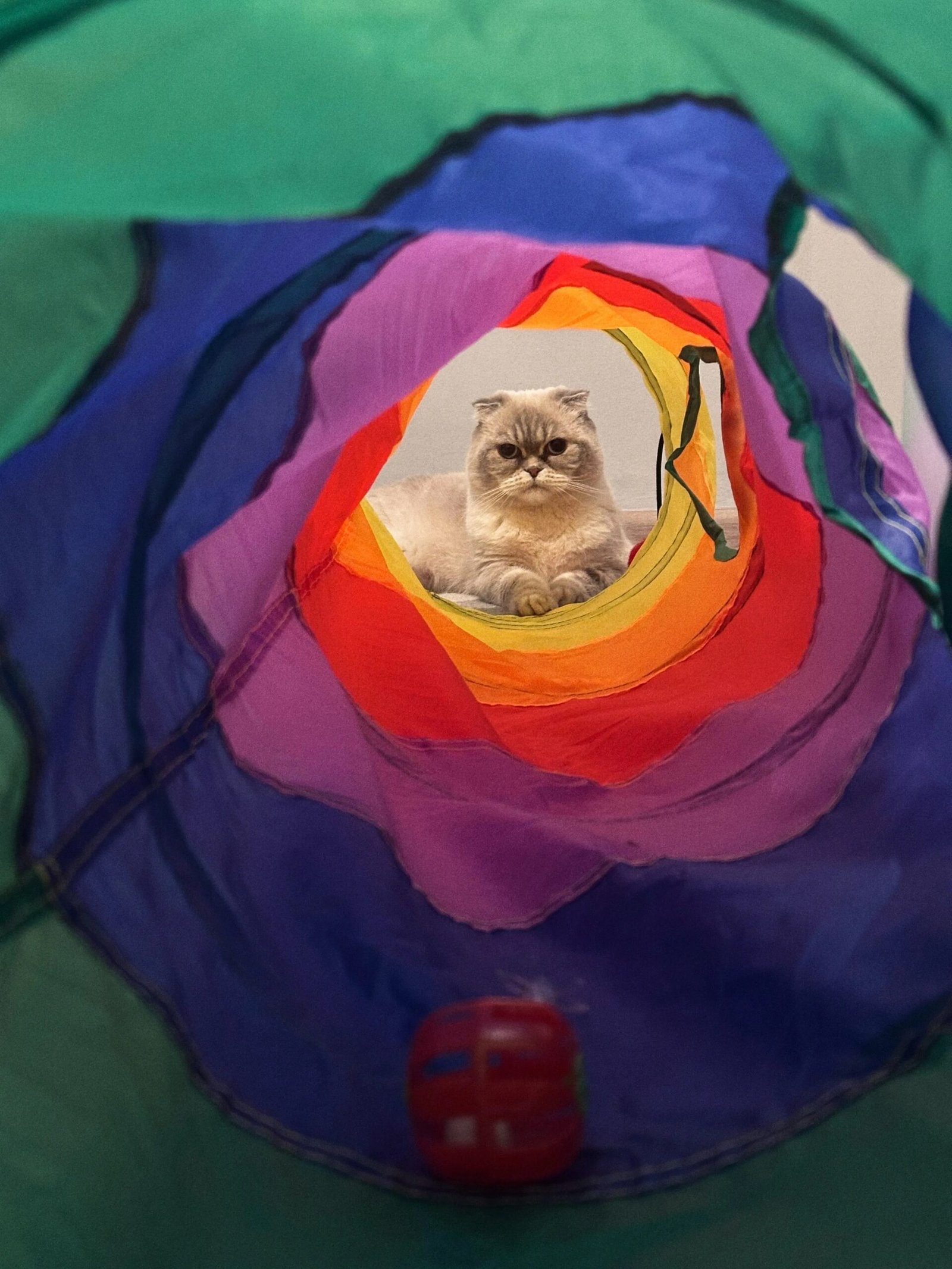
Put the tunnel where the cat already moves, not in the middle of your only clear floor. Good starting places are under a coffee table, along a wall, beside a sofa, or in a quiet corner that is not also the route to the door. If the cat already lurks under a particular chair, a short tunnel that leads into that gap will often get more use than a bright tube in the center of the rug.
Keep a walking path for people. In a narrow flat, a tunnel across the hallway will be kicked and eventually ignored. Along a wall or under furniture, it can stay in place long enough for the cat to treat it as part of the room.
You can place a hide or tunnel near other resources without turning this into a tree or perch guide. A covered path that ends near a climbing base, or a hide a few feet from a window seat, lets the cat move between cover and a view. Leave the litter box and food out of that cluster.
If you need the floor in the evening, fold the tunnel away after play rather than leaving a trip hazard in the dark. A hide in a corner can usually stay put.
How to introduce a tunnel or hideaway without forcing it
Leave the new item on the floor and let the cat investigate. You can drop a familiar treat near an opening, or rest a piece of an old towel inside so the space smells like home. You can also trail a wand toy through the tunnel during a short play session, then stop while the cat is still interested. Do not push the cat in, hold a flap shut, or “show them” by stuffing them into a cave.
If the cat ignores it, change one thing at a time: a quieter wall, a shorter run, a plain box instead of loud crinkle fabric, or an opening toward a spot the cat already uses. Some cats prefer to sit on a tunnel rather than go through it at first. That is information, not a failure.
Give unused gear a fair few days in a good location before you decide it was a waste, then be willing to stop. A cardboard box in the right corner may be the whole answer, and a cat who wants height or a window may need those resources more than another floor item. A cat who suddenly refuses to come out of a hide, or who only lives in a cave after a change in appetite or litter habits, needs a veterinary conversation, not a different tunnel.
Tunnels and hideaways are a small, specific kind of enrichment: cover, a path, a place to duck out of sight. In a small apartment, the best version is the one your cat uses, that you can wash, and that still leaves you a way across the room—a short fabric tunnel under the sofa, a washable cube in the corner, or a box you cut this afternoon.
FAQ
Do apartment cats actually need a tunnel?
Need is a strong word. Many indoor cats enjoy a covered path or a tight hiding spot, and a small home often has fewer natural gaps than a larger house. A tunnel or hideaway can add that cover without taking a whole room. It is optional enrichment, not a cure for stress or a substitute for play, climbing, or a comfortable bed. If your cat already lives happily under a chair or in a box, you may already have the idea in place.
Is a cardboard box as good as a bought tunnel or hideaway?
It can be. A sturdy box with smooth openings is a fair test and, for many cats, a lasting favorite. Bought tunnels and caves are mainly about washability, a more stable shape, and a look you are willing to leave out. Start with a box if you are unsure. Replace it when it gets dirty or weak, and avoid tape loops, staples, and handles that could catch a neck or a paw.
How do I keep a cat tunnel clean in a small home?
Choose a fabric you can machine-wash or wipe, and a design that unzips or folds inside out. Shake or vacuum it when you tidy hair from the floor, and wash it often enough that litter dust and dander do not settle into the room. Keep it off the litter tray and away from food bowls. Retire the item if the fabric tears, a wire is exposed, or you can no longer get it clean.
Where should I put a tunnel if I barely have floor space?
Under a sofa or coffee table, along a wall, or in a corner that is not the path to the door. Measure the height of the gap first, and leave both ends open. Avoid the center of a narrow room, where the tunnel will be kicked and folded. If even that is too much, a box tucked beside a chair can give you a hide without a long tube.
My cat ignores the tunnel. Should I try something else?
Yes, after you have given it a fair try in a better spot. Try a shorter tunnel, a quieter fabric, a box, or a hide with a wider opening, and do not force the cat inside. Some cats want a still cave more than a run-through tube; others would rather use a tree or a window than anything on the floor. Unused gear does not need to stay in a small apartment out of hope.