

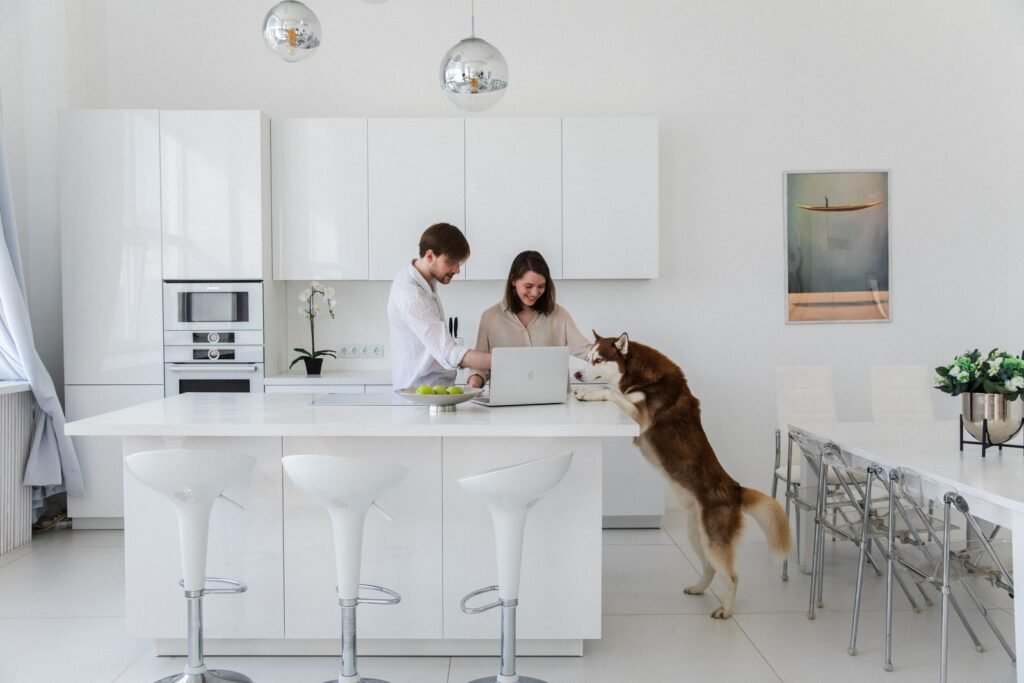
If you want to stop a dog from stealing food off counters, the useful work is not a lecture delivered after the bread has already vanished. It is a short apartment counter, a table that also does prep, a grocery bag left for “just a minute,” and a dog who can reach leftovers, butter, or a cutting board without much of a jump.
This is general information for US and UK dog parents in flats and small homes, not a veterinary diagnosis and not a behaviorist plan. There is no honest promise that the habit will fade in three days. A dog that has already swallowed chocolate, xylitol, grapes, onions, bones, wrappers, or anything else unsafe is a veterinary emergency; contact a veterinarian rather than waiting to see. This article is about unattended food on a tight kitchen surface. Stopping a dog from begging at the table is manners during a sit-down meal. Teaching a dog to ignore food and trash on city sidewalks is the street version of leave-it, not the counter at home.
Why a small kitchen makes this easy

In a large, closed-off kitchen, a dog may need a running start or a chair dragged from another room. In a small kitchen, the geometry already favors the dog. The counter is often shorter and lower. The cook space may open straight into the living room, with no door you can close while you chop. A stool, a recycling bin, or a low chair parked at the island can become a step. A dining table that doubles as a prep board sits at exactly the height a medium dog can investigate with a raised paw.
Food is also left out more often in a tight room, not because you are careless, but because there is nowhere else to put it. The grocery bags land on the only clear stretch of counter. The butter stays out while you look for a knife. A cutting board with cheese or chicken rests near the edge so you can reach the sink. You step into the hallway for a phone charger, and that is enough.
Watch the real path, not a generic idea of “the kitchen.” If the dog can stand in the living room and already have a nose at the island, the work zone is not separate. If a stool is always tucked under the counter, assume it will be used. If you prep on the table because the counter is too narrow, treat that table as a counter for this plan.
Management first: do not leave food unattended

Training will go further if the kitchen stops handing out easy wins. Management is the first job, and it is not a lesser one.
Do not leave food unattended on the counter, the island, or the table you use for prep, even for a short trip out of the room. Put groceries away before you step into another room, including bags that still have bread, butter, or snacks at the top. Use the fridge, or a microwave with a door that closes, for anything you cannot watch. Push boards, pans, and plates back from the edge so a raised paw or a quick hop does not meet food on the first try.
If the layout allows it, close a kitchen door or set a gate during cooking so the dog is not practicing the snatch while you chop. A gate only helps if it actually blocks the path and the dog cannot climb or squeeze it. If you need help choosing one that fits a small doorway, see best dog gates for apartments. A gate is a management tool for the cook window, not a stand-in for teaching a wait.
Keep the dog’s own food out of the same “open bag on the counter” pattern. An open bag of kibble is still food on a surface the dog has learned to raid. Storing dog food in a small apartment is the plan for that bag, the bin, and the space under the counter. If you also share the kitchen with a cat, cat food left on a worktop is another target, which is why feeding a dog and a cat in the same apartment is a separate logistics plan. A raised bowl can keep the dog’s meal off the floor in a tight kitchen; best elevated pet bowls for small kitchens is about that station, not about making human leftovers easier to reach.
Hunger can make a counter more interesting, but this article is not a feeding-amount guide. If portions or a schedule still feel unsettled, how much you should feed your dog is the companion piece. A dog who leaves their bowl and then hunts the cutting board is also not a picky-eating problem; getting a picky dog to eat is a different job.
Management also means you decide, in advance, what you might share later from a plate, and what never belongs on an open board. Which human foods are safe for dogs is a guide for foods you may choose to offer on purpose, not a reason to leave a taste test on the edge of the counter.
A settle or place spot just outside the work zone

While you manage the food, give the dog a legal place that is not “right under the cutting board.” Pick a settle or place spot just outside the work zone: a mat, a bed, a rug, or a crate the dog already rests in, set where the dog can still see you if that helps them stay put, but cannot reach the counter in one step. In a studio, that may be the far side of the sofa or a mat behind a baby gate.
Teaching a dog to settle in an apartment is the skill underneath this spot. Practice it on ordinary days, with short sessions, so the mat already means “this is a rest place” before you ask for it during a busy cook. Keep unsafe foods in the pan, in the fridge, or under your hand, never parked as a test.
During prep, pay the dog for being on that spot and for keeping four paws on the floor. A few small treats delivered to the mat, or a stuffed chew the dog can use there, are fair if the dog can actually stay and chew. If the dog gets up and drifts back to the counter, guide them back to the spot without a scolding speech, then reinforce the next stretch of staying. You are building a pattern: cooking starts, the dog goes to the place, four-on-the-floor is worth something, the counter does not pay.
If the only “spot” you have is the kitchen itself, the dog will keep rehearsing the snatch. Move the bed first. Then ask for the settle.
Leave-it, a wait at the threshold, and what to do mid-snatch

Two cues make the management easier to live with. A reliable leave-it helps when something is already on a surface and you need the dog to turn away. A wait at the kitchen threshold helps when you want the dog to pause at the edge of the work zone instead of following you to the board. Neither cue should be taught with food the dog is not allowed to have sitting out as bait.
Start leave-it with ordinary, allowed food in your hand or on the floor, at a level the dog can notice without lunging, and reward the moment the dog looks away or steps back. Build slowly. The kitchen counter is a hard version of the same idea, not the first lesson. The sidewalk version is a different context; keep that work for walks, and keep this work for the home surface.
A wait at the threshold can look like the door skill you may already be teaching. The dog pauses before entering the work zone, then is invited in or sent to the settle spot. Teaching a dog to wait at the door is the related entry skill; here the “door” may be a real kitchen door, a gate, or simply the line where the flooring changes. Reward the pause. If the dog bursts past, reset calmly and ask for a shorter wait.
If a snatch is already in progress, do not turn it into a chase. Running after the dog, yelling, or playing tug with a stolen bag teaches a lively game: grab food, get a sprint, get attention. Instead, try to be boring and clear. If you can calmly block access to a second grab, do that. If the dog already has a safe item, trade it for something you are willing to give, then put the original food away. If you know the item is unsafe, or you are not sure, get the dog to you without a wrestling match if you can, and contact a veterinarian if anything risky may have been swallowed.
If a stolen towel or spoon turns into chewing, or if furniture is already being chewed, use how to stop a dog from chewing furniture in an apartment as the separate plan, and still put the food away so the kitchen stops paying for the grab.
What not to try, and when it is an emergency
Do not use a shock, prong, or citronella collar to punish a counter raid. Those tools add a sudden, unpleasant feeling after the dog has already reached the food, and they do not teach a settle or a leave-it. Do not use leftover medication, or any sedating leftover, to “take the edge off” kitchen time. If a veterinarian has already prescribed a plan, follow that advice. Otherwise, stay with management and training.
Do not leave chocolate, xylitol, grapes, onions, bones, or wrappers out as a “training test.” A practice leave-it should use food you are willing to have the dog notice, under your control, not a dangerous item parked on the board to see what happens. A dog that has already swallowed something unsafe is a veterinary emergency. Call a veterinarian or an emergency clinic. Do not wait for symptoms, and do not try to handle that at home with advice from a neighbor.
Skip the promise that the kitchen will be quiet by Friday. Some dogs change quickly once food stops being available and a settle spot starts to pay. Some need more time, or help from a qualified professional, especially if the dog guards food, growls when you approach a stolen item, or seems unable to settle near the kitchen at all. This guide cannot offer a timetable, and it is not a substitute for that help.
A tight kitchen will always be a tempting room. Closing the easy opportunities, giving the dog a place just outside the work zone, teaching a leave-it and a wait you can actually use, and staying calm mid-snatch will do more than a single dramatic correction at the butter dish.
FAQ
Is it enough to tell my dog “no” after they have already taken food off the counter?
A late “no” usually arrives after the dog has already been paid. Put the food away, reset the dog to the settle spot if you can do it calmly, and spend your energy on management and on rewarding four-on-the-floor before the next grab. A scolding speech after a successful raid does not teach leave-it.
Should I leave a piece of bread on the counter to practice leave-it?
No. Do not leave food unattended as a test, and never use chocolate, xylitol, grapes, onions, bones, or wrappers as practice bait. Teach leave-it with ordinary, allowed food you still control, then raise the difficulty slowly. The real counter comes later, with you present and the unsafe items already put away.
What should I do if I catch my dog mid-snatch?
Do not turn it into a chase or a tug-of-war. Stay as calm as you can, prevent a second grab if you can do that safely, and trade for a legal item if the dog already has something that is not dangerous. If you think the dog may have swallowed something unsafe, contact a veterinarian or an emergency clinic right away.
Can a gate replace training in a small, open kitchen?
A gate can help during cooking if the layout allows a real block, but it is management, not the whole plan. Combine it with putting food away, a settle spot just outside the work zone, and a wait at the threshold. If the dog can climb, squeeze, or walk around the gate, fix the setup rather than adding a harsher tool.
If my dog swallowed chocolate, xylitol, grapes, onions, a bone, or a wrapper, can I wait and see?
No. That is a veterinary emergency. Contact a veterinarian or an emergency clinic, and do not use leftover medication or home remedies while you wait. This guide is general information, not a diagnosis and not a promise that a kitchen habit will change on a set timetable.
[…] this article on the indoor can. Food left on the worktop is a different problem, covered in how to stop a dog from stealing food off counters. Mealtime pestering belongs with how to stop a dog from begging at the table. Outdoor scraps on a […]