


If you want to help a cat stay calm when guests visit, the hard part in a small apartment is rarely the idea of “give them space.” It is a knock at the door, a burst of voices in a hallway, and a cat that hides, bolts, or winds up in a home where the front door, the sofa, and the only bedroom share a few square metres.
A useful mindset is this: you are managing the guest-at-the-door moment, not forcing a social cat by Friday. Set up a safe room before the doorbell, give the cat a way out, coach guests not to reach in, and keep the first visits short and boring. Pulling the cat out of hiding usually makes the next visit harder.
This is general information for cat parents in the US and UK, not a veterinary diagnosis, and not a promise that every cat will enjoy guests after a few evenings. A cat that suddenly hides all the time, stops eating, or seems painful should be a veterinary question, not a wait-and-see. This is not a medical article or a socialization deadline.
This is the guest-at-the-door moment, not everyday shy-cat work
The job here is the knock, the arrival, and the first hour when someone new is in the flat. It is not a rewrite of how to help a shy cat feel safe in an apartment. That guide is the everyday confidence plan. This article is what to do when a guest is actually coming over.
It is also not how to stop a cat from door dashing, though an open front door during greetings is a real escape risk. It is not how to introduce a new cat, how to introduce a cat and a dog in an apartment, a plan for a cat that wakes you at night, or a full guide to signs your cat is stressed. A new roommate animal is not the same moment as a friend staying for tea.
Think of four jobs, not one:
- Set up a safe room before the doorbell. Food, water, a litter box, and a hiding place are ready first.
- Give the cat a way out. The cat can leave the room where guests sit, and is not passed around.
- Coach guests not to reach in. People sit and ignore the cat unless the cat comes closer.
- Keep the first visits short and boring. Early guests are quiet and brief, not a party used as a test.
Set up a safe room before the doorbell
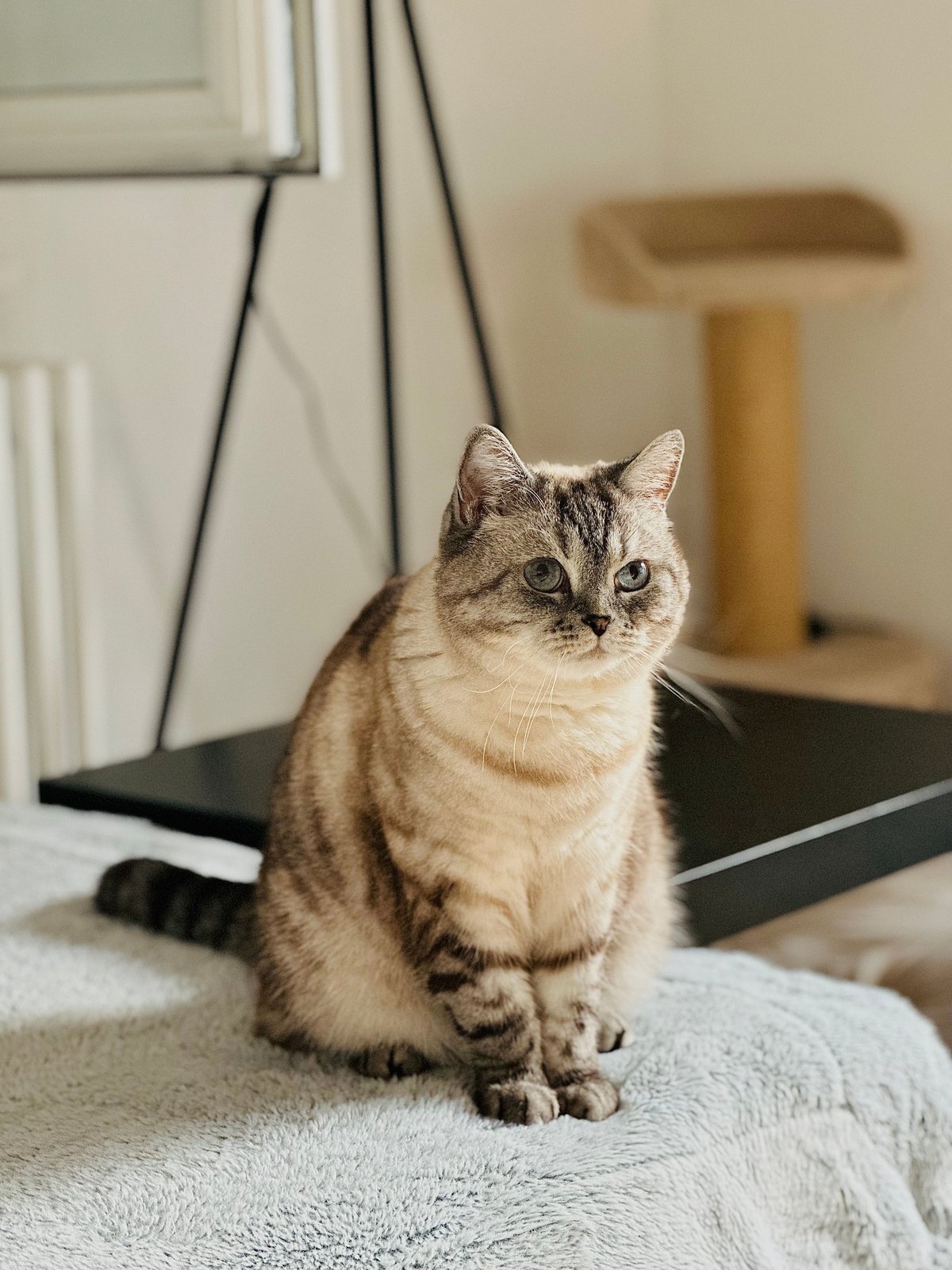
The photo above is a cat sitting on a bed in a bedroom, with a cat tree behind. It is a quiet-room picture, not a guest arriving.
In a small apartment, the safe room is often the bedroom, a bathroom that can hold a litter box for a short visit, or a corner you can close with a door. The point is a familiar space the cat already uses, set up before anyone knocks.
The room needs a litter box, water, the cat’s usual food if the visit may run long, and at least one hiding place the cat chose, such as a covered bed, a box, or a space under furniture. A cat bed that fits a small home or a tunnel or hideaway can make that spot obvious. If you are still doing a broader hazard pass, how to cat-proof a small apartment covers daily safety; this section is only the guest-visit room.
A closed door can be a kindness if the cat prefers to be fully away from voices, or a problem if the cat wants to watch from a gap. Choose the setup the cat already accepts. Do not lock a frightened cat in a carrier “so they get used to people,” and do not drag the cat into the living room to practice being brave.
Do this work on a quiet day, then keep the room ready. When you know a guest is coming, get the cat to that space, or leave the door open so the cat can go there, before the knock.
Give the cat a way out

The photo above is a cat peeking from under a curtain. It is a hiding-place picture, not a guest at the door.
Hiding is a normal way for a cat to manage a new person in a small space. The useful plan is to let the hide exist, and to make sure the cat can also leave the room where people are sitting. A route to the safe room, a high perch, or a gap behind furniture is better than a guest who follows the cat from chair to chair.
If you close the cat in, keep the stay short, and make sure food, water, and a litter box are already there. If you leave doors open so the cat can move, watch the front door. Greetings in a narrow hallway are a classic dash moment, so put the cat in the safe room before you open the door, or have someone block the exit. A visit should not turn into an escape.
Do not reach under the bed, shake a treat bag to lure the cat out for introductions, or pass a hiding cat from lap to lap. If the cat comes to the edge of the room to look, that is enough for now. Curiosity is not a cue to crowd.
Coach guests not to reach in

The photo above is two people talking over coffee in a living room. There is no cat in the frame, and this is a seated conversation, not a doorbell arrival.
Give the brief before the guest arrives, not after someone is already kneeling by the sofa. A few clear lines are enough: please sit down, do not call the cat, do not reach under furniture, and let the cat come to you if they want to. If there are children, an adult needs to keep that rule.
Staring, kissing, and picking the cat up are common well-meant mistakes, and so is following the cat into the safe room to “make friends.” Ask guests to stay seated and keep their hands to themselves. If the cat walks in, they can offer a still hand only if the cat clearly chooses contact. If the cat leaves, the visit continues without a chase.
Some cats will not come out at all, and that is an acceptable visit. You do not owe anyone a meeting. A friend who cannot follow the brief is a friend to see elsewhere for a while, or to invite only when the cat can be fully in the safe room.
Do not use essential oils, sprays, or “calming” scents as a promise that the cat will like guests. There is no miracle pheromone product in this plan, and a strong scent in a small flat can be a problem of its own. The work is setup, space, and boring guests.
Keep the first visits short and boring

The photo above is a cat sitting on a bed by a window in a quiet room. It is a calm moment, not a guest arrival, and not a cat being brought out of hiding.
The first visits should be shorter and quieter than a normal social evening. One familiar person, a brief stay, and ordinary talking are easier than a group, a loud dinner, or an overnight guest. You are not running a test to see whether the cat “can handle it.”
A practical shape might look like this:
Before the knock. The safe room is ready. The cat is already there, or can get there easily. You have told the guest the rules.
At the door. Open the door calmly. Keep the cat from the threshold if they dash. Do not make a fuss of calling the cat to greet anyone.
During the visit. Guests sit and talk. You do not drag the cat out. If the cat appears, nobody lunges for a photo or a cuddle. If the cat stays away, you leave them alone.
When the guest leaves. Let the hallway settle before you invite the cat back into the main room, if they were shut away. A little quiet after the door closes is useful. There is no set week in which the cat will start greeting people, and this guide will not invent one.
Overnight guests and parties are a bigger ask than a short afternoon visit. If you must have them, lean harder on the safe room. Do not treat a houseful of people as exposure therapy.
Play and predictability around a visit
A visit is easier when the rest of the day still looks like the cat’s usual day. A short play session before guests arrive can help some cats settle, but it is not a guarantee and not a substitute for a safe room. For a simple pattern you can repeat on ordinary days, see a daily play routine for an indoor cat and indoor cat enrichment ideas. Those guides are about everyday activity, not a last-minute trick.
If you work away from home and guests sometimes arrive before you do, that is a harder setup. The cat should still have a room they can use, and the guest should still get the same brief. Keeping an indoor cat busy while you are at work is about the hours you are out; it does not replace a plan for the moment someone walks in.
Keep feeding, litter, and play on the usual schedule as much as you can. A guest visit should not also be the day you rearrange the furniture or introduce a new animal.
When hiding is a veterinary question
Hiding during a knock or a visit is often a normal response, especially in a cat that is already cautious. This article will not treat that as a disease, and it will not promise that a shy cat will become a greeter.
Contact a veterinarian if the cat suddenly hides all the time, even on quiet days, stops eating, stops using the litter box, seems painful, or looks unwell in other ways. A change that arrives without guests, or that lasts well after the visit is over, is not something to wait out as “just shyness.” For a broader look at everyday stress signs, see signs your cat is stressed. That guide can help you notice patterns. It is not a diagnosis, and neither is this article.
If the hiding came on after a fall, a fight, or a sudden limp, skip the guest plan and call your veterinarian. The visit can wait.
FAQ
Will my cat start enjoying guests after a week of visits?
No. Some cats become more relaxed when visits stay short and predictable. Others keep hiding, and that can still be a successful visit. This guide will not invent a week by which every cat will like guests. Do not treat a social evening as a deadline.
Should I pull the cat out of hiding so they can meet people?
No. Forcing a greeting usually makes the next visit harder. Let the cat stay hidden, and make sure they have a way to the safe room. If the cat comes to the edge of the room, that is enough. Guests can sit and wait; they do not need a hello.
What should I tell guests before they arrive?
Give the brief early: please sit down, do not call the cat, do not reach under furniture, and let the cat come to you if they want to. Ask them not to follow the cat into the safe room. If someone cannot follow that brief, it is kinder to meet elsewhere, or to keep the cat fully in the safe room.
Is it all right to close the cat in a bedroom for the whole visit?
It can be, if the room already has a litter box, water, and a hiding place, and if the stay is not a long confinement the cat hates. A closed door is a management tool, not a way to “get them used to people.” Watch the front door when you open it, so the visit does not turn into a dash.
When is hiding a reason to call a veterinarian?
If the cat suddenly hides all the time, even on quiet days, stops eating, seems painful, or looks unwell in other ways, contact a veterinarian rather than waiting it out as shyness. Hiding during a knock can be normal. A lasting change, or hiding after a fall or a limp, is a healthcare question.