

If you are looking at reflective gear for dog night walks, the useful question is not which light to put at the top of a list. It is whether a light or a strip of reflective trim will actually help on the route you walk after dark, or whether a well-lit pavement and a visible handler already do most of the work.
A useful mindset is this: visibility gear is a supplement to a planned night outing, not a substitute for one. Use a light or reflective trim when you are crossing at poorly lit corners, sharing space with bikes and cars, or walking a dark coat that disappears against the pavement. Keep the light charged before you leave the lobby, and check the fit so nothing dangles into the dog’s mouth. A light is not a guarantee that a driver will see you, and it is not a reason to drop the leash.
This is general information for dog parents in the US and UK, not a veterinary diagnosis, and not a scored test of products. If a dog is bumping into things, unusually hesitant in low light, or lame, contact a veterinarian. A light is not treatment for a dog that suddenly refuses walks or seems unable to see well after dark.
This is visibility gear, not the night-walk plan
The job here is being seen, and wearing gear that stays on and stays charged. It is not a rewrite of how to walk a dog at night in the city, which is the outing plan for moving through the street after dark. This article is the light, the trim, and the habits that go with them.
It is also not a buying guide to leashes for city walks or harnesses for pullers. Those articles help you choose a lead or a harness. You may add a light or reflective trim to gear you already use. That does not mean a pulling dog only needs to be lit up.
Keep weather and paw care in their own places: dog raincoats for city walks, dog coats for cold weather walks, dog booties for city walks, walking a dog in the rain, and paw care after city walks. A raincoat or winter coat can have reflective patches, but warmth and wet-weather cover are separate jobs from visibility. Do not treat a dark coat, a wet pavement, or a set of booties as if they were night-visibility gear.
Think of three jobs:
- Decide when gear helps. Poorly lit corners, traffic, and a dark-coated dog are stronger reasons than a bright, open high street.
- Choose a simple setup. A clip-on light, reflective trim on a collar, harness, or leash, or both, as long as the fit is safe.
- Keep it working. Charge or replace batteries before you leave, and check that nothing hangs where the dog can chew it.
When a light or reflective trim actually helps

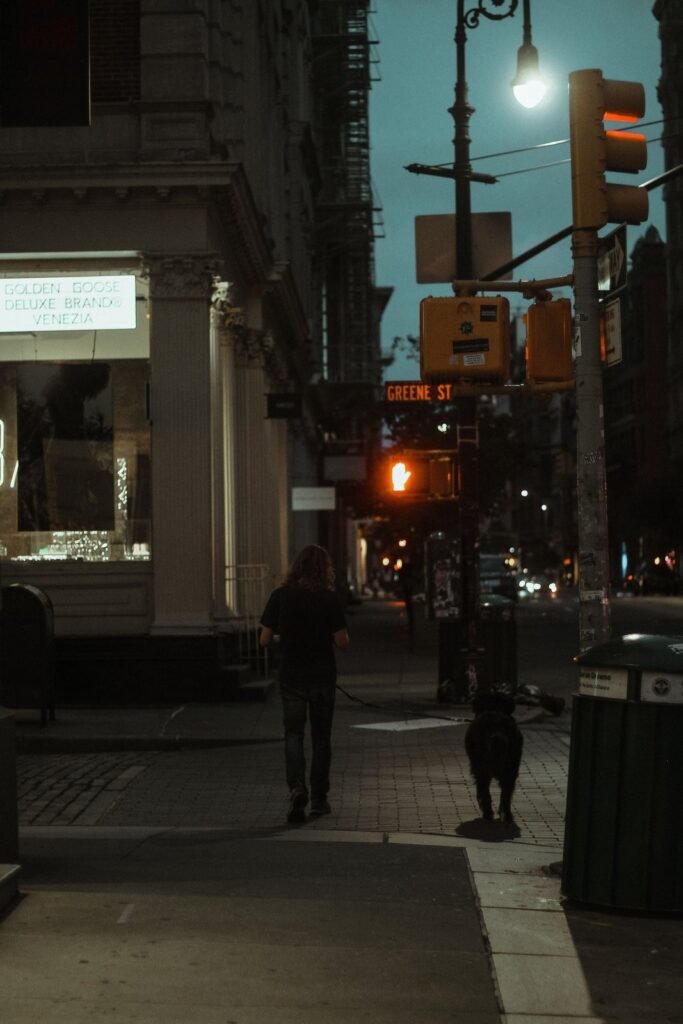
The photo above is a narrow, dimly lit street at night. The shop lights help in patches, and the darker stretches between them are the kind of place where a moving light or a reflective strip can make a dog easier to notice. Reflective trim works when a light hits it: car headlights, a bike lamp, a streetlight at a certain angle. It is quiet and has no battery, but it does nothing in a dark gap if nothing is shining on it. A small light on the dog or the leash can be seen even when no headlight is aimed at you, which is useful on a path with bikes coming from behind, or at a corner where a car turns before its beams catch a strip of trim.
A dark coat against dark pavement is a common reason to add something visible. Black, navy, or deep brown fur can vanish at a crossing even when you, standing taller, are easier to see. Poorly lit corners, unlit side streets, and shared cycle lanes are the stretches where a light or trim earns its place. A short toilet loop under continuous shop lighting may need less. The same dog can need more gear on one route than on another, especially after the clocks change and the evening walk is suddenly dark. A light still does not mean a driver or cyclist will see you in time. Stay on a leash, watch the corner, and treat the light as one more signal, not a shield.
When a well-lit route and a visible handler may be enough
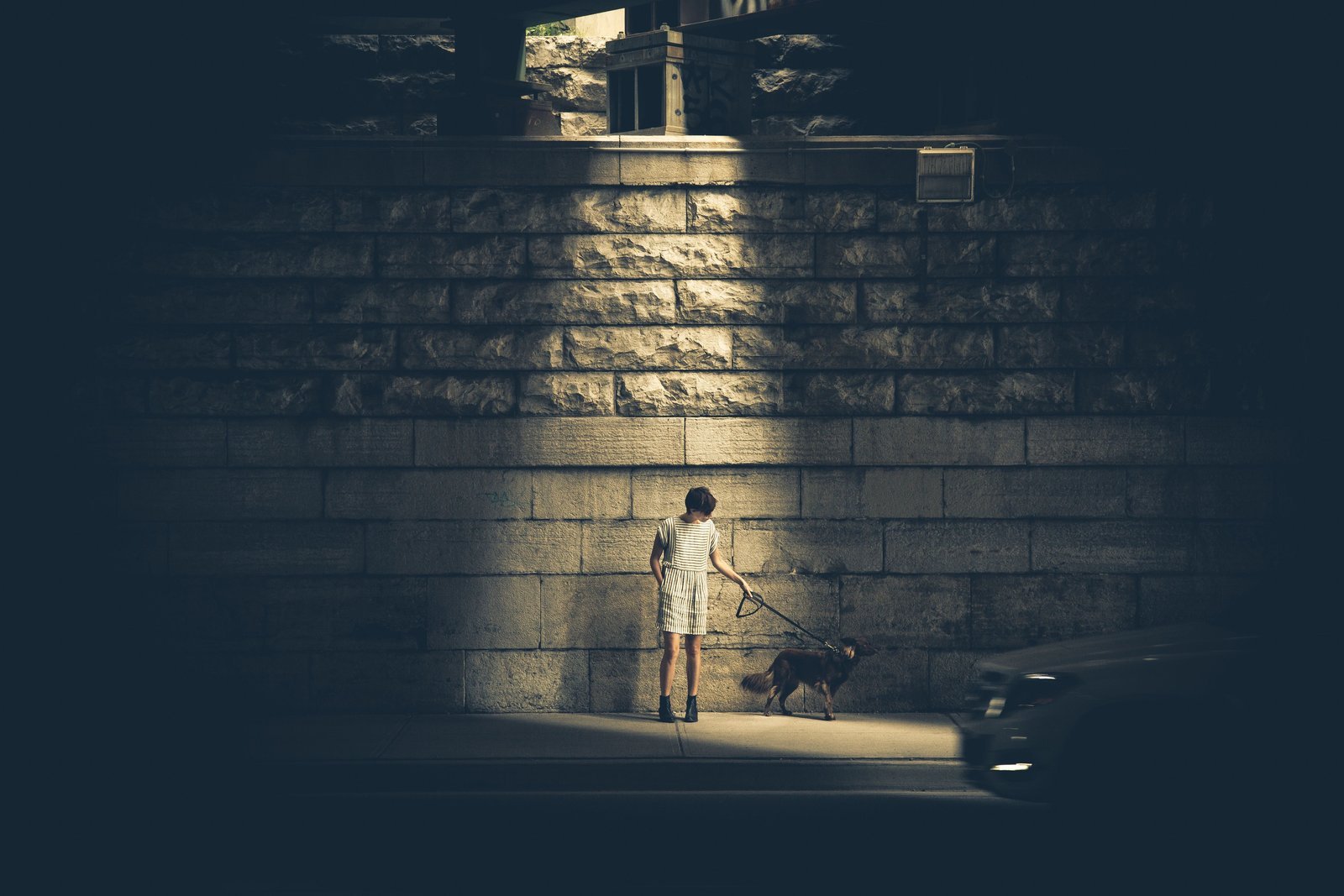
The photo above is a person and a dog standing in a strong patch of streetlight, with a car passing in the dark around them. Official titles on stock photos can be misleading; what you can actually see is a woman in a short striped dress and a leashed dark dog. A visible handler in a lit place is part of the plan, even when the dog is not wearing a lamp.
On a short, familiar route with even lighting, your own clothing may do as much as a small light on the collar. A pale jacket, a reflective sash, or a clip on your own bag puts the taller moving shape in view first. “Enough” is not a rule for every night. Rain, fog, and a sudden detour onto a darker street change the picture. If you already use a well-lit loop for most of the walk, you may still want a light for the last unlit corner or the crossing outside the building.
Do not drop the leash because the street looks bright or because the dog is wearing a light. Check local leash rules, and keep the dog on a lead in the city unless a clearly signed space says otherwise. A lit-up dog is still a dog beside traffic. Visibility gear is not an off-lead pass. If the dog suddenly refuses the walk, hangs back in low light, bumps into curbs or bins, or seems sore, stop treating it as a gear problem and contact a veterinarian.
Clip-on lights vs reflective trim on a collar, harness, or leash

The photo above is a collar and leash close-up at twilight. The leather is ordinary, not a reflective strip, and there is no clip-on light in the frame. A clip-on light is usually a small lamp that attaches to a ring, a harness strap, or the leash. It can flash or stay on, and it needs power. Reflective trim is material that bounces light back. Place a clip-on where it can be seen from the side and from behind, and where it cannot swing into the dog’s mouth. If the dog is a chewer, avoid dangling charms and long straps. Fit the collar or harness so you can slip two fingers under the strap, and so the light does not slide around the neck.
Do not hang a light from a chain that the dog can catch on a gate. If you already use a harness for pulling, add the light to that harness rather than stacking a second tight collar just to hold a lamp. There is no model list or test score here. Choose a light you can turn on with gloves, a clip that stays shut, and trim that is actually reflective in a headlight, not just a pale colour in the shop.
Battery habits and a fit you can check in the lobby

The photo above is a dark-coated dog on a city sidewalk at night. The handler is visible, the dog is harder to see, and the streetlights are ahead, not evenly underfoot. Check the light in the lobby, or at the door, before the lift closes. Turn it on, confirm it is bright enough, and confirm the clip is closed. A light that spent all week in a coat pocket can be dead when you need it. If the light is rechargeable, give it a regular place to charge, the way you would a set of keys. If it uses disposable batteries, keep a spare pair where you keep the lead.
Make the check part of leaving, not an afterthought on the pavement. The same pause is a good time to run a finger around the collar or harness: nothing twisted, nothing dangling at the mouth. If you also need a raincoat, a winter coat, or booties that night, put those on first, then attach the light where it can still be seen and cannot hang into the dog’s face.
A light does not change leash rules, and it does not make an off-lead trot safer on a dim street. If the light fails mid-walk, shorten the route, choose the brighter side of the road if you can, and keep the dog close. Do not let the dog run on the theory that someone might see them.
When a night walk is a veterinary problem
Most questions about lights and trim are equipment questions. Some are not. If a dog is bumping into things, missing the edge of the pavement, unusually hesitant in low light, or lame, contact a veterinarian. A new lamp is not treatment for a dog that suddenly refuses walks or seems night-blind.
Do not wait to see whether a brighter light “makes them braver.” Pain, vision changes, and fear can all look like stubbornness at the door. Describe what you have noticed, including whether the hesitation is new and whether it is worse after dark. This article cannot diagnose those problems, and it will not claim that visibility gear will fix them.
A calm starting plan you can repeat
Use this as a first draft, then adjust to the street in front of you:
- Walk the route in your mind. Add a light or reflective trim when you will cross poorly lit corners, share space with bikes and cars, or walk a dark coat against dark pavement. A well-lit loop and a visible handler may be enough for part of the walk, but not always for the last unlit stretch.
- Pick a simple setup: reflective trim on a collar, harness, or leash, a clip-on light, or both. Place anything that hangs where the dog cannot chew it.
- Check the light in the lobby. Confirm it is on, the clip is closed, and the batteries are not already fading. Charge or replace them as a leaving habit, not a pavement surprise.
- Keep the dog on a leash. Check local rules. A light is not a guarantee a driver will see you, and it is not a reason to drop the lead.
- If the dog is bumping into things, unusually hesitant in low light, lame, or suddenly refusing walks, contact a veterinarian. A lamp is not a treatment.
A walk where the dog is easier to see, the light actually works, and the lead stays in your hand is more useful than relying on a gadget to do the noticing for everyone else.
FAQ
Does a light guarantee that drivers will see my dog?
No. A light or reflective trim can make a dog easier to notice, especially on a dark coat or at a poorly lit corner, but it is not a promise that a driver, cyclist, or scooter will see you in time. Keep the dog on a leash, watch the crossing, and treat the gear as one signal, not a shield.
Do I need a light if my street is already well lit?
Not always. A well-lit route and a visible handler can be enough on a short, evenly lit loop. You may still want a light or reflective trim for a darker side street, a turning car, or the last corner outside your building. Lighting can change with weather, season, and a last-minute detour.
Where should I put a clip-on light?
Place it where it can be seen from the side and from behind, and where it cannot swing into the dog’s mouth. The back of a harness or a point mid-leash is often safer than a charm hanging under the chin. Check the fit in the lobby, and avoid anything the dog can chew or snag.
Can I let the dog off the leash if they are wearing a light?
No. Check local leash rules, and keep the dog on a lead in the city unless a clearly signed space says otherwise. A lit-up dog is still a dog beside traffic. Visibility gear is not an off-lead pass, and a dead or failed light mid-walk is not a reason to let the dog run.
What if my dog suddenly refuses night walks or seems not to see well?
Contact a veterinarian, especially if the dog is bumping into things, unusually hesitant in low light, or lame. A new light is not treatment for a vision, pain, or fear problem, and it is not a test of whether the dog can see. Describe whether the change is new and whether it is worse after dark.