

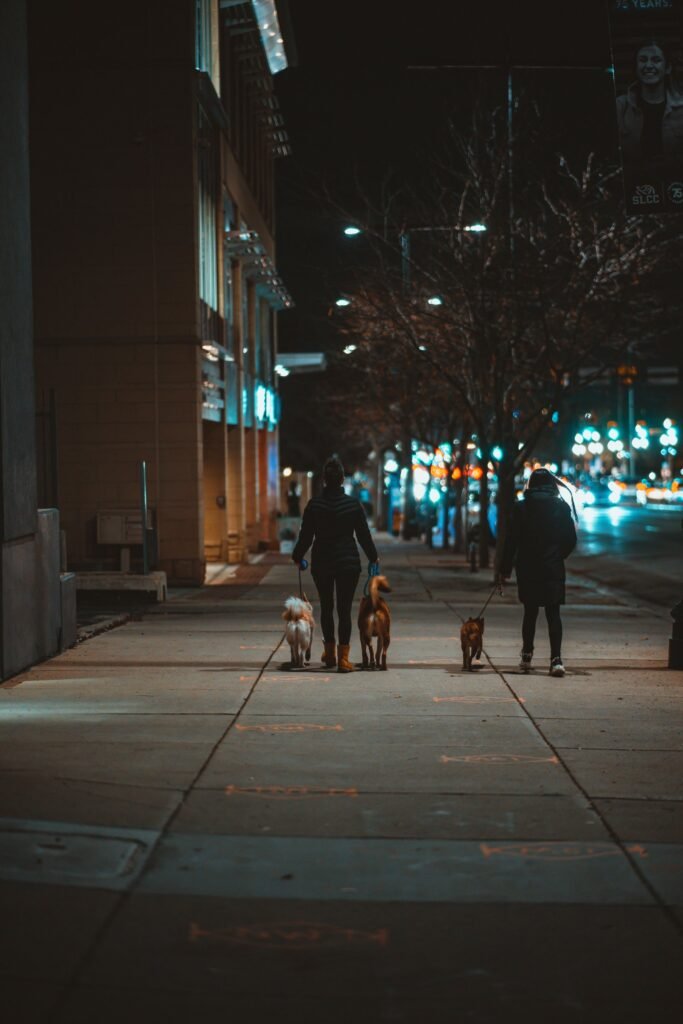
If you need to walk a dog at night in the city, the hard part is not the idea of “go outside after dark.” It is the dim corner, the driveway you can barely see into, the short walk back through a shared hallway, and a sofa that is only a few steps from the door. Houses with a front path and a porch light can hide a lot of that. Many flats cannot.
A useful mindset is this: you are fitting the outing to the light you have, and you are planning the walk back into the building as carefully as the sidewalk. A familiar, well-lit loop, a shorter outing when visibility is poor, and a quick paw-and-belly check in a small entry will do more than one long circuit down streets you cannot see well.
This is general information for dog parents in the US and UK, not a veterinary diagnosis. This guide does not use hard temperature cutoffs, curfews, or neighborhood crime figures. If your dog is limping, shivering hard, disoriented, or will not put weight down, go inside. If that does not settle, contact a veterinarian.
This is an after-dark walking plan, not a weather or training rewrite
Night sidewalks have their own job: choose a well-lit route you already know, keep the loop modest when you cannot see far, and get back into a small building without a last-minute scramble. It is not a substitute for how to walk a dog in the rain in the city or how to walk a dog in cold weather on city streets. Wet pavement, ice, and winter wind belong in those guides. Aftercare for pads lives in how to care for your dog’s paws after city walks.
How many outings a typical day should hold is covered in how often you should walk your dog. Loose-leash skills and the leash you hold are different topics; see how to teach loose-leash walking on city sidewalks and best dog leashes for city walks. A coat is only an option here if the evening is also cold. Choosing one is a buying question in best dog coats for cold weather walks.
Think of three jobs, not one:
- Choose the route. A familiar loop with streetlights or shop lighting is usually kinder than a new shortcut.
- Fit the length. If you cannot see the pavement clearly, a shorter outing is a reasonable plan, not a failed walk.
- Plan the return. A shorter leash at corners, a light or reflective detail as an option, and a paw-and-belly check before the sofa all belong to the same outing.
The goal is a livable after-dark routine, not a claim that extra lighting makes every night street easy.
Choose a well-lit familiar route

Pick a loop you already know in daylight, then walk it when the streetlights are on. The usual longer circuit through a park, a dim alley, or a stretch with no lighting can wait. A shorter block on even pavement, with lighting you can actually use, is often the better after-dark map.
“Well-lit” here is practical, not a safety ranking of neighborhoods. You want to see the curb, the dog, and what is coming out of a driveway. Shop windows, porch lights, and regular streetlamps can all help. If one street always feels too dark to watch your footing, turn before you reach it.
Stay on the sidewalk or pavement when you can. Cross at places you already trust, and give yourself time rather than jogging through a dark dip. Unfamiliar cut-throughs and paths that lose their lighting halfway are poor places to improvise at night, even if they feel efficient during the day.
If your building opens onto a poorly lit stretch, reach the nearest better-lit sidewalk and keep the loop close.
Keep the loop shorter when visibility is poor
A clear, well-lit evening can still be a normal walk, especially if your dog needs a toilet trip and is comfortable moving. Heavy shade between lamps, wet pavement that hides edges, or a dog who already looks uneasy may be a reason to keep the outing shorter than your daytime loop. There is no honest single cutoff that fits every block and every dog.
Separate the jobs if you can. A toilet trip can be a brief, familiar loop close to the building. A longer sniff walk can wait for better light, or move to a well-lit block you already use. If you usually combine both in one outing, a dark evening is a good time to split them.
In a flat, that decision also includes the corridor and the lift. If getting downstairs already takes a few minutes, do not add a long, dim loop just to match a daytime distance. Two shorter outings often work better than one long one you cannot see well.
If the dog hesitates, plants their feet, or keeps trying to turn home, shorten the route. Keep this trip to a toilet loop if needed, and offer a short indoor settle afterward. Teaching a dog to settle in a small apartment is a separate skill, and it helps the evening end calmly when the walk is brief.
Use a shorter leash around driveways and corners
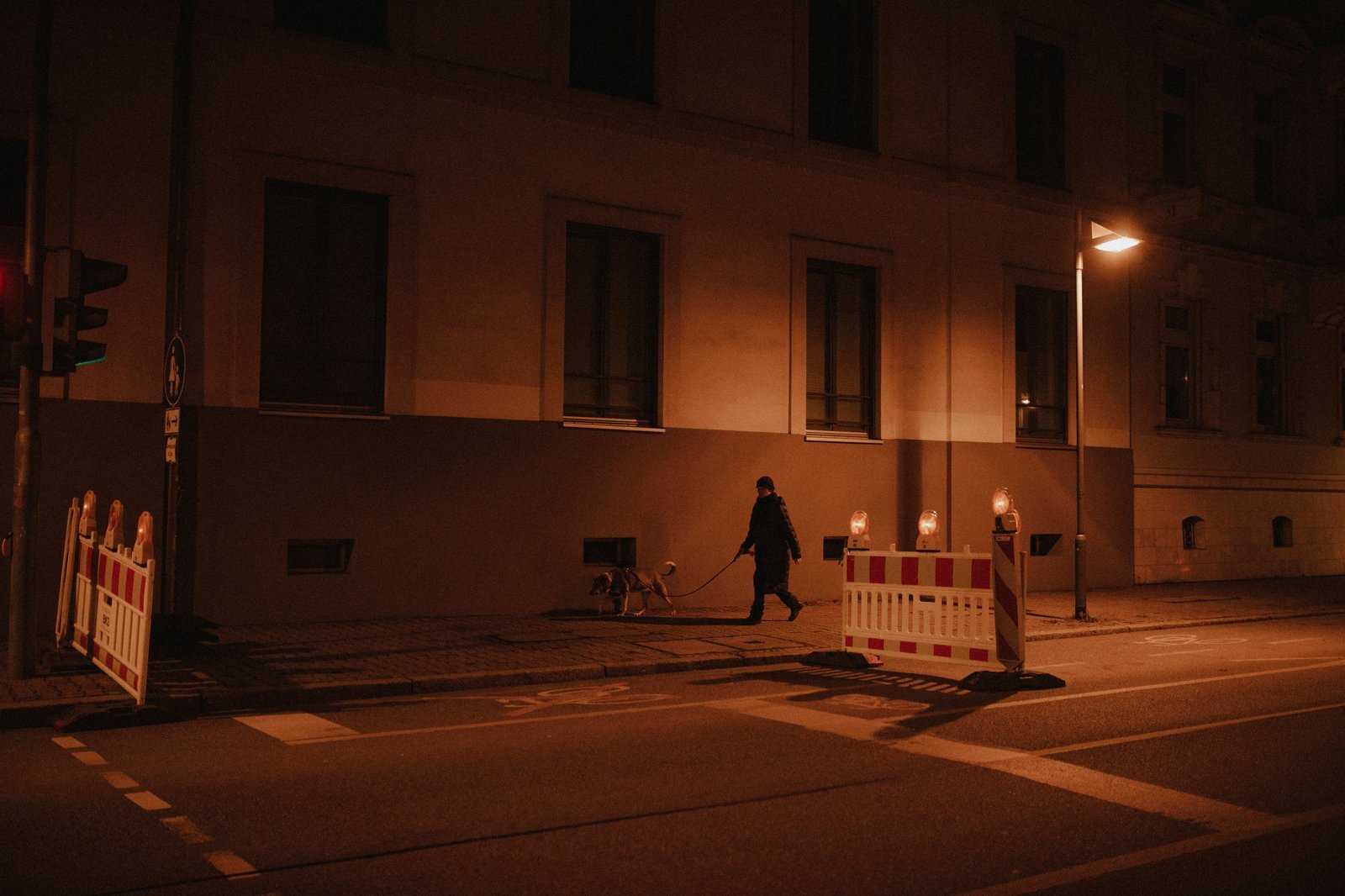
Cars, bikes, and people can appear quickly from a driveway, a basement ramp, or a corner you cannot see around. A shorter leash for those few metres is a management choice, not a new training project. Keep the dog closer while you pass the hidden edge, then ease out again on the open, lit sidewalk.
This is not a loose-leash lesson and not a leash-buying guide. If pulling is already a daytime problem, work on that separately with the loose-leash guide and the city leash guide. At night, you only need the dog close enough that they cannot step off the curb or into a driveway before you notice.
A handheld light or a reflective bit on the leash, a collar, or your own jacket can help drivers and cyclists see you sooner. It is optional. If you add a light or a reflective detail, try it at home first and keep it simple. This is not a flashlight or coat buying guide, and it does not rank models, prices, or brands.
If you use a long line in the park during the day, leave it at home after dark on city streets. A standard leash, shortened at the uncertain points, is enough.
The quiet loop still includes the walk back into the building
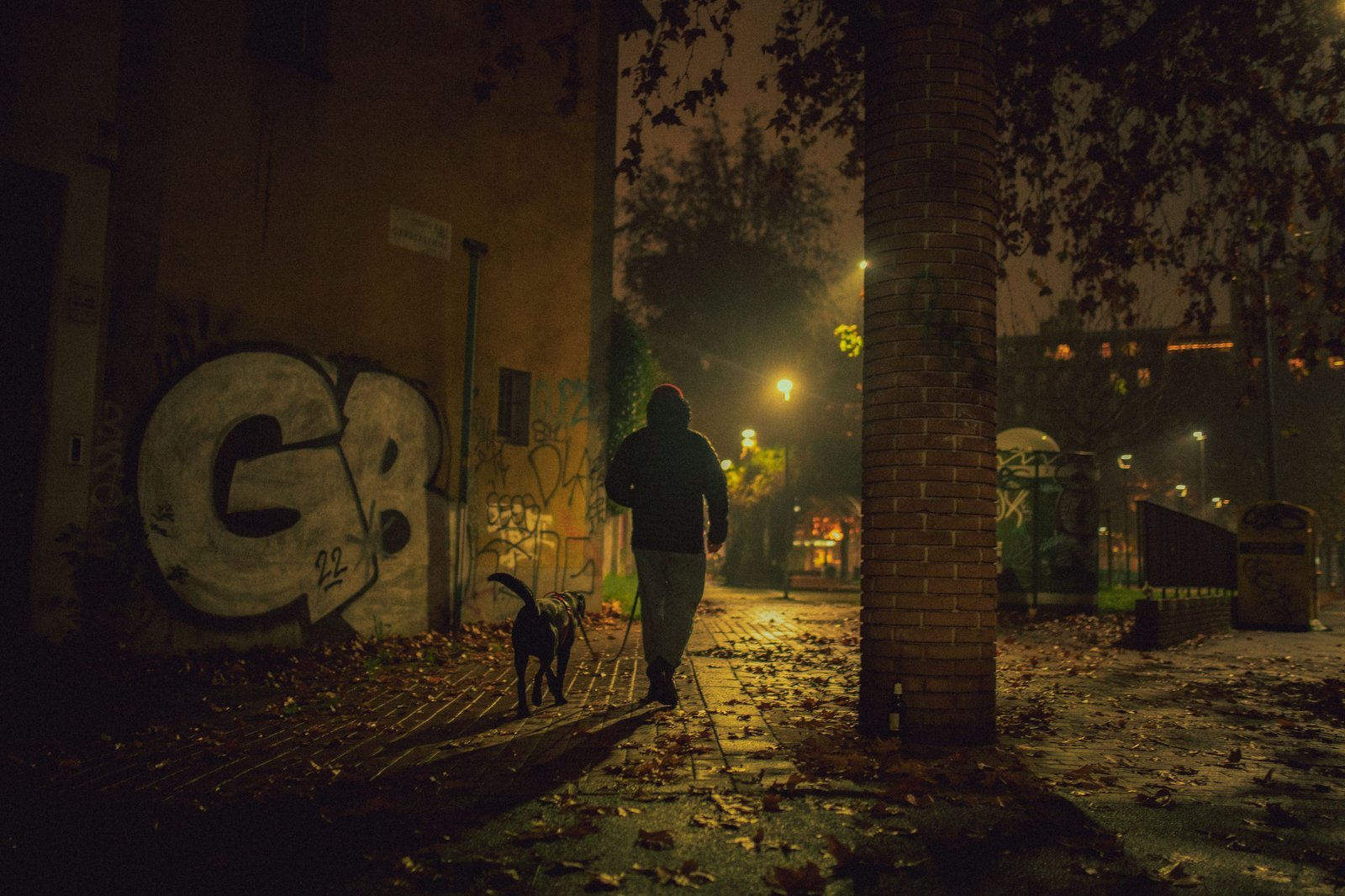
The walk is not finished when you reach the building door. In a small apartment, the hallway, the lift, and the last few metres to your own door are part of the outing. A dog who has been sniffing a quiet block can suddenly surge toward a neighbor, a bicycle in the lobby, or the smell of another dog in the lift.
Pause before you go in if you can. Shorten the leash, let the dog finish a sniff at the threshold, and then enter in a calm, ordinary way. If your dog already rushes doors, teaching a dog to wait at the door in hallways and elevators will make these night returns easier, but you do not have to rebuild that training in a dim lobby.
Check paws and belly before they hit the sofa
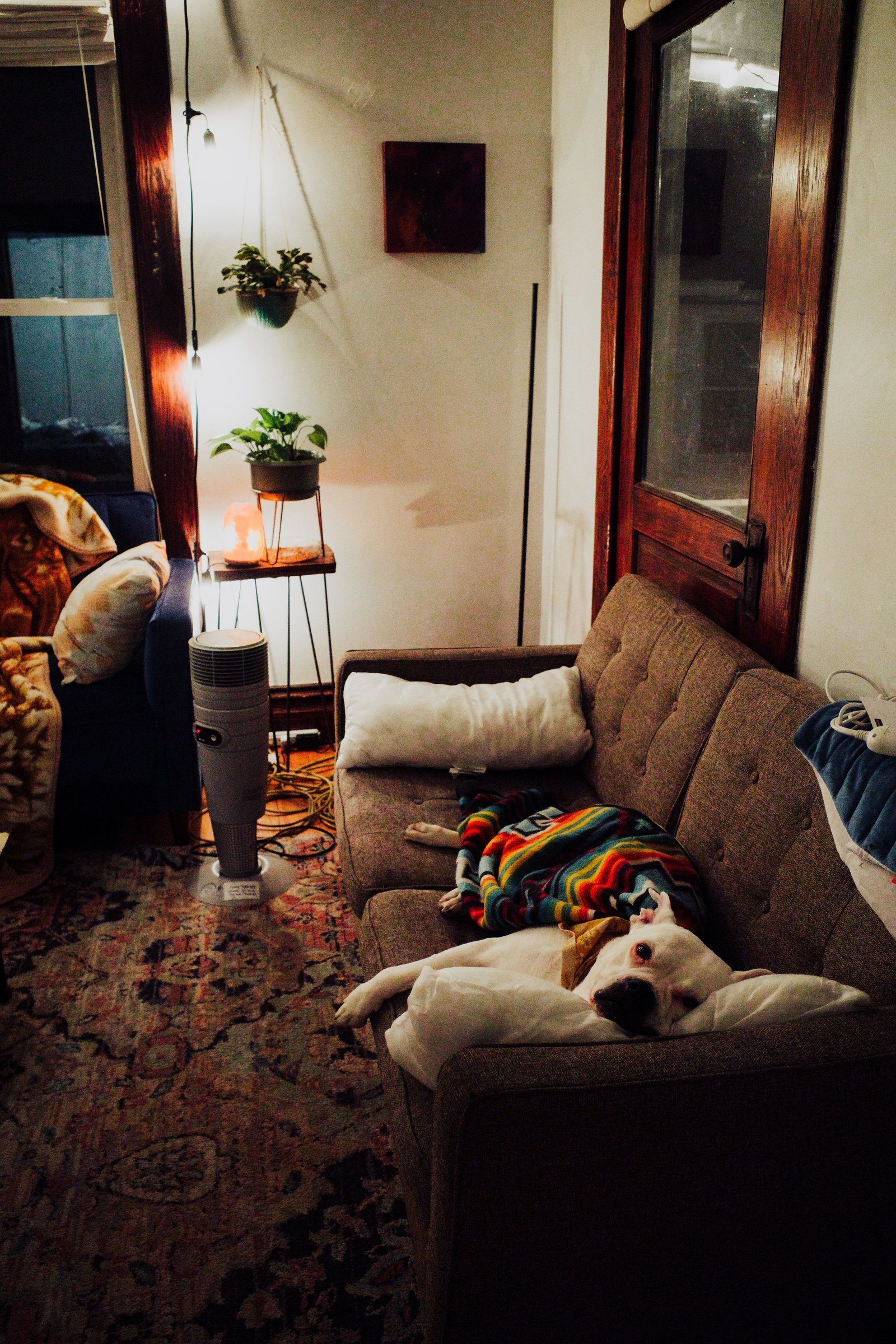
Night pavement can hide grit, salt, small glass, or a wet patch you did not see. You do not need a full exam in the hallway. You do need a short pause before the dog jumps onto the furniture.
Set that habit before you go out, not after you are standing in a narrow entry with a leash still attached. A washable mat, a towel you can actually reach, and enough room to stand the dog for a moment will do, even if the “entry” is only the first metre of a studio.
When you come in, pause. Glance at and feel the paws, the legs, and the belly, and wipe anything wet or gritty before anyone wanders off to the sofa. The belly and chest are easy to miss after a puddle or a low curb. Be gentle, and if the dog hates having paws handled, keep the session short. This is a quick check, not a treatment.
If you notice redness, a cut, or licking that does not settle, the more detailed aftercare lives in the paw-care guide. If the dog is limping or will not put weight down, skip the sofa, keep them quiet, and contact a veterinarian if it does not settle. A dog already on the sofa is a reminder of why that pause matters, not a reason to skip the check.
Hang the towel so the next outing has a dry one waiting. If the evening is also wet or cold, use the rain or cold-weather guides for drying and coats.
When to go inside — and when to call a veterinarian
Go inside if the dog is limping, shivering hard, disoriented, or will not put weight down. Go inside if they suddenly refuse to walk, seem exhausted, or look unlike themselves. A tired or uneasy dog on a dim street is not a problem you have to “push through.”
Once you are home, offer water, do the quick paw-and-belly check, and let them rest. If the limping, hard shivering, disorientation, or refusal to bear weight does not settle, contact a veterinarian. This plan is not a treatment for injury or illness.
Do not invent a rule such as “never walk after a certain hour” or “never walk below a certain temperature.” Dogs, streets, and health vary. Watch this dog, on this pavement, in this light, and treat a clear problem as a reason to go in.
A calm starting plan you can repeat
Use this as a first draft, then adjust to your dog and the evening:
- Choose a familiar route with streetlights or other lighting you can actually use, and skip dim shortcuts.
- Keep the outing shorter than your daytime loop when visibility is poor.
- Shorten the leash around driveways, basement ramps, and corners, then ease out again on the open sidewalk.
- Treat a light or a reflective detail on the leash or your jacket as an option, not a requirement.
- Pause at the building door, keep the dog close in the hallway or lift, and enter calmly.
- Check and wipe paws, legs, and belly in the entry before the dog reaches the sofa.
- If the dog is limping, shivering hard, disoriented, or will not put weight down, go inside and contact a veterinarian if it does not settle.
A short, repeatable after-dark plan matters more than a long loop you cannot see well. The aim is a modest walk on a familiar, lit sidewalk, a careful return into a small building, and a pause at the door — not a claim that extra lighting makes every night easy.
FAQ
Is it all right to walk a dog at night in the city every evening?
Yes, many city dogs have their last outing after dark, especially in winter when daylight is short. The better question is whether tonight’s route is familiar and lit enough, and whether the dog looks comfortable. A shorter loop close to the building can still meet a toilet need. Match the walk to the light and to the dog, rather than to a rule that every evening must copy a long daytime circuit.
Do I need a flashlight, a lighted collar, or a reflective jacket?
Not automatically. On a well-lit, familiar block, many people walk without extra lighting. A small light or a reflective detail on the leash, a collar, or your own jacket can make you easier to see near driveways and darker corners, and it is a reasonable option if it does not upset the dog. Try new gear at home first. This is not a buying guide, and you should not feel you must purchase a particular model to leave the building.
How much shorter should a night walk be than a daytime walk?
There is no honest single number. If the pavement is easy to see and the dog is moving happily, the loop can be close to your usual length. If lighting is patchy, the surface is hard to judge, or the dog is uneasy, cut the route down, even to a brief toilet loop. Watch this street and this dog. A shorter outing you both finish calmly is more useful than a long one you regret.
What if my dog seems nervous on dark streets?
Keep the route familiar, stay on well-lit sidewalks, shorten the leash where the dog startles, and keep the outing brief. Let the dog sniff and turn for home if they need to. Do not flood them with a new, dim path in the hope they will “get used to it” in one evening. If the nervousness is sudden, extreme, or paired with limping, shivering, or disorientation, go inside and contact a veterinarian if it does not settle.
When should I skip the walk or call a veterinarian?
Skip a longer loop, or stay in after a brief toilet trip, if you cannot see the pavement well enough to walk it calmly, or if the dog already looks unwell or unwilling. Go inside and contact a veterinarian if limping, hard shivering, disorientation, or a refusal to put weight down does not settle. This guide cannot diagnose a sore paw or an illness, and it is not a reason to delay care.
[…] job here is being seen, and wearing gear that stays on and stays charged. It is not a rewrite of how to walk a dog at night in the city, which is the outing plan for moving through the street after dark. This article is the light, the […]