


If you are looking for the best balcony cat enclosure for apartments, the useful question is not “which kit won a test.” It is whether a screened balcony, a cat net, or a compact catio is actually the right job for your rental, your railing, and the cat in front of you. Houses with a private garden can often skip this decision. Many flats cannot, and a high railing with wide gaps is not itself an enclosure.
A useful mindset is this: you are buying and setting up a barrier that has to stay put, keep the cat in, and respect the building. Secure attachment, escape-proof mesh, weather and neighbor sightlines, and a shady landing will do more than a handsome photo of a balcony. Supervision still matters on a high floor. This guide does not invent model rankings, prices, or test scores.
This is general information for cat parents in the US and UK, not a promise that a net will hold every cat, and not a reason to leave a cat unattended on a high balcony. Check the lease and building rules before drilling, wrapping rails, or putting weight on a balcony.
When a balcony enclosure is actually appropriate — and when it is not

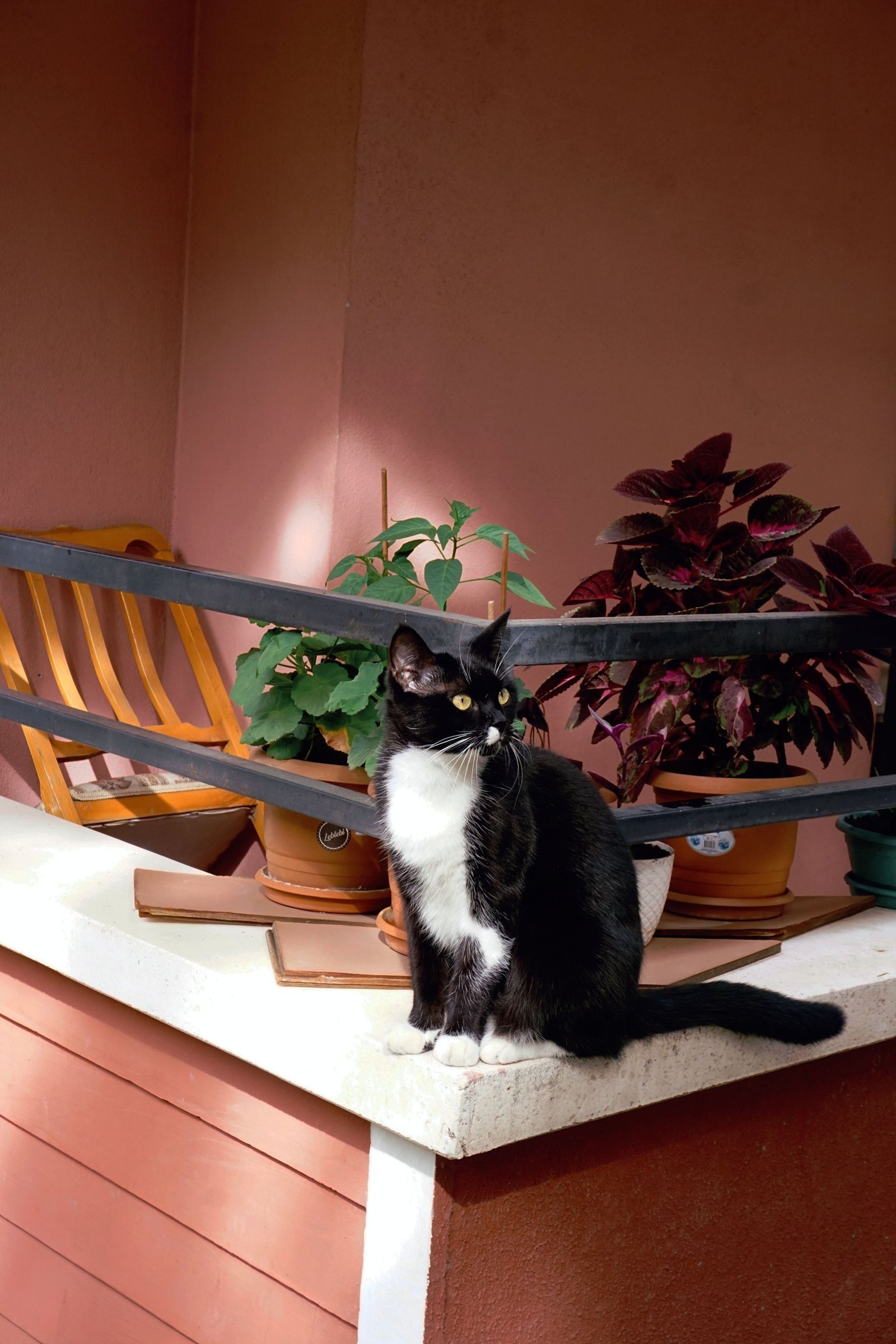
The photo above is a cat sitting on top of an ordinary balcony railing. That is the situation an enclosure is meant to prevent, and it is not a screened balcony, a cat net, or a compact catio.
An enclosure in this sense is a barrier you add to a balcony or similar outdoor landing so a cat can be out there without stepping through or over the existing rail. It might be a full screened box, a net or mesh fixed to the railing and ceiling line, or a compact catio that sits on the floor of a small balcony. It can be appropriate when you have a genuine outdoor landing, permission to attach something, a rail and floor that can take the load, and a cat who can be guided in and out calmly.
It is not appropriate as a fix for a cat who already bolts, as a way to skip indoor play, or as a workaround on a balcony you are not allowed to alter. A decorative rail with wide gaps, a decaying ledge, or a space that bakes in full sun with no shade is a poor starting point.
This is the enclosure purchase, not everyday window safety
Everyday open-window and sliding-door risk — insect screens that were never meant to hold a cat, a slider left ajar, an unsecured balcony used “just for a minute” — belongs in how to keep an indoor cat safe around windows and balconies. That guide covers openings you already have. This article is the purchase and setup of an added enclosure.
A stable place to watch from inside is also a different job. For a perch that stays put at a window you have already made safe, use best window perches for cats. The rest of a small home still needs a hazard pass and indoor options: how to cat-proof a small apartment, best cat trees for small apartments, and best cat tunnels and hideaways for apartments.
Outdoor time on a harness or in a backpack is not a balcony enclosure. Those belong in best cat harnesses for indoor cats and best cat backpacks for apartment travel. A cat who already dashes for the front door needs a door plan first; use how to stop a cat from door dashing.
Think of three jobs, not one:
- Get permission. The lease and the building have to allow the attachment and the weight.
- Close the gaps. Mesh and fixings have to hold a climbing, curious cat, not only look tidy from the street.
- Stay present. A high balcony is still a high balcony, even after you install a barrier.
Check the lease and building rules before you attach anything
The photo above is a planted balcony with an open rail. It is a pleasant landing, and also the kind of space where drilling, wrapping, or adding weight can matter to a landlord.
Read the lease, any balcony or alteration clause, and the building’s rules before you buy. Some rentals forbid drilling into walls, floors, or railings. Some forbid wrapping rails, hanging loads from the exterior, or placing heavy structures on the slab. A managing agent may also have rules about what is visible from the street. Ask in writing if the wording is unclear. Permission comes before a drill or a weighted base.
Check what the balcony itself can take. A small apartment landing is not always designed for a person, planters, and a framed enclosure at once. Keep the load modest, and do not block a fire escape or a door swing. If you cannot attach anything, keep the door closed and offer the view from inside instead.
When you do have permission, choose fixings you can later remove without ugly damage, and take photos of the balcony before you start.
Escape-proof mesh, and a railing that can take it
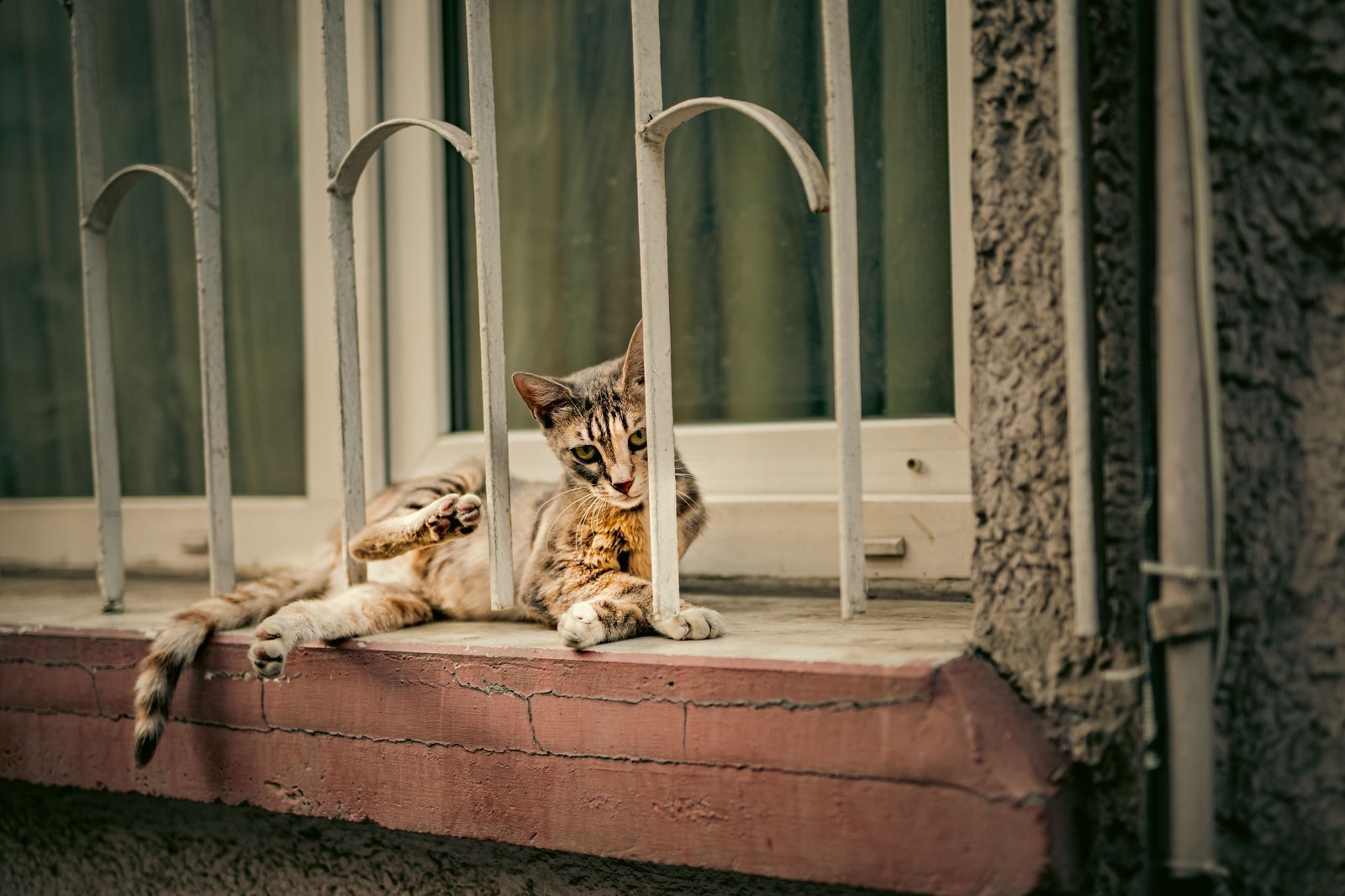
The photo above is a cat on a windowsill behind a metal grille. The bars are widely spaced. It is not a cat net, and it is not escape-proof mesh on a balcony.
If you buy an enclosure, the mesh is the product. Gaps that a paw, head, or slim body can push through are not close enough, even if they look fine from the sofa. Look for a tight, durable mesh that a cat cannot tear, stretch, or unhook at the edges. Seams, ties, and the line where the mesh meets the railing, the floor, and the ceiling or wall are the usual weak points. Press on those joins before the cat ever uses the space.
The existing railing is not automatically a safe frame. Widely spaced bars, a low top rail, decorative iron a cat can climb, or a rail that already wobbles will not become secure because you draped a net over it. The attachment has to suit the rail you actually have, and the rail has to be sound. Recheck after wind and rain. A loose corner is an escape route.
Do not treat a decorative net, a temporary drape, or an insect screen as a stand-in. Those can fail under a climbing cat. This is not a ranked list of models; it is a reminder to inspect the barrier you plan to trust.
Weather, neighbor sightlines, and a shady landing
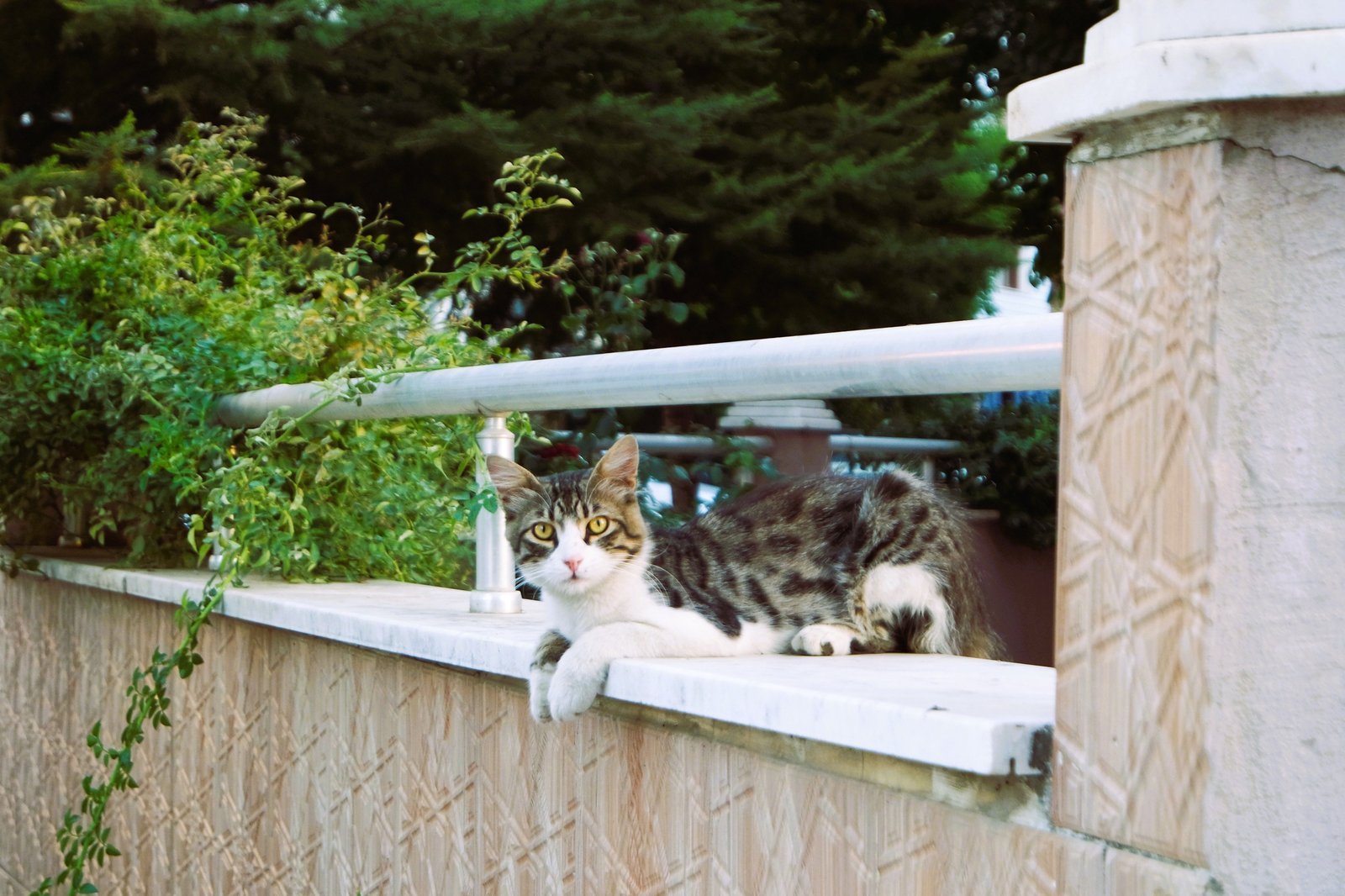
The photo above is a cat resting on an open ledge with plants nearby. Shade and a flat place to land matter, but greenery alone is not an enclosure.
A balcony can be much hotter, wetter, or windier than the room behind the door. Provide a shady, stable landing — a corner out of direct midday sun, or a covered side — and a way back inside. Mesh can trap heat. Dark flooring can scorch paws. After rain, a slick slab and a wet net are a poor play space.
Neighbor sightlines cut both ways. A clear mesh may let the cat watch the street, and it may also put the cat’s whole afternoon in view of the next building. If privacy matters, place the landing toward a wall or a quieter corner rather than hanging a busy setup on the most visible rail. Noise, dripping water, and loose ties that flap in the wind are neighbor issues as well as product issues.
Keep toxic plants, unsteady pots, and anything a cat can knock off the ledge off the balcony. An enclosure does not make a crowded plant collection safe.
Supervision still matters on a high floor
A high balcony is still a fall risk if a join fails, a door is left wrong, or a startled cat climbs. A net is not a reason to leave a cat unattended on a high balcony. Stay with the cat, especially for the first uses, in strong wind, and when hallway noise might spook them.
Check the mesh and the fixings before each use, not once after installation. Look for sagging, chewed edges, lifted ties, and any gap at the floor. Keep a way back into the apartment, or stay where you can open the door immediately. Do not leave the cat out there alone while you go to work or take a long shower, even if the setup looked solid the day before.
If the cat panics, claws the mesh, or tries to climb the ceiling line, bring them in and stop the session. A net is not a playpen for a panicked or door-dashing cat. Frightened climbing is how weak corners fail. Do not use the balcony as a time-out space.
A net is not indoor enrichment, and it is not a door plan
An enclosure, even a well-fitted one, does not replace play, climbing, and hiding inside the apartment. If the cat is bored, a balcony will not fix that, and a frustrated cat will test the mesh sooner. Keep the indoor day intact, including indoor enrichment ideas for cats when you want a fuller indoor plan.
A balcony net also does not train a cat to wait at the front door. If the problem you actually have is a dash into the hallway, solve that at the door rather than hoping the balcony will absorb the energy.
Give a new enclosure a short, supervised introduction: door open, a familiar bed on the landing, and an easy way back in. If the cat refuses or tries to climb out, do not force longer sessions. Some cats are happier with a window perch and a closed balcony door, and that is a valid choice in a rental.
A calm starting plan you can repeat
Use this as a first draft, then adjust to your building and your cat:
- Decide whether you actually have a balcony or landing that can take an enclosure, and whether the cat will use it calmly.
- Check the lease and building rules before drilling, wrapping rails, or putting weight on a balcony.
- Inspect the railing and the floor, then choose tight, durable mesh and attachments you can check and, if you rent, later remove.
- Provide a shady, stable landing, think about heat, rain, wind, and neighbor sightlines, and keep unsafe pots off the ledge.
- Stay with the cat on a high floor. A net is not a playpen for a panicked or door-dashing cat, not a substitute for indoor enrichment, and not a reason to leave a cat unattended on a high balcony.
- Recheck the joins often, and be ready to keep the balcony door closed if the setup is not sound or not allowed.
The look of a screened balcony should not come before permission, a barrier that actually holds, and a plan for being there. If those pieces are not in place, a window view and a solid indoor day are the kinder choice.
FAQ
Do I need a balcony enclosure if my railing already looks high?
Not automatically. A high rail with wide gaps, climbable ironwork, or a ledge a cat can sit on is not an enclosure. Buy one only if you have a real outdoor landing, permission to attach a barrier, and a cat who can be guided in and out calmly. Otherwise, keep the balcony door closed and offer a safe indoor view.
Can I install a cat net in a rental apartment?
Only if the lease and building rules allow it. Check before drilling, wrapping rails, or putting weight on a balcony. Some buildings forbid attachments or extra loads on the slab. Ask in writing if you are unsure, and choose fixings you can remove without damage if you do get permission.
Is a cat net escape-proof?
No net is a promise. Escape-proof in practice means tight mesh, sound attachments at the rail, floor, and ceiling or wall, and a frame that does not already wobble. Recheck after wind and use. A decorative drape or an insect screen is not enough. Even a careful setup can fail if a join loosens or a startled cat climbs.
Can I leave my cat alone on a screened balcony?
No. Supervision still matters on a high floor. A net is not a reason to leave a cat unattended on a high balcony, and it is not a playpen for a panicked or door-dashing cat. Stay with the cat, keep a way back inside, and bring them in if they claw the mesh or try to climb out.
Does a balcony enclosure replace indoor play and furniture?
No. A net or compact catio is not a substitute for indoor enrichment, a tree, a hideaway, or a door plan. Keep those in place. If the cat is bored or already dashes for the hallway, fix that indoors rather than hoping the balcony will absorb the problem.
[…] them in that closed room long enough to find it. Keep the box inside, not on an unsecured balcony; balcony enclosures for apartment cats are a home-safety topic, not a travel-toilet […]