


If you need to stop a cat from chewing cords, the hard part in a flat is rarely the idea of “make the wire uninteresting.” It is a lamp cord along the baseboard, a phone charger left on the floor, and a small room where those lines are at nose height all day. Houses with spare closets can hide some of that. Many flats cannot.
A useful mindset is this: you are making the cord boring and hard to reach, and you are giving the cat something legal to do instead. Unplug and lift what you can, route and sleeve what has to stay, take away the game instead of chasing, and offer a short play session so the cable is not the most interesting object in the room.
This is general information for cat parents in the US and UK, not a veterinary diagnosis, and not a promise that the habit will stop in a set number of days. A cat that suddenly starts chewing non-food items, or that bites through a live cord, belongs with a veterinarian. Electrical burns and pica are medical. If you think the cat was shocked, has burns in the mouth, or is hiding and breathing oddly, seek emergency veterinary care.
This is the cord-and-charger habit, not the full proofing plan
The job here is the specific habit of mouthing lamp cords, phone chargers, and cables along the baseboard. It is not a rewrite of how to cat-proof a small apartment, which is the broader, room-by-room hazard pass. Enrichment, a daily play routine, and what to leave out when you go to work are also separate: see indoor cat enrichment ideas, how to build a daily play routine for an indoor cat, and how to keep an indoor cat busy while you are at work.
Play biting, scratching furniture, and kitchen counters are different problems again: how to stop a cat from biting during play, how to stop a cat from scratching furniture, and how to keep a cat off kitchen counters. If the chewing arrived with other changes in mood or hiding, also see signs your cat is stressed.
Think of three jobs, not one:
- Remove access. Unplug and lift chargers, lamp cords, and loose cables when you can.
- Protect what must stay. Route and sleeve remaining lines so they are not a dangling toy along the baseboard.
- Replace the game. Stop the chase, and give a legal play outlet in the same small room.
Unplug and lift what you can

The photo above is a cat sleeping on a utility box under a tangle of cables. The cat is napping, not mid-chew, and the box is not a typical apartment desk.
Start with what does not need to stay in reach. Unplug phone chargers when they are not in use, and lift them onto a shelf, into a drawer, or into a high basket. Coil laptop cables after you sit down. Move a lamp cord off the floor if the lamp can live on a table with the slack gathered behind it. Headphones, extension leads, and holiday lights belong in the same pass.
In a studio or one-bedroom, this is often half the job. A charger that lives on the rug is a toy. A charger that lives in a closed drawer overnight is not. You do not need to clear every cable in the building; you need to take the easy ones out of the game.
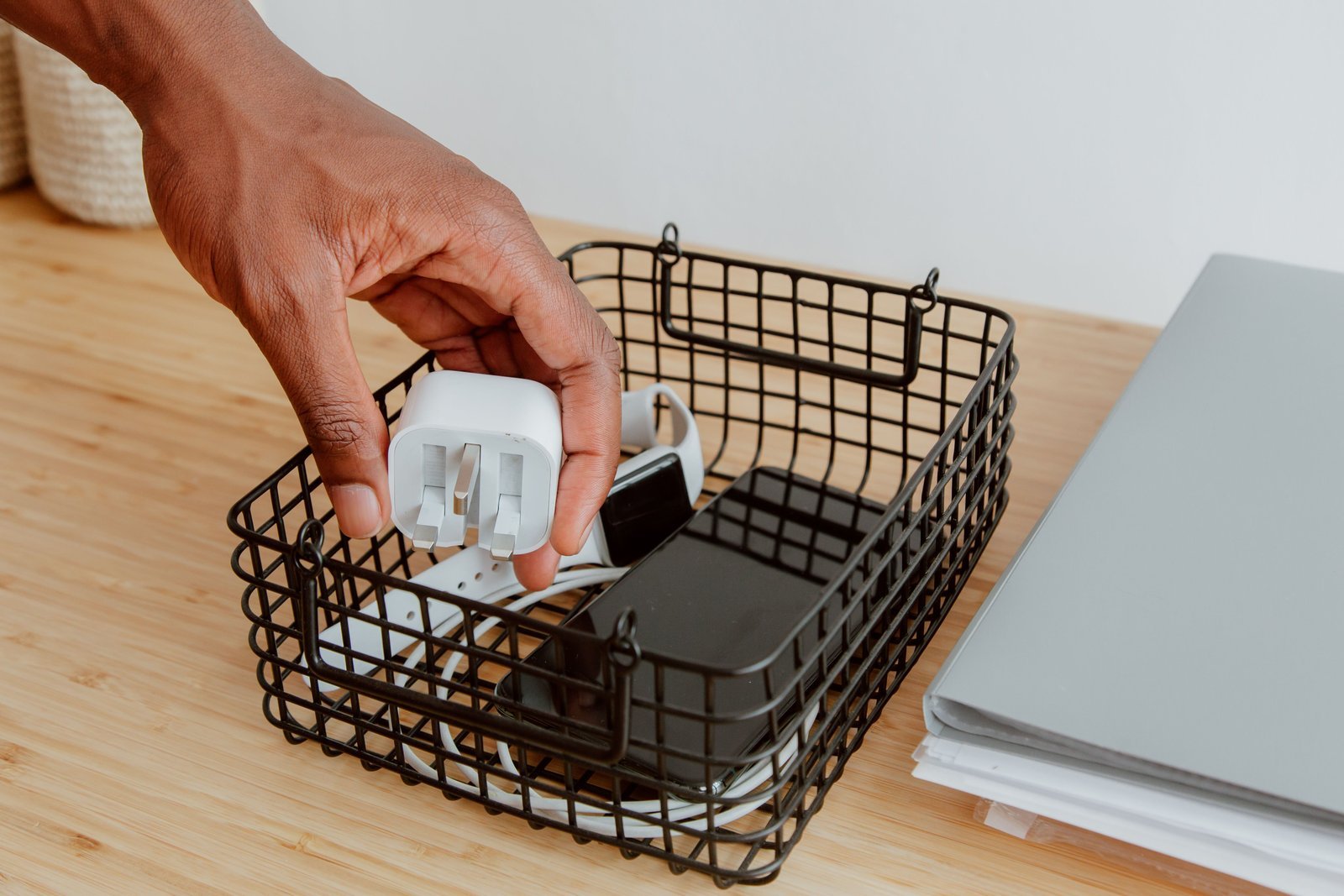
The photo above is a hand lifting a charger into a small basket with a phone and a watch. There is no cat in the frame, and it is not a picture of a cord protector.
Build a simple habit at the door and at the desk: plug in only while you are there, then unplug and lift. If a roommate or a visitor leaves a cable on the floor, treat that as part of the plan, not as a one-off exception the cat is supposed to ignore.
Route and sleeve what has to stay
Some lines have to remain: a lamp you use every evening, a router, a desktop computer, or a TV against the wall. Those should not dangle, loop, or run across a path the cat already patrols.
Route them tight to the wall, along the baseboard, or behind furniture, so they are not swinging at paw height. Gather slack with clips, ties, or a channel made for cables, and use a sleeve or a cord cover on sections the cat can still reach. The point is to make the line look and feel like part of the wall, not like a moving string.
Do it honestly. A sleeve only helps on the section you actually cover. A tidy desk with loose chargers still hanging to the floor is not finished. Check behind the sofa, under the TV stand, and along the path from the outlet to the lamp. In a small room, those few feet are often the whole problem.
A bitter spray, foil, or a strip of tape can be an extra deterrent on a spot you cannot fully hide, but they are not a miracle fix and they do not replace lifting and routing. Some cats ignore the taste, some start to like the crinkle, and a scolding after the fact does not explain the outlet. Use deterrents, if you use them at all, as a backup on a shortened, covered line — not as the whole plan.
Take away the game instead of chasing

The photo above is a kitten resting under a table, which is often where lamp cords and chargers run. No cable is visible in the frame, and the kitten is not chewing.
If you catch the cat mouthing a cord, do not turn it into a chase. A dash across the room, a shout, or a grab at the cable can make the object more interesting. Interrupt calmly, pick the cable up or guide the cat away, and then fix the access. The interesting thing should disappear, not become a game you both play along the baseboard.
The same is true of “just this once” chargers left on the sofa or a laptop cable hanging off a coffee table. Under tables, behind TV stands, and along skirting boards are the usual hunting grounds. Walk those edges the way you would in a broader proofing pass, but stay on this habit: if a line is still loose there, lift or cover it.
If the cat is shy, or the space already feels tense, a loud correction can make the room harder, not safer. A shy cat still needs the cords out of reach; see how to help a shy cat feel safe in an apartment for the broader comfort plan, and keep this article’s job to the cables.
Cats that knock objects off shelves are doing a different job than chewing a charger, even if both happen on a desk. That problem has its own plan in how to stop a cat from knocking things off shelves.
Give a legal play outlet so the cord is not the most interesting object
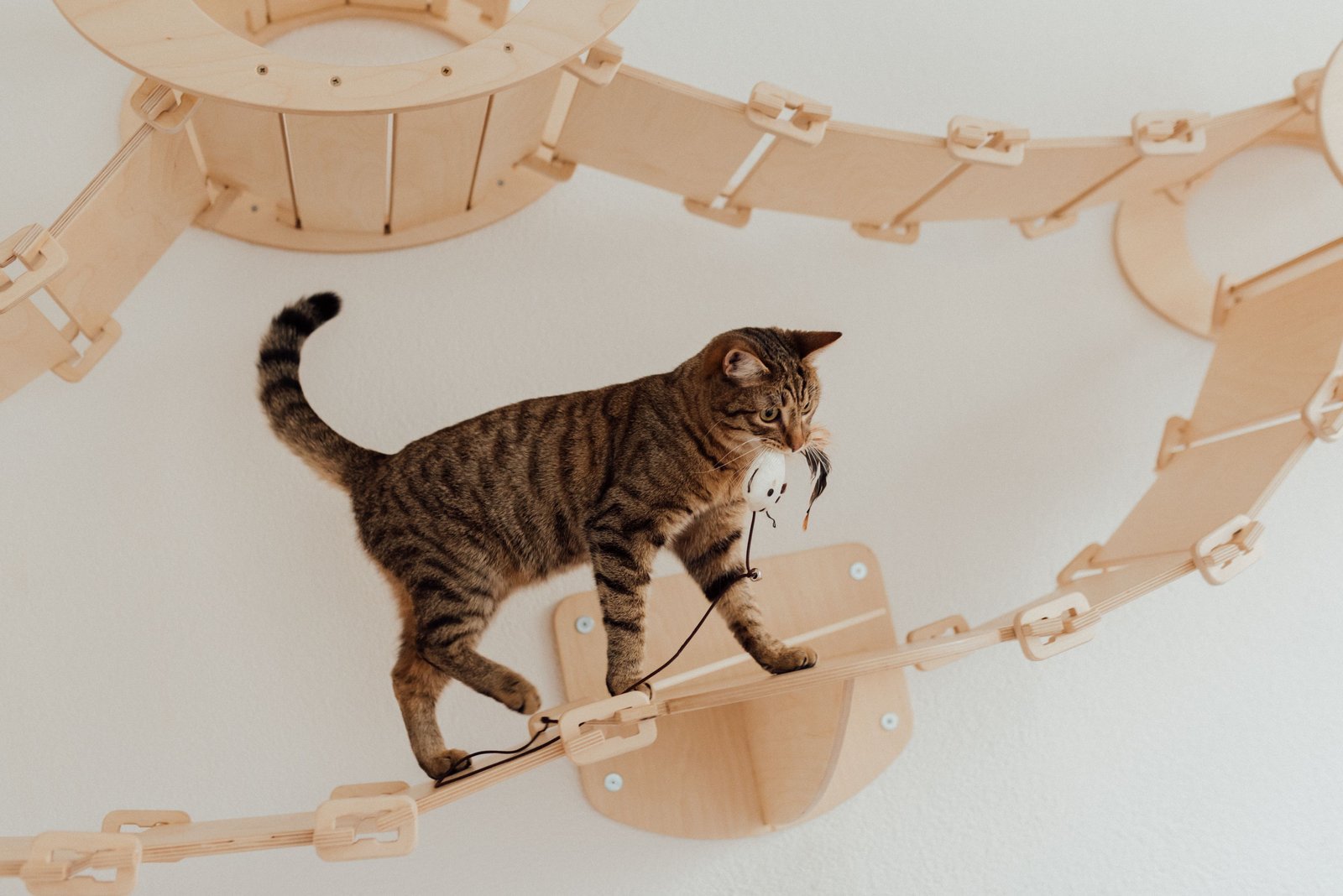
The photo above is a tabby carrying a toy mouse with a cord and bell. It is a legal toy, not a charger, and it is not a cat mid-chew on a live cable.
Management makes the cord less available. Play makes something else worth doing. A short wand session, a fishing-rod teaser, or another toy you can move and then put away gives the cat a legal hunt in a small room. For toy ideas that actually get used, see best wand toys for indoor cats and best interactive cat toys. Put the wand away when you are done, so it does not become another dangling string on the floor.
This is not a rewrite of the full daily routine or of how to keep a cat busy while you are at work. Those guides stay with the wider day. The point here is narrower: if the only moving line in the room is a charger, that charger will keep winning. Offer a real play outlet, especially before you sit down at the desk or leave a lamp cord in use for the evening.
Do not use yarn, loose string, or a real electrical cord as a toy. If a toy has a string, supervise it, and pick it up afterward. The goal is a legal outlet, not a new thing to swallow.
When chewing is a veterinary problem
A long-standing interest in a dangling charger is often a management problem. A sudden start, chewing of other non-food items, or a cat that has already bitten through a live cord is a reason to contact a veterinarian. Pica and electrical burns are medical. This article cannot diagnose either, and it cannot tell you that the habit is “just boredom.”
If you think the cat was shocked, has burns in the mouth, is drooling, or is hiding and breathing oddly, seek emergency veterinary care. Do not wait to see whether the chewing stops on its own, and do not try to treat a burn at home with a spray or a cream from the cupboard.
The advice here is general information, not a veterinary diagnosis and not a promise that a setup will end the habit in a week. Some cats need a medical workup. Some need a tighter management plan than a single covered lamp cord.
A calm starting plan you can repeat
Use this as a first draft, then adjust to the room in front of you:
- Unplug and lift phone chargers, lamp cords, and loose cables when they are not in use. A basket, a drawer, or a high shelf is enough.
- Route and sleeve what has to stay, tight to the wall or the baseboard, so the line is not a dangling toy.
- If you catch the cat mouthing a cord, take the game away calmly. Do not chase, and do not rely on a scolding, foil, or a bitter spray as the whole fix.
- Give a legal play outlet, such as a short wand session, so the cord is not the most interesting object in a small room.
- If the cat suddenly starts chewing non-food items, or bites through a live cord, contact a veterinarian. If you think the cat was shocked, has burns in the mouth, or is hiding and breathing oddly, seek emergency veterinary care.
A room where the easy cables are up, the necessary ones are covered, and the cat has something legal to chase is safer than a room where you hope the next scolding will be the one that works. The aim is a practical safety plan, and a clear line for when the next step is a veterinarian rather than another spray.
FAQ
Will bitter spray or foil stop a cat from chewing cords?
They can be a backup on a spot you cannot fully hide, but they are not a miracle fix and they do not replace unplugging, lifting, and covering the line. Some cats ignore the taste or like the crinkle. A scolding after the fact does not explain the outlet either. Make the cord hard to reach first, then add a deterrent only if you still need one.
What should I do with phone chargers in a small apartment?
Unplug them when they are not in use, and lift them into a drawer, a high basket, or onto a shelf. Do not leave a charging cable draped from a sofa or across the floor. If a charger has to stay plugged in for a short time, keep it in sight, keep the slack off the floor, and unplug it when you leave the room.
How do I cover cords that have to stay along the baseboard?
Route them tight to the wall or behind furniture, gather the slack, and use a sleeve or a cord cover on the sections the cat can still reach. A tidy desk with a loop still hanging to the floor is not finished. Check behind the sofa, under the TV stand, and along the path from the outlet to the lamp.
Should I chase the cat away from the cable when I catch them?
No. A chase can make the cord more interesting. Interrupt calmly, remove or cover the cable, and then offer a legal play outlet, such as a short wand session. The interesting object should disappear, not become a game you both play along the baseboard.
When is cord chewing a reason to call a veterinarian?
Contact a veterinarian if a cat suddenly starts chewing non-food items, or if the cat has bitten through a live cord. Electrical burns and pica are medical. If you think the cat was shocked, has burns in the mouth, or is hiding and breathing oddly, seek emergency veterinary care rather than waiting to see whether the habit stops.