

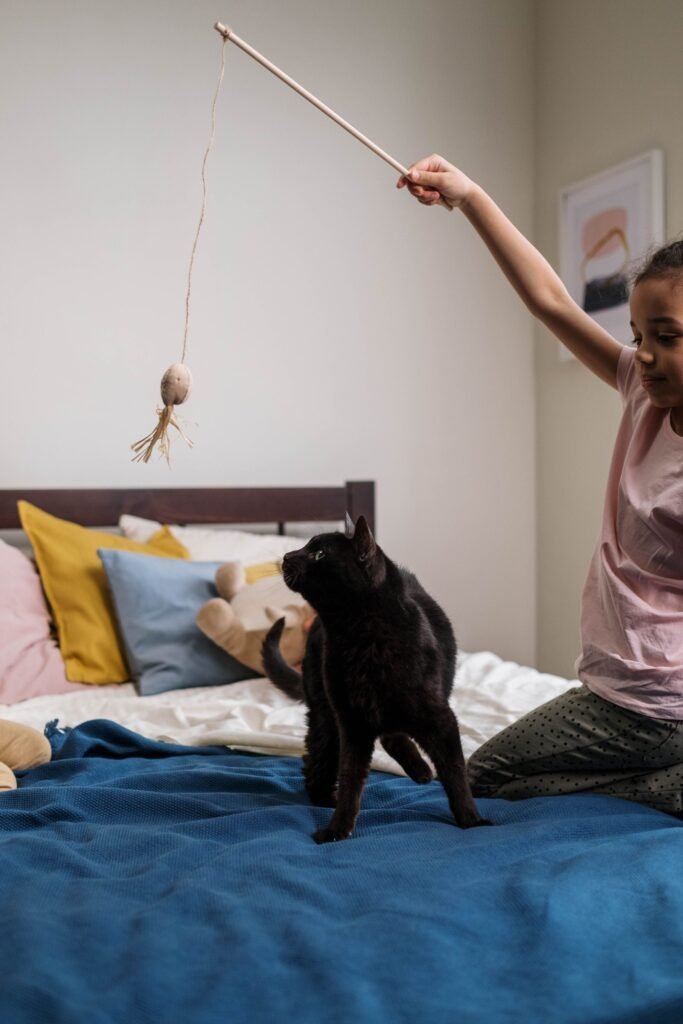
If you are choosing the best wand toys for indoor cats, the hard part is not the idea of “get a stick with a string.” It is using that toy for a short hunt the cat can finish, in a room that also holds a lamp and a side table, and then putting the wand away so the string is not left to chew.
A useful mindset is this: you are giving the cat a brief chase they can complete, and you are letting them catch the teaser or earn a small food reward so the hunt has a win. A length that stays clear of lamps, a teaser you can replace when it frays, and a wand that goes back into storage will do more than a longer game that ends with a swallowed feather.
This is general information for cat parents in the US and UK, not a veterinary diagnosis and not a treatment for aggression, boredom, or weight loss. It is not a ranked test of models and does not use prices or scores. If your cat coughs, gags, or swallows a string or a feather, contact a veterinarian. Strings and feathers can be swallowed, which is a reason to supervise and put the wand away when you are done.
This is a wand-play guide, not a toy-aisle rewrite
A wand, sometimes called a fishing-pole toy, has a job of its own: a short, supervised chase in a small room, ending with a catch. It is not a substitute for the wider set of best interactive toys for cats, or for a daily play routine for an indoor cat. Electronic toys and what to leave out when you are not in the room belong in those guides, and in how to keep an indoor cat busy while you are at work.
The rest of an indoor day is also a separate topic. Climbing, looking out a window, and other outlets live in indoor cat enrichment ideas. Tunnels and hideaways, and food puzzles, are setup questions of their own; see best cat tunnels and hideaways for small apartments and best puzzle feeders for cats. If the cat is waking you at dawn, use how to stop a cat from waking you up at night.
Think of three jobs, not one:
- Chase, then catch. The teaser moves like prey, then the cat is allowed to pin it or trade it for a small food reward.
- Fit the room. A wand that can clear a lamp or a mug is too long for that corner.
- Put it away. Strings and feathers are for a supervised session, not for an afternoon on the floor.
What a wand is actually for
A wand is a handle, a length of cord or string, and a teaser the cat can see and catch. You move the teaser along the floor or around a chair leg, then you let the hunt end. The point is not to keep the toy just out of reach until the cat gives up. The point is a burst of stalking and pouncing that finishes with a win.
In a small room, that usually means a few minutes, not a long workout. Drag the teaser along the rug, pause it, let the cat pounce, and wait while they hold or “kill” the toy. Then start another short burst, or stop there. Two or three brief sessions in a day often fit better than one frantic marathon. The daily play-routine guide can help you place those bursts.
A food reward at the end is optional, but it can help if the cat did not get a solid catch. A few pieces of the cat’s normal food, or a small treat, is enough. This is not a weight-loss plan.
A laser pointer is a useful contrast, and that is the only reason it belongs here. A wand has a physical teaser the cat can catch. A laser usually does not. If you ever use a light, you still need an ending the cat can complete: a toy they can hold, or a small food reward, so the hunt does not finish on an empty patch of floor. This is not a laser guide.
After a good session, many cats like a quiet place to settle. A window perch or a cat tree can help, but choosing one is a separate question; see best window perches for indoor cats or best cat trees for small apartments. The wand’s job is the hunt, not the whole evening.
Feather vs fabric teasers

Feather teasers move easily and often trigger a fast chase. They also break down. Loose feathers can be swallowed, and a chewed head can leave sharp quills or a bare clip. Inspect the teaser before each session, and retire it when it starts to come apart. If the cat coughs, gags, or you think a feather was swallowed, contact a veterinarian.

Fabric, felt, and raffia teasers are often sturdier for the “kill” at the end of the chase. A ball or a soft tassel is easier to hold than a cluster of feathers that shreds in one good bite. They still need a check: loose threads, weak bells, and torn bits should be removed or replaced. The string that joins the teaser to the wand is part of the toy, and it can be swallowed too.
You do not have to pick only one style. Many households keep a feather teaser for the chase and a fabric one for the catch, or they swap heads on the same wand. What matters is that today’s teaser is still in good enough shape to be held, and that you let the cat catch it. There is no honest ranking of which teaser “wins” for every indoor cat.
A length that will not sweep the side table
In a house with a long hallway, a very long wand can be fun. In a studio or a one-bedroom flat, the same wand can take a mug or a lamp off a side table in one swing. Choose a length you can keep close to the floor and inside the space you actually have.
A shorter wand, or a wand you hold lower, is easier to steer around furniture. You can still get a long chase by moving yourself around the rug or sending the teaser under a chair and back out. The cat is following the teaser, not the full span of the rod.
Clear a small play zone before you start: cords tucked, a plant or a cup taken off the edge. If the only open floor is a narrow path, keep the motion low and short. You can also play on a bed or a clear rug, as long as you can still let the cat catch the toy. For broader knock-over and cord hazards, how to cat-proof a small apartment is the room-by-room plan.
Replaceable wands help here too. If the connector is a simple clip or a tied loop, you can keep one modest-length handle and swap teasers, instead of storing three long poles.
Let the cat win, then put the wand away

The session should end with a catch, or with a small food reward, so the cat “wins.” If every pounce misses because the teaser is snatched away, some cats get frustrated or start looking for another target. Let them pin the toy, hold it, and wrestle it for a few seconds. That bite belongs on the teaser.
When you are finished, put the wand away. Do not leave the pole leaning on a chair with the string trailing across the floor. Cats can chew strings and feathers when you are in the other room, or overnight. A hook inside a closet, a high shelf, or a bin with a lid is enough. Store spare teasers in the same place.
Replaceable heads make this easier. When a feather cluster starts to moult, or a fabric mouse loses its stuffing, clip on a new teaser and throw the damaged one away. Check clips and knots; a clip that has opened can leave a loose length of cord. A wand is not a toy to leave out unsupervised while you work. For the workday, use the guide on keeping an indoor cat busy, and lean on puzzles and perches rather than a trailing string.
Safety: strings, feathers, and supervision

Supervise every wand session. The same features that make the toy work — a string, feathers, bells, or a crinkly insert — are the features a cat can tear off and swallow. Stay in the room, keep the cord off the cat’s neck, and end the game if the teaser starts to come apart.
If you see coughing, gagging, vomiting, a string hanging from the mouth or under the tail, or a sudden change in appetite or energy after play, contact a veterinarian. Do not pull on a visible string yourself if you think it continues inside the body. This article cannot tell you what is in the throat or the gut, and it is not a reason to wait and see.
Cut off loose threads. Skip toys with long, thin ribbons if your cat is a dedicated chewer. Do not use a loose length of yarn or sewing thread as a stand-in wand; it has no handle, it is easy to swallow, and it is hard to take back. Children can use a wand if an adult is close enough to end the session, keep the swing away from lamps, and store the toy afterward.
If play regularly turns into biting of hands, stop and reassess. This guide is not a treatment for aggression. A sudden change in play style, or a cat that seems painful, belongs with a veterinarian, and sometimes with a qualified behavior professional.
A calm starting plan you can repeat
Use this as a first draft, then adjust to your cat:
- Choose a wand you can steer in the space you have, with a teaser the cat can actually catch.
- Clear a small floor path, and keep the motion low enough that lamps and mugs stay put.
- Play a short chase, then let the cat pin and wrestle the teaser, or finish with a small food reward so the hunt has a win.
- Inspect feathers, fabric, clips, and string, and replace a teaser that is coming apart.
- Stay in the room. If the cat coughs, gags, or may have swallowed a string or feather, contact a veterinarian.
- Put the wand and spare teasers away when you are done, out of reach, not on the floor.
- Repeat short sessions, and use the daily routine and enrichment guides for the rest of the day.
A wand is a hunt you can finish in a small room, not a drawer of unused poles. The aim is a catch the cat is allowed to have, a length that fits the furniture, and a toy that is put away, not a claim that one session will fix boredom, weight, or rough play.
FAQ
What is a wand or fishing-pole toy actually for?
It is for a short, supervised chase the cat can complete, usually in a living room or bedroom, ending with a catch or a small food reward so the cat “wins.” You move a teaser on a string, let the cat stalk and pounce, then let them hold the toy. It is not meant to be left trailing on the floor, and it is not a substitute for a full daily routine, puzzle feeders, or time alone when you are at work.
Are feather teasers better than fabric ones?
Neither style is best for every cat. Feathers often start a fast chase but can shred and be swallowed. Fabric, felt, or raffia teasers are often easier to pin and wrestle at the end of the hunt, and they still need a check for loose threads. Many households use both, or swap heads on one wand. Inspect the teaser you are using, and retire it when it comes apart. If a feather or string may have been swallowed, contact a veterinarian.
How long should the wand be in a small apartment?
Long enough that you can move the teaser along the floor without putting your hands in the pounce, and short enough that a normal swing will not sweep a lamp or a mug off a side table. In a tight room, a shorter wand, or a longer one held low, is usually easier to control. You can still get a good chase by moving yourself around a clear rug. There is no honest single measurement that fits every flat.
Can I leave a wand out for my cat while I am at work?
No. Strings and feathers can be chewed or swallowed when you are not there to end the game or take the toy back. Put the wand away when the session is over, and use other outlets — perches, hideaways, puzzle feeders, and the workday enrichment plan — for the hours you are out. A wand is a supervised toy.
What should I do if my cat swallows a string or a feather?
Contact a veterinarian. Coughing, gagging, vomiting, a string hanging from the mouth or under the tail, or a sudden change in appetite or energy after play are all reasons to get help rather than wait. Do not pull on a visible string if you think it continues inside the body. This article cannot tell you whether something has been swallowed, and it is not a treatment plan.
[…] then put away gives the cat a legal hunt in a small room. For toy ideas that actually get used, see best wand toys for indoor cats and best interactive cat toys. Put the wand away when you are done, so it does not become another […]