

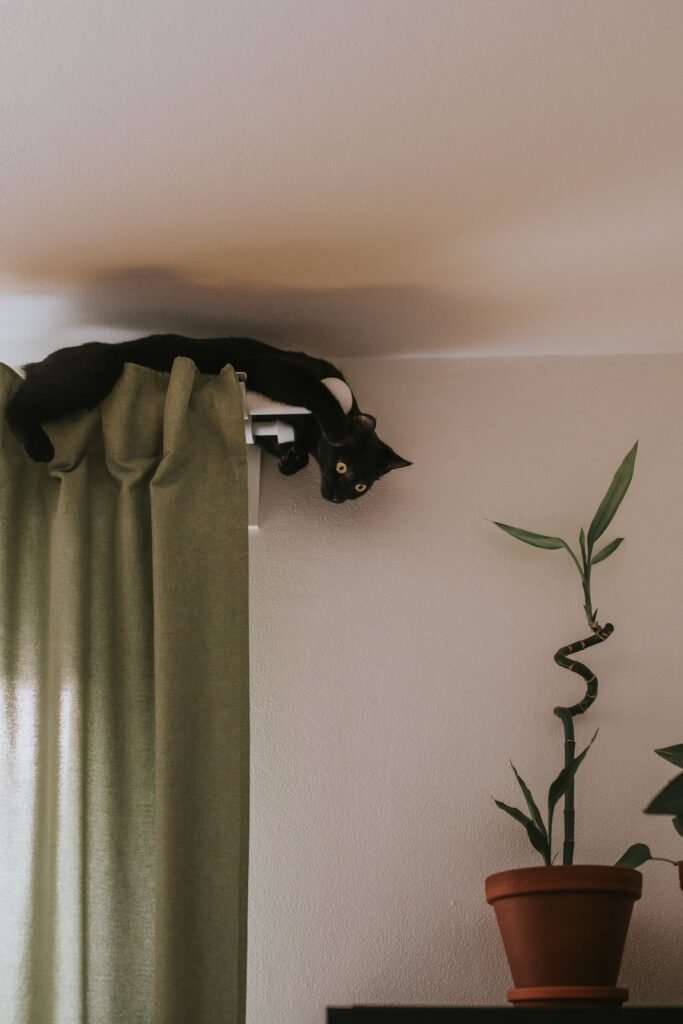
If you are looking for the best wall mounted cat shelves for apartments, the useful question is whether a short, well-anchored route would actually help in the flat you have, or whether a compact tree or a window perch would do the same job.
Cats already take the high ground when they can. The featured photo is a black cat on a curtain rod, not a purpose-built shelf, and a curtain rod is not a climbing route to copy. The point of a wall shelf is to give that height on something designed to hold a cat, attached to a wall that can take the load, and placed so a jump does not end on a stove, a sharp edge, or a wobbly television.
This is a buying and setup guide for cat parents in the US and UK, not a product ranking, and not a promise that a shelf will keep a cat off the kitchen worktop. There are no model lists, prices, or test scores here. Check your lease and the wall type before you drill. If a cat suddenly cannot jump, seems painful, or falls, contact a veterinarian.
This is a wall route, not a tree or a window perch
A wall-mounted shelf, step, or hammock-style perch is fixed to the wall. A cat tree for a small apartment is a freestanding unit that stands on the floor. A window perch lives on one sill, or attaches at that window, and does not create a route across the room. Those are useful tools, not the same as a shelf on the wall.
This article is also not a rewrite of cat scratching posts for small apartments, tunnels and hideaways, balcony enclosures, or the wider cat-proofing plan for a small apartment. A scratching post gives a legal place to scratch. A tunnel or hideaway gives cover on the floor. A balcony enclosure is an outdoor-access question with its own safety rules. You can later connect a shelf route to a tree or a window, but the buying decision here is the wall-mounted piece.
When a short cat highway actually helps
Getting a cat off the worktop. If the cat uses the kitchen counters because they are the highest place in the room, a stable shelf or a short route to a higher perch can make the worktop less attractive. It is not a guarantee. For the habit itself, use how to keep a cat off the kitchen counters. Do not place the first step above the hob or a sharp edge, and do not treat a shelf as a substitute for keeping food and knives out of reach.
Giving a shy cat a high perch. Some cats want to watch the room from above when the floor feels busy. A solid shelf, set away from the main walkway, can be a quieter lookout than the back of the sofa. This is a height tool, not a full plan for a worried cat. For the wider setup, use how to help a shy cat feel safe in an apartment.
Connecting a window to a tree. If the cat already loves a sill, a couple of well-spaced steps can link that window to a compact tree without turning the sofa into a launch pad. The route should land on a secure platform, not on an unsecured screen. Window and balcony safety still applies; see indoor cat window and balcony safety. Once the route exists, indoor cat enrichment ideas is the broader activity guide.
A full wall of shelves is rarely necessary in a studio. Two or three well-placed steps often do more than a busy route.
When a window perch or a compact tree is enough

If the cat mainly wants to watch the street, a secure window perch on that sill may be enough. You do not need a wall route to solve a one-window habit. The photo above is a cat on an ordinary sill, not a suction-cup perch and not a wall shelf, but it shows the job: a stable place at the glass.
If the cat wants to climb, scratch, and nap in one footprint, a compact freestanding tree may be the better first purchase, especially in a rental. A tree does not require you to drill, and you can take it with you when you move. A wall shelf is not automatically rental-friendly, and this guide will not promise no-damage mounting. Many so-called damage-light fixings still leave holes, fail under a jumping cat, or are not rated for the wall you have.

Choose a tree when the lease is strict, the walls are fragile or unknown, you cannot find a safe fixing, or you want one piece of furniture that includes a scratcher and a perch. Choose wall shelves when you have permission, a wall that can take the load, and a clear job the tree or the sill is not already doing.
Load, attachment, and rental-friendly mounting

The shelves in the photo are ordinary household wall shelves, not a cat highway, and the pots and bottles should not be on a route a cat will use. What the picture does show is the attachment problem: boards, brackets, and screws going into a wall. A cat shelf has to take a landing, not just hold an ornament, so the fixing matters more than the finish.
Read the maker’s weight rating and stay under it, with a margin for your cat. Use the brackets as designed. Follow the hardware instructions, and do not invent a no-damage method the maker did not supply.
Wall type comes first:
- Studs in a stud wall. A screw into a stud is usually the most reassuring option in a timber-frame apartment, if you can find the stud.
- Plasterboard or drywall alone. A hollow wall may need an anchor specified for that surface and a jumping load. A decorative hook is not enough.
- Plaster, brick, or masonry. These need the right masonry fixing. A wood screw used as a guess is how shelves pull out.
Check the lease before you drill. Some buildings forbid holes, require a listed tradesperson, or ask you to make good at move-out. If you cannot get permission, or cannot identify a safe fixing, a freestanding tree is the better rental choice. Adhesive strips, tension poles, and no-hole claims are easy to over-trust.

The close-up above is the same kind of household shelf meeting the wall: a bracket and a screw, not a damage-free pad. If you cannot put a comparable, load-rated fixing into a sound part of the wall, do not mount a cat shelf there. Keep clear of hidden cables and pipes. After mounting, test the shelf with a firm downward press before any cat uses it. If it flexes, shifts, or sounds loose, take it down. A poorly anchored shelf is not safe, even if it looks tidy.
Spacing so a cat can jump safely
A route is only useful if the cat can get from one platform to the next without a long, awkward leap. Spacing depends on the cat’s age, size, and confidence, and this guide will not invent a single gap that fits every cat.
Start closer than you think, especially for the first step off the floor or off a tree. The cat should be able to land with all four feet on the shelf, not on the edge. Leave a clear take-off and landing zone. Do not place a shelf so the natural landing is a cooktop, a sharp worktop corner, a wobbly TV, or an unsecured window screen.
A first step that is too high becomes a jump the cat cannot reverse, especially in a narrow hall. If an older cat already struggles with the sofa, wall shelves may be the wrong project. Pet stairs and ramps for small apartments can help with furniture height without asking the cat to jump a wall route. If a cat that usually jumps suddenly cannot, seems painful, or falls, contact a veterinarian rather than adding another shelf.
Give each perch enough depth for the cat to sit or lie, not just a narrow picture ledge. If you already have decorative shelves with objects on them, move those objects off the route; otherwise you are building a knocking-off game. For that separate habit, see how to stop a cat from knocking things off shelves.
What to look for in a shelf, step, or hammock-style perch
You are looking for a stable platform, not a style match for the sofa. Useful checks include:
- A non-slip surface. Carpet, felt, or a textured cover helps more than a polished board.
- A lip, side, or generous depth. A very narrow, smooth shelf is a harder landing, especially on a downward step.
- Hardware meant for a pet load. Brackets should be included or clearly specified. Decorative pins designed for paperbacks are not a substitute.
- A shape that fits the job. A simple step is for moving along a route. A wider shelf or a hammock-style perch is for resting. A hammock still needs solid wall attachment at every hanging point; a fabric pocket on weak hooks is not enough.
- A finish you can wipe. A cover you can take off and wash is a convenience, not a safety feature.
Skip anything that would attach to a TV, a radiator, a moving door, or a wardrobe that is not itself fixed to the wall. The shelf should not depend on furniture that can tip.
There is no brand list here, and no score. If two products both use clear load ratings, honest hardware, and a platform your cat can sit on, the better one is the one you can mount safely where the cat will use it.
A realistic plan for a small apartment
In a small flat, start with one job and one short route. If the worktop is the problem, a high perch in the living room, plus the counter-training plan, may be enough. If the cat is shy, one solid lookout above the busy floor may be enough. If the cat already uses a window and a tree, two steps that join them may be enough.
Walk the route in your head before you drill: floor or tree, first step, mid perch, landing, and an easy way back down. Keep the kitchen hob, the TV, and any unsecured screen out of that line. Leave decorative objects off the route. Confirm the lease, find a suitable wall, and mount fewer shelves well rather than many shelves weakly.
A curtain rod, a stack of boxes, or the top of an unsecured bookcase is not a substitute for a properly anchored shelf. If you cannot mount one safely, use a freestanding tree or a window perch until the wall and the lease allow a better plan.
FAQ
Are wall-mounted cat shelves a good idea in a rental apartment?
They can be, if the lease allows holes, the wall can take a jumping load, and you use the right fixing for that wall. This guide will not promise no-damage mounting. Adhesive strips and many “rental-friendly” claims are easy to over-trust. If you cannot get permission or cannot find a safe attachment, a freestanding cat tree is the better rental choice.
Will wall shelves keep my cat off the kitchen counters?
No. A well-placed shelf can make another high spot more appealing, but a shelf is not a guarantee the cat will stay off the worktop. Keep the route away from the hob and sharp edges, and use the counter-training guide for the habit itself. Do not treat a new perch as a substitute for keeping food and knives out of reach.
How far apart should cat shelves be?
There is no single gap that fits every cat. Start closer than you think, especially for the first step, so the cat can land with all four feet on the platform. Watch how your cat actually jumps. Place the route so a miss does not end on a cooktop, a sharp corner, a wobbly TV, or an unsecured screen. If a cat suddenly cannot jump, seems painful, or falls, contact a veterinarian.
What should I look for when I buy a shelf, step, or hammock-style perch?
Look for a load rating with a margin for your cat, hardware meant for that wall, a non-slip surface, and enough depth to sit or lie on. A hammock-style perch still needs solid attachment at every hanging point. Skip polished picture ledges, weak decorative pins, and anything that would be mounted to a TV or an unsecured cabinet. There is no ranked model list in this guide.
Is a compact cat tree or a window perch a better first purchase than wall shelves?
Sometimes yes. If the cat mainly watches one window, a secure window perch may be enough. If you want climbing, scratching, and a nap in one footprint, or you cannot drill, a compact freestanding tree is often the better first piece. Choose wall shelves when you have a clear job those tools are not already doing, permission to drill, and a wall that can take the load.